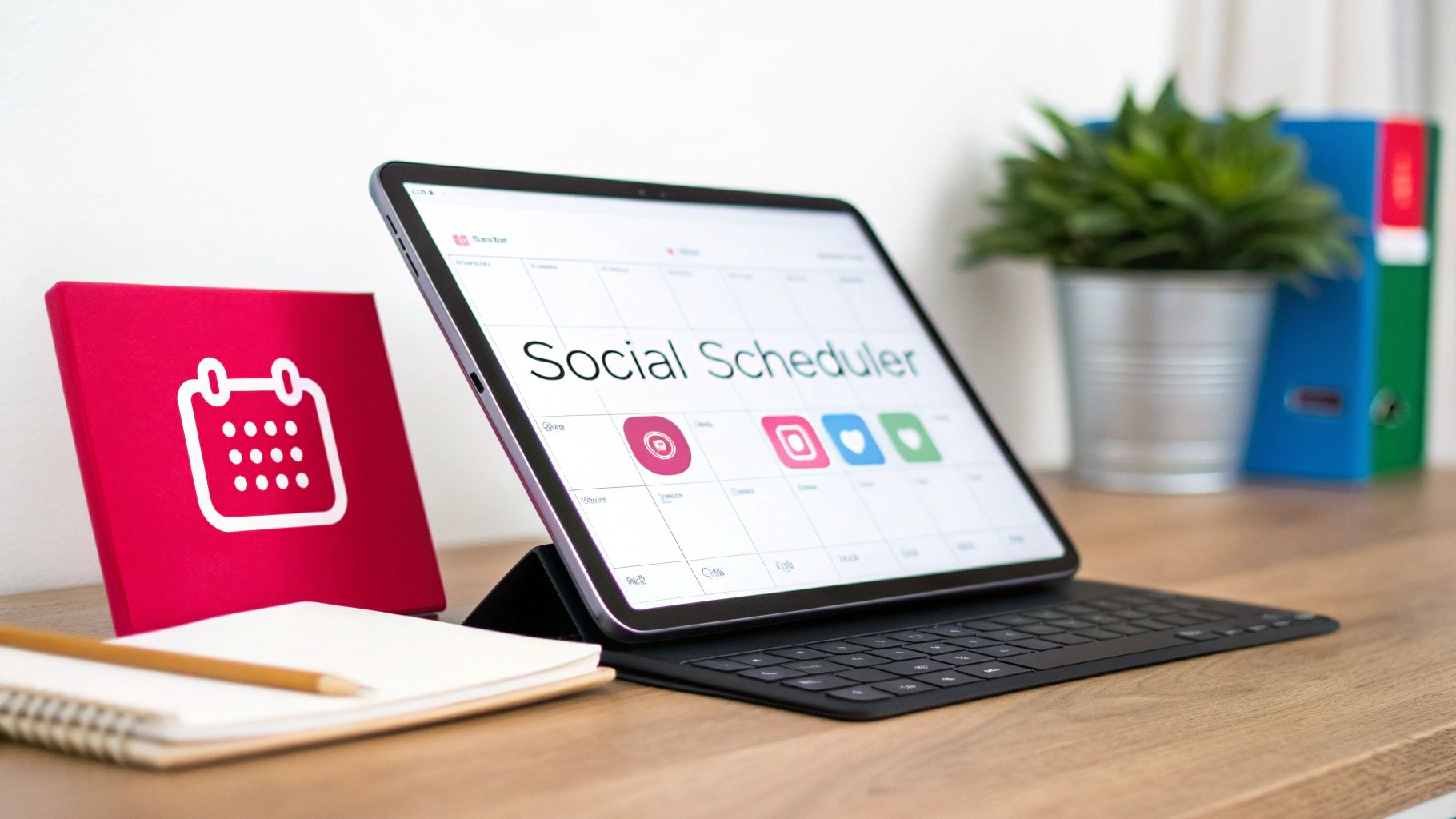
Ever found yourself scrambling to post on Instagram at 8 PM because you just remembered it's peak engagement time? A social media scheduler is the tool that puts an end to that chaos. Simply put, it's software that lets you plan, organise, and automate all your social media posts in advance.
Instead of the daily grind of logging into each platform, you can batch-create your content, load it into the scheduler, and let it handle the publishing for you at the exact times you choose.
What Is a Social Media Scheduler

Think of a social media scheduler as your marketing team’s very own digital personal assistant. It completely removes the pressure of having to post in real-time. Instead, you get a central command centre—a single dashboard—to manage your entire content calendar. Grassroots Creative Agency developed its own scheduler, Poster.ly, to provide businesses with a powerful and intuitive platform.
It’s a bit like a chef doing their mise en place. They get all their ingredients chopped and ready before the dinner rush begins. A scheduler lets you do the same for your social media, organising and lining up your posts with precision so that everything goes out smoothly.
This is the key difference between just pushing out content reactively and building a thoughtful, proactive content strategy. You can ensure your best posts go live during peak hours, even if you’re in a meeting or fast asleep.
The Strategic Value of Planning Ahead
Using a scheduler isn't just about making life easier; it's a fundamental shift in how you approach your brand's online presence. When you plan content weeks or even months ahead, you gain a bird's-eye view of your marketing narrative. This foresight is crucial for spotting gaps, avoiding repetitive messaging, and weaving campaigns together seamlessly.
It means no more last-minute panic to find something—anything—to post. Your team can finally move from being content firefighters to content architects, focusing their energy on creating higher-quality, more creative work that actually resonates with your audience. Strategic planning also solidifies your brand's voice and posting rhythm, which are two of the most important ingredients for building trust online.
A well-organised social media presence is a direct reflection of a well-organised brand. Scheduling tools provide the framework to build that consistency, turning chaotic daily posting into a streamlined, effective marketing function.
How Schedulers Empower Your Marketing
In a fast-moving market like the UAE, a social media scheduler is more than a convenience—it's a competitive edge. It helps solve some of the biggest headaches in digital marketing by letting you:
- Manage Multiple Platforms Efficiently: Juggling Facebook, Instagram, LinkedIn, and TikTok can feel like spinning plates. A scheduler brings everything under one roof, so you can customise and publish content for each network without jumping between a dozen browser tabs.
- Optimise Posting Times: Most good schedulers offer data on when your audience is most active. This lets you schedule posts for those golden hours to maximise reach and engagement, no matter what your personal work schedule looks like.
- Maintain Brand Consistency: A scheduler is your secret weapon for keeping your brand voice, visual style, and messaging locked in across all channels. Tools like Poster.ly make it simple to ensure every single post aligns with your established brand guidelines.
- Free Up Strategic Time: This is the big one. By automating the repetitive task of manual posting, your team's valuable time is freed up. They can now focus on what really moves the needle: analysing performance, engaging with your community, and refining your overarching strategy.
Ultimately, a social media scheduler is what transforms your social media efforts from a collection of random daily tasks into a cohesive, powerful, and measurable part of your marketing engine.
The Real Benefits of Automated Social Media Scheduling

Bringing a social media scheduler into your workflow does so much more than just claw back a few minutes here and there. It fundamentally reshapes how you manage your online presence. The most obvious win? The sheer amount of time you save. Gone is the daily scramble to think up, create, and publish posts on the fly.
Instead, you can dedicate a single block of time to plan and schedule an entire week or even a month's worth of content. This technique, known as ‘content batching’, is an absolute game-changer. It breaks the relentless cycle of manual posting, which some studies estimate can eat up over 15 hours per week for small business owners. That's time you can pour back into what really matters—growing the business.
Reclaim Your Time for Strategic Growth
Think about what your marketing team could achieve if they weren't bogged down by the repetitive, administrative side of social media. A scheduler acts like a force multiplier, automating the mundane tasks so your team can shift their focus from just doing social media to being truly strategic about it.
This is where the real value kicks in. Instead of just trying to post at the "right time," your team can invest that energy into activities with a far bigger payoff. They can dive deep into analytics, figure out what content genuinely connects with your audience, and plan future campaigns with real insight.
With scheduling handled, you can finally concentrate on:
- Community Engagement: Having real conversations, responding to comments, and building relationships.
- Creative Development: Actually having the headspace to brainstorm fresh campaign ideas and content formats.
- Performance Analysis: Digging into the data to see what’s working and, just as importantly, what isn’t.
- Competitor Research: Keeping a pulse on what others in your space are doing successfully.
Achieve Unbreakable Brand Consistency
An erratic posting schedule—a flurry of posts one week, silence the next—sends a messy signal to your audience. Consistency is the foundation of building trust and brand recognition. When your followers can rely on you for valuable content at a regular cadence, you build credibility and stay front-of-mind.
A scheduler makes this consistency effortless. It ensures your brand shows up with a steady, professional voice across all your platforms, even when you're swamped, on holiday, or after hours. This reliable rhythm is what nurtures an audience, slowly turning casual followers into genuine fans of your brand.
By maintaining a consistent voice, aesthetic, and posting frequency, you create a reliable and recognisable brand experience. A scheduler is the engine that drives this consistency, ensuring your brand story is told without interruption.
Unlock Data-Driven Content Insights
The best scheduling platforms today are far more than just "set it and forget it" tools; they're powerful analytics hubs. A great example is Poster.ly, which provides the kind of detailed metrics that can turn your social media efforts from a guessing game into a data-informed strategy.
These dashboards track all the crucial key performance indicators (KPIs)—engagement rates, reach, clicks, and follower growth—for every single post. This gives you a crystal-clear view of which content formats, topics, and timings deliver the best results. You might discover your LinkedIn audience loves case studies posted on a Tuesday morning, while your Instagram crowd prefers behind-the-scenes videos on a Friday afternoon.
Armed with that knowledge, you can stop throwing resources at content that doesn't perform and double down on what your audience truly wants. It creates a continuous feedback loop: post, measure, refine. This cycle is absolutely essential for maximising your return on investment and achieving real business goals.
What to Look for in a Social Media Scheduler
Walking into the world of social media schedulers can feel a bit overwhelming. There are dozens of them, all promising to make your life easier. But what really separates a genuinely useful tool from just another piece of software? It's not just about scheduling a post for later. The best platforms are more like a central hub for your entire social media operation, giving you the power to be truly strategic.
Think of it as your command centre. You need a clear, bird's-eye view of everything you have planned, but also the ability to zoom in and manage the tiny details. Without the right features, you'll end up with a tool that just adds to your workload instead of reducing it.
A Visual Content Calendar
First things first: a visual, drag-and-drop content calendar is non-negotiable. This is the heart and soul of any good scheduler. It’s not just about seeing what posts are going out on what day; it's about seeing the bigger picture. A solid calendar lets you spot content gaps, avoid sounding like a broken record, and make sure your messaging stays consistent.
Imagine seeing your entire month laid out in front of you—a product launch on Instagram, a deep-dive article on LinkedIn, and a quick tip on X, all in one cohesive view. This is what turns scheduling from a chore into a strategic advantage. It helps you make sure every single post is working towards your main goals.
Multi-Platform Support
Your customers aren't just on one platform, so why would your content be? A top-tier scheduler must have solid multi-platform support, letting you manage everything from Facebook and Instagram to LinkedIn, TikTok, and X (formerly Twitter) all from one place. This is especially true here in the UAE.
People in the UAE are incredibly active online, bouncing between an average of 8.62 social platforms every month. That's a huge number, far higher than in most other places. According to DataReportal, this intense engagement means businesses have to be present everywhere their audience is. A scheduler that can’t handle all your key channels simply won't cut it.
In-Depth Analytics and Reporting
Posting content without tracking its performance is like driving with your eyes closed. You need to know what’s working and what isn’t to get better. That's why your scheduler must offer in-depth analytics that go way beyond simple likes and follower counts.
You should be looking for a tool that tracks the metrics that actually matter:
- Engagement Rate: What percentage of your audience is actually interacting with your posts?
- Reach and Impressions: How many people saw your content, and how many times was it viewed?
- Click-Through Rate (CTR): Are people clicking the links in your posts?
- Audience Growth: Is your community growing steadily over time?
We actually built our own tool, Poster.ly, with this exact need in mind. It's designed to turn confusing data into simple, actionable insights that help you fine-tune your strategy and get a real return on your efforts.
A great social media scheduler doesn't just help you post; it helps you understand. It provides the data you need to stop guessing and start making informed decisions that drive real business growth.
Team Collaboration Tools
Unless you're a one-person show, social media is a team sport. Team collaboration features are crucial for keeping everything running smoothly, especially as you grow. These tools let your team draft, review, and approve content right inside the platform, which means you can finally say goodbye to messy email threads and lost feedback.
A good system will let you set up different roles and permissions, so a junior team member can draft posts while a manager has the final say. It creates a clean, organised workflow where everyone knows exactly what they need to do. To see how this works in practice, have a look at our guide on the core functions of a social media scheduler. This is how you scale up your content creation without letting quality or consistency slip.
How to Weave a Scheduler into Your Marketing Strategy
Bringing a social media scheduler into your marketing toolkit is about much more than just the tech. It’s about the strategy behind it. If you just jump into a tool without a clear plan, you’re setting yourself up for a messy, ineffective process. The real goal is to build a system that moves you from frantic, daily posting to a smooth, strategic operation.
It all starts with a solid foundation. Before you even think about scheduling your first post, you need to lock down your content pillars. These are the main themes your brand will consistently talk about. For instance, a local coffee shop might have pillars like 'Behind the Beans', 'Community Events', and 'Customer Spotlights'.
With your pillars defined, you can start building a content library. Think of this as your treasure chest of approved photos, videos, and copy ideas that all tie back to your themes. Having this ready-to-go resource is a lifesaver, preventing that last-minute scramble for something—anything—to post.
Getting Your Scheduling System Up and Running
Once you’ve done the strategic groundwork, it’s time to put your chosen tool to work. Setting up a platform like Poster.ly is usually a breeze. You’ll start by securely connecting your social media accounts—Facebook, Instagram, LinkedIn, and so on—to one central dashboard. This gives the scheduler permission to publish content for you.
Next, you'll start mapping out your posting schedule on a visual calendar. Decide how often you want to post on each platform and begin slotting in content from your library, making sure you've got a good mix from all your content pillars. This bird's-eye view is brilliant for spotting gaps and keeping your feed balanced. A strong framework is everything, and you can dive deeper by exploring our guide to building a powerful social media content strategy that gets real results.
Mastering the Art of Content Batching
One of the biggest wins you get from a scheduler is the ability to do content batching. Instead of trying to create posts every single day, you set aside a dedicated block of time—maybe a few hours once a week—to create all your content for the upcoming week or even the whole month.
This workflow is a game-changer for efficiency. It lets your team get into a creative groove without the constant stop-start of daily deadlines. The process generally follows a few simple steps:
- Brainstorming & Ideas: Look at your content pillars and come up with fresh ideas for the next batch.
- Creation: In one focused session, write all the captions, design the graphics, and edit the videos.
- Scheduling: Upload everything into your scheduler. Tweak the captions for each platform and pick the best times for them to go live.
- Review & Approval: If you work in a team, this is the perfect time for a manager to look over all the scheduled posts in the calendar, give feedback, or give the final green light.
This process diagram breaks it down beautifully, showing the simple flow from planning and automation to measurement.
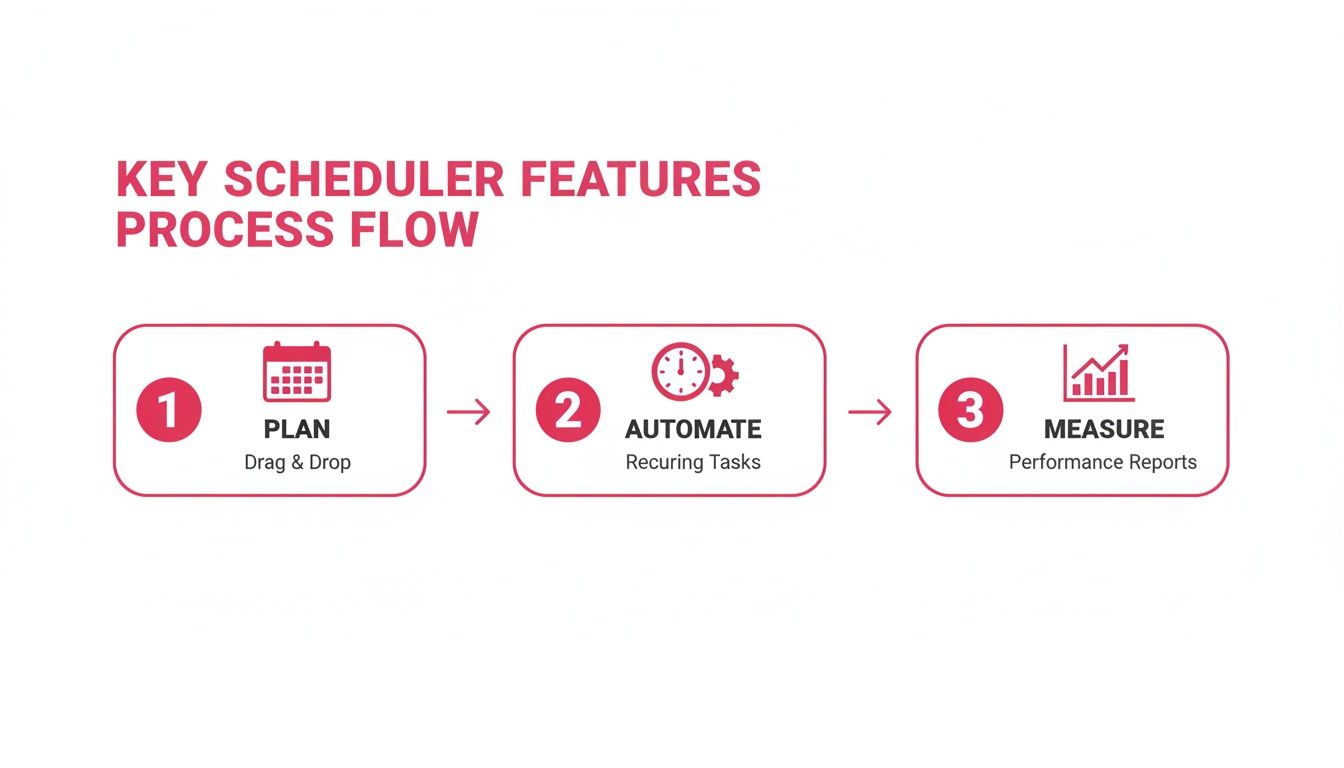
As you can see, a scheduler creates a repeatable cycle. You plan strategically, automate efficiently, and measure the results, which then informs your next plan.
By bringing a scheduler into your workflow, you're not just automating posts; you're creating a system for your entire content operation. This consistency boosts content quality and, most importantly, frees up precious time for big-picture thinking and engaging with your community.
At the end of the day, this methodical approach ensures your brand shows up online consistently and with high-quality content. It turns social media management from a daily chore into a well-oiled machine that actively supports your wider marketing goals.
How to Measure Your Social Media Success
Pushing content out with a social media scheduler is only half the job. The other, more critical half, is figuring out what’s actually working. A solid strategy isn't just about posting consistently; it's about posting with purpose, and that means you need to measure your results. It's time to look past vanity metrics like 'likes' and dig into the Key Performance Indicators (KPIs) that tell you how your social media is really impacting your business.
Think of the analytics dashboard in your scheduler as your mission control. Every dial and gauge offers a specific piece of information about your performance. When you know how to read them, you can start making smarter, more informed decisions instead of just guessing. The objective isn't just to be on social media, but to use it to achieve something real, whether that's boosting brand awareness or driving actual sales.
Core Metrics That Truly Matter
To get a clear, honest picture of your performance, you really only need to focus on a handful of core metrics. These are the KPIs that give you actionable insights and help you understand your audience and content on a much deeper level.
Most good schedulers, like the one offered by Poster.ly, have built-in analytics that present this data in a straightforward way.
Here are the essentials you should be watching:
- Engagement Rate: This is the big one. It's the percentage of your audience that actually interacts with your posts—think likes, comments, shares, and saves. A healthy engagement rate is a clear sign that your content is hitting the mark and building a genuine connection.
- Audience Reach: This number tells you how many unique people saw your post. It’s your best gauge for brand awareness and shows how well your content is travelling beyond your existing followers.
- Click-Through Rate (CTR): If you're trying to get people to your website or a landing page, CTR is your go-to metric. It measures the percentage of people who clicked the link in your post, telling you how compelling your call-to-action was.
- Conversions: This is where the rubber meets the road. A conversion happens when someone clicks your link and then takes a specific action you wanted them to, like buying a product, signing up for a newsletter, or filling out a form. It's the ultimate measure of ROI.
Turning Data into Smarter Decisions
Let's make this practical. Imagine you run an e-commerce business in Dubai, scheduling posts twice a day. After a month, you look at your analytics and notice a pattern: your Tuesday evening posts are consistently getting the highest Click-Through Rate and driving a ton of traffic to your product pages.
That single insight is gold. It tells you exactly when your audience is in the mood to shop. Armed with this knowledge, you can shift your strategy to save your most important promotional content for Tuesday evenings, giving you a much better shot at making a sale. You can get even more granular by tracking what happens after the click; our guide on using Google Analytics is a great place to start learning how.
Data from your social media scheduler isn't just a report card on past performance; it's a roadmap for future success. Each metric is a clue that helps you understand your audience's behaviour and refine your strategy accordingly.
This data-first mindset is especially powerful in the MENA region. Global trends show that people are spending an average of 141 minutes per day on social media, but in markets like the UAE and Saudi Arabia, that number climbs to over 31 hours per month. You can read more about these social media usage trends on Statista.com.
That incredible level of engagement means every single post has massive potential—but only if it's optimised based on what the data tells you. When you consistently analyse your metrics, you transform your scheduler from a simple automation tool into a strategic engine for growth.
Common Scheduling Mistakes and How to Avoid Them

Getting a social media scheduler is a great move for efficiency, but it's easy to fall into a few common traps that can sabotage your efforts. The biggest one? The classic ‘set it and forget it’ approach. This is where automation gets confused with a total replacement for actual human interaction.
When you just pump out a steady stream of pre-loaded posts without ever jumping into the conversation, your brand starts to sound like a megaphone, not a friend. Social media is built on connection. If you're not monitoring comments, replying to questions, or joining in on discussions, you come across as robotic and aloof.
This disconnect can seriously erode trust and stall your growth. Thankfully, the fix is simple: schedule your engagement time just as carefully as you schedule your posts. Carve out dedicated blocks in your calendar each day specifically for community management.
Ignoring Platform Nuances
Another classic blunder is the one-size-fits-all content strategy. Pushing the exact same message, image, and hashtags across LinkedIn, Instagram, and TikTok just doesn't work. Each platform has its own vibe, its own audience, and its own rules of engagement.
That formal, text-heavy post that gets traction on LinkedIn will likely die a quiet death on the fast-paced, visual-first world of Instagram Reels. It’s a dead giveaway that you don't really 'get' the platform, which can tank your engagement and make your brand look out of touch.
The solution is to tailor everything for the specific channel.
- LinkedIn: Think professional insights, company news, and more detailed text.
- Instagram: It's all about high-quality visuals, short-form video (Reels), and interactive Stories.
- X (formerly Twitter): Go for short, punchy copy, witty remarks, and jumping on relevant trends.
This audience-centric mindset is critical, especially in markets near the UAE. For instance, research shows that 70% of Nigerian users use social media specifically for brand discovery, as detailed in these stats about consumer behaviours on social media at ElectroIQ.com. If your content isn't perfectly tuned to their expectations on that platform, you're missing a huge opportunity.
Failing to Stay Agile and Adapt
Finally, a surprisingly common mistake is sticking to the schedule no matter what’s happening in the world. A scheduler gives you a framework, but your strategy needs to be able to breathe. Pushing out a cheerful, promotional post during a major news event or a local crisis can make your brand seem completely tone-deaf and insensitive.
Your content calendar should be a living document, not a stone tablet. The ability to pause, pivot, and adapt to real-world events is crucial for maintaining brand relevance and integrity.
The key is to build in regular check-ins. Take a quick look at your content queue at the start of each day to make sure everything still feels right. A flexible tool like Poster.ly makes it easy to hit pause on your entire schedule or quickly swap in more timely content. This kind of agility ensures your scheduler is supporting your strategy, not running it, keeping that all-important human touch front and centre.
Got Questions About Social Media Schedulers? We've Got Answers.
Stepping into the world of social media tools can feel a little overwhelming. If you're wondering whether a scheduler is right for you, or maybe you're thinking of switching to a better one, you've probably got some questions. Let's clear up the most common ones.
Think of this as your quick-start guide. Getting these fundamentals right from the beginning means you’ll pick a tool that actually helps you hit your marketing goals, not just another piece of software that complicates your day.
Are Schedulers Really Worth It for a Small Business?
Without a doubt. In fact, you could argue that small businesses get the biggest bang for their buck. As a small business owner, your time is your most precious asset. A scheduler takes the tedious, repetitive job of posting off your plate, so you can spend your energy on things that really move the needle—like talking to customers, refining your strategy, and growing your business.
It’s also about punching above your weight. A scheduler lets you maintain a consistent, professional presence that builds trust, making you look just as polished as the big brands, even if you’re a one-person show. It's an investment that pays you back in saved hours and better, more strategic content.
If I Schedule Posts, Can I Still Post in Real-Time?
Absolutely! A common misconception is that schedulers lock you into a rigid plan. The reality is, a great social media strategy is a blend of planned content and spontaneous, real-time posts. Your scheduler is there to handle your core content—the evergreen posts, the campaign announcements, the weekly tips—so your feed never goes quiet.
Think of a scheduler as the backbone of your content plan, not a cage. It gives you the consistency you need, while leaving you free to jump on a trending topic or share a live update from an event.
This way, you get the best of both worlds. You build a reliable rhythm that your audience can count on, but you also have the freedom to be human and reactive when the moment calls for it.
Does Using a Scheduler Kill Your Engagement?
This is a persistent myth, and the short answer is no—but there's a catch. Engagement only drops when people treat scheduling as a "set it and forget it" task. The tool itself has no negative impact on your reach or how people interact with your posts; it's how you use it that matters.
If you schedule your content and then make a point to show up, reply to comments, and join the conversation, your engagement will likely go up. Why? Because the scheduler helps you post at the exact times your audience is online, which can give your content a powerful initial engagement boost. The secret is to pair smart automation with genuine human interaction.
Ready to get a real handle on your social media and turn your efforts into growth? Grassroots Creative Agency is here to help. Check out our own powerful tool, Poster.ly, and discover how a smarter scheduling solution can completely change your marketing game.