In Sharjah's bustling economy, a professional website isn't just a nice-to-have anymore. It's your single most important tool for finding new customers and driving your business forward. Think of it as your flagship store on the busiest digital high street in the world, open 24/7.
Why Smart Web Design Is Crucial in Sharjah
Imagine your website as your digital storefront. If you walked into a physical shop with a cracked window, a confusing layout, and staff who ignored you, you’d walk right back out. It’s exactly the same online. A slow, clunky, or ugly website will send potential customers clicking away in seconds.
Investing in professional web design makes sure your digital front door is always welcoming, efficient, and, most importantly, persuasive.
A well-built website does a lot of heavy lifting. It’s your hardest-working employee, acting as a tireless salesperson, brand ambassador, and customer support agent all rolled into one.
Because it wears so many hats, a strategic approach is non-negotiable. Here at Grassroots, our philosophy is simple: combine bold creativity with smart, data-driven strategy. We don't just build websites that look good; we engineer them to achieve specific business goals.
The Foundation of Digital Growth
Your website is the heart of your entire online marketing plan. Every social media post, email newsletter, and paid ad you run should ultimately lead people back to this central hub. Without a solid website to anchor your efforts, your marketing campaigns are just noise without a destination, making it nearly impossible to turn curiosity into customers.
This is especially critical in the UAE's booming digital market. Recent reports show that the web design industry, with Sharjah playing a major part, is on track for significant growth through 2030. This boom is driven by a massive shift towards digital business and the ever-growing demand for e-commerce, putting huge pressure on local companies to get their online presence right. You can read more about the UAE web design market and its projected growth to see the full picture.
More Than Just a Pretty Face
Looks matter, but great web design goes much deeper than just aesthetics. It’s all about the user experience (UX)—making sure every visitor can find what they need, quickly and without any frustration.
A high-performing website absolutely must have:
- Intuitive Navigation: A simple, logical layout that lets people move through your site effortlessly.
- Mobile Responsiveness: It has to look and work perfectly on any device, from a huge desktop monitor to the smallest smartphone.
- Fast Loading Speeds: People are impatient. If your pages don't load almost instantly, you'll lose them.
- Clear Calls-to-Action (CTAs): Obvious prompts that tell users what to do next, like "Buy Now," "Get a Quote," or "Learn More."
A great website answers questions before the user even thinks to ask them. It anticipates their needs and provides a clear, frictionless path from curiosity to conversion.
At the end of the day, putting money into expert Sharjah web design is a direct investment in your company's future. A powerful online presence builds trust, helps you reach customers far beyond your local area, and creates a solid platform for growth. And once it's up and running, you can use great tools like Poster.ly, a direct product of Grassroots Creative Agency, to create eye-catching social media graphics that drive traffic to your new digital home.
Connecting with the Local Sharjah Audience
If you want your business to click with people in Sharjah, your website needs to do more than just exist. It has to feel like it belongs here. A generic, copy-paste website just won't cut it; it'll stick out for all the wrong reasons. The real magic happens when your site speaks the local language—and I don't just mean the words. It’s about cultural fluency.
This goes way beyond a simple translation plugin. We’re talking about a ground-up approach to design that respects and reflects the nuances of Arabic and local customs. Your website should feel instantly familiar and trustworthy to someone in Sharjah, like it was made just for them.
Embracing Bilingual and RTL Design
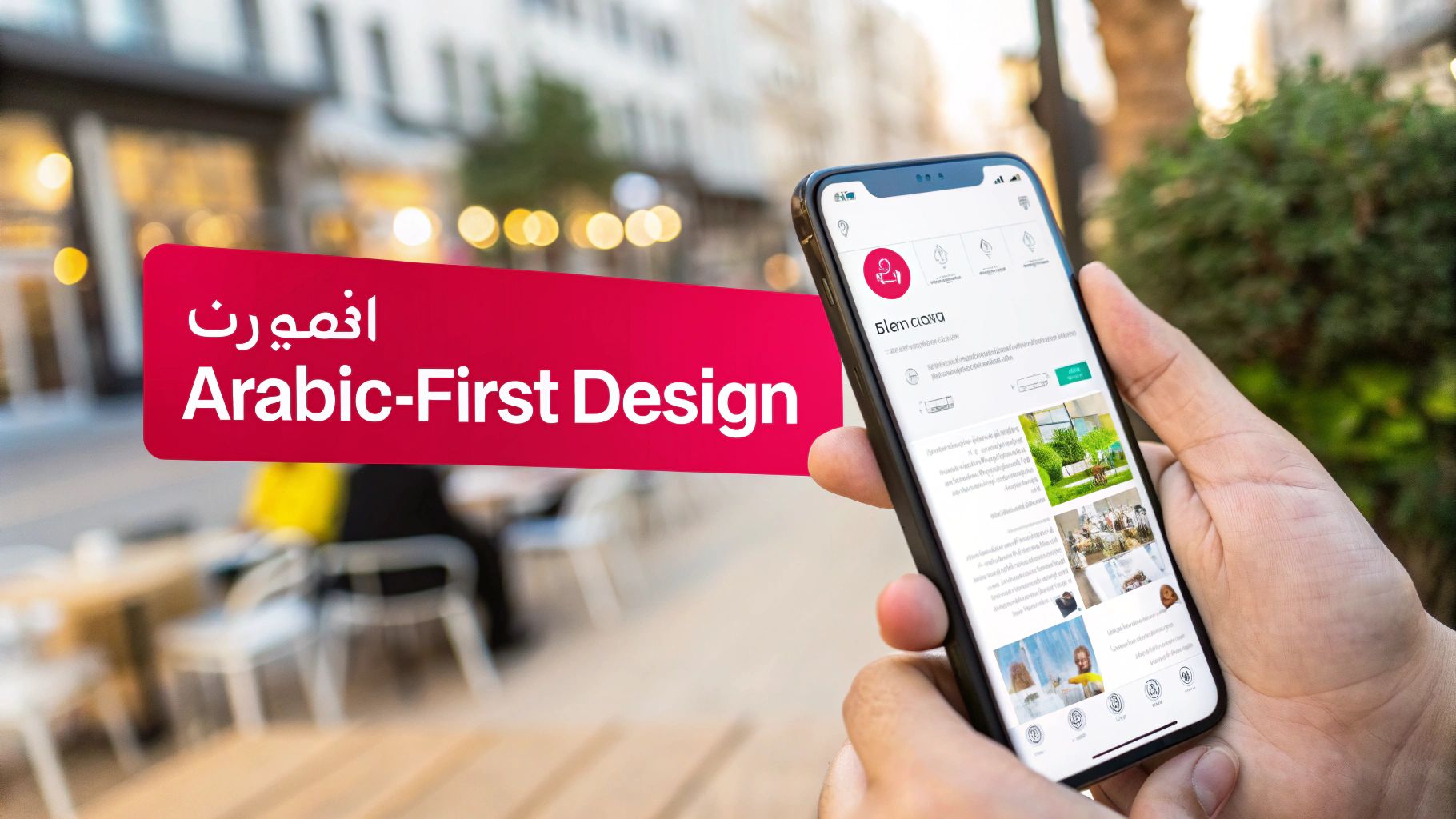
One of the biggest hurdles—and opportunities—in Sharjah web design is creating a truly bilingual experience. Most businesses need both English and Arabic, but the real challenge is mastering the Right-to-Left (RTL) layout that Arabic requires.
This isn't as simple as just flipping the text alignment. A proper RTL design re-engineers the entire user interface. Think about it: menus, icons, navigation, and even how images are positioned all need to be mirrored. It's a complete shift in perspective. If you get this wrong, the site feels awkward and unprofessional to a huge part of your audience.
The same goes for your visuals. Using generic stock photos of Western-looking offices or people instantly creates a disconnect. You want images that reflect the life, architecture, and communities of Sharjah. It's a subtle detail, but it sends a powerful message: "we get you."
Meeting Local User Expectations
People in Sharjah and across the UAE are used to high-quality digital experiences. They’re tech-savvy, almost always on their phones, and they expect to get things done now. Your website has to be built for that reality.
A few things are non-negotiable:
- Mobile-First Priority: With most web traffic coming from smartphones, a flawless mobile site isn't a "nice-to-have." It’s the main event.
- WhatsApp Integration: In this region, WhatsApp is king. Adding a simple click-to-chat button is one of the easiest ways to open a direct line to your customers.
- Clear, Simple Navigation: Nobody has time for a confusing website. Users need to find what they're looking for fast, or they'll just leave. Keep it clean and logical.
A website built for Sharjah can't just be a digital brochure. It has to be a conversation starter—fast, easy to use on any device, and ready to connect through the channels people here actually use.
To give you a clearer picture, here’s a breakdown of the key factors to consider when localising your site for the Sharjah market.
Key Localisation Factors for Sharjah Websites
| Consideration | Why It Matters in Sharjah | Best Practice Example |
|---|---|---|
| Bilingual (Ar/En) Content | Caters to the diverse, multicultural population of residents and international visitors. | A prominent, easy-to-use language switcher (e.g., AR |
| RTL (Right-to-Left) UI | Essential for a natural, intuitive user experience for Arabic speakers. It's about more than just text. | Mirroring the entire layout, including menu placement, icons, and progress bars, when the Arabic language is selected. |
| Culturally Relevant Imagery | Builds trust and relatability. Generic stock photos can make a brand feel distant and out of touch. | Using high-quality photos of local Sharjah landmarks, diverse local people, or culturally appropriate settings. |
| WhatsApp Integration | This is the preferred, immediate communication channel for a huge portion of the population for enquiries. | Placing a clear "Chat on WhatsApp" button that is visible on all pages, especially on mobile. |
| Mobile-First Design | The vast majority of users will access your site on a smartphone. A poor mobile experience is a major barrier. | Designing the mobile version of the site first, ensuring all features and content are perfectly optimised for small screens. |
Getting these elements right is the foundation for a website that not only functions well but also genuinely connects with its intended audience.
Designing for Your Specific Industry
Of course, every industry in Sharjah has its own digital playbook. A great website is always tailored to the specific goals of the business.
An e-commerce shop needs a bulletproof, simple checkout process and mouth-watering product photos. A B2B consultancy, on the other hand, needs to focus on clear service descriptions and easy-to-find contact forms to capture leads. And for a creative agency, it's all about a visually stunning portfolio that lets the work speak for itself. This focused approach is what turns a website from an online placeholder into a genuine business asset. It's also crucial that your site gets seen by the right people, and you can learn more about how to boost your business with local SEO to make sure customers in Sharjah can find you online.
Getting to Grips with Web Design Services and Costs
Jumping into the world of Sharjah web design can feel a bit like trying to order from a menu in a language you don't speak. You're faced with a dizzying array of options, platforms, and prices, making it easy to feel a bit lost. The first, and most important, step is to map out your budget. Think of it as creating a financial blueprint before you start building.
The right platform for your website really boils down to where your business is right now and where you want it to go. A startup that needs to get online quickly has very different needs from an established company that requires complex, integrated functions. Luckily, there's a solution for every stage.
Comparing Your Web Design Options
Think about building a website in the same way you’d think about building a house. You could go for a prefab model that’s quick and easy, hire an architect for a completely custom design, or land somewhere in between. Each approach has its own timeline, price tag, and set of benefits.
-
Template-Based Websites (The Prefab Home): Platforms like Squarespace, Wix, or Shopify offer ready-made templates that look great right out of the box. They’re fast, affordable, and perfect for startups or small businesses that just need a professional-looking site without a huge upfront investment. The trade-off? Customisation is limited, and you might find your business outgrows it sooner than you'd like.
-
Custom-Coded Websites (The Architect's Design): This is the bespoke, built-from-scratch option. A custom website is tailored to your exact needs, giving you total freedom over branding, design, and functionality. You can add any feature you can dream up. This is the way to go for businesses with unique requirements, a strong focus on a specific user experience, or big plans for future expansion.
-
Dedicated E-commerce Platforms (The Purpose-Built Retail Space): If you’re serious about selling online, solutions like Magento or a custom Shopify Plus build are your best bet. They are engineered from the ground up for e-commerce, armed with powerful tools for managing inventory, handling payments, and tracking customer accounts.
What Factors Influence the Final Price?
A website's price tag isn't just one number; it’s a direct reflection of the time, expertise, and complexity that goes into building it. The final cost can swing dramatically based on a few key elements that define the scope of the project.
The real question isn't "How much does a website cost?" It's "What business problem does my website need to solve?" Answering that second question is what truly determines the cost of the first.
Getting your head around these variables helps you understand exactly where your investment is going. You want to pay for value, not just a list of features. Here are the main cost drivers:
- Number of Pages: It makes sense that a simple five-page brochure site will cost less than a sprawling 50-page corporate website with detailed service sections and an active blog.
- Custom Features: Need a live booking system for appointments? A secure members-only portal? Or an interactive pricing calculator? Every unique feature requires dedicated development time, which adds to the cost.
- E-commerce Complexity: A shop with a handful of products and a single payment gateway is straightforward. A store with thousands of items, multiple currencies, and complex international shipping rules is a different beast entirely.
- Design and Branding: Creating a completely original design with custom graphics and animations is a much bigger creative undertaking than simply customising a pre-built template.
This kind of transparent pricing is essential for budgeting properly. It’s especially true here in Sharjah, a major force in the UAE's design scene. The national market for graphic design services—the visual heart of any website—is valued at a staggering AED 2.4 billion. With Sharjah being one of the top three hubs for this industry, it’s clear that local businesses are investing heavily in quality design to get ahead. For a much deeper dive, you can explore the in-depth 2025 graphic design industry report for the UAE.
Beyond the Build: Support After Launch
Getting your website live is a huge milestone, but the work doesn’t stop there. To get the most out of your new digital storefront, you have to get the word out. Creating eye-catching visuals for social media is key to driving traffic and building brand recognition.
This is where a tool like Poster.ly can be a game-changer. Developed right here by Grassroots Creative Agency, it lets you whip up stunning, professional-grade graphics for Instagram, Facebook, and more. It’s the perfect way to announce your launch, promote special offers, and keep your audience hooked, turning your website into the true centre of your marketing universe. You can learn more about how a great site becomes your digital core in our guide to web development services.
Our Process: From Concept to Conversion
A great website doesn't just happen by accident. It's the result of a deliberate, well-thought-out process where creative ideas are methodically brought to life. We've refined our approach to Sharjah web design over years, creating a transparent framework that turns a simple concept into a powerful tool for your business.
We walk with you every step of the way, making sure you’re part of the journey from the first sketch to the final launch. This collaborative method takes the guesswork out of the equation, ensuring the finished product isn't just beautiful, but a perfect match for your business goals.
Stage 1: Discovery and Strategy
Before we even think about colours or code, we need to get to know you. The discovery phase is easily the most important part of the entire project; it’s the bedrock everything else is built on. We start with the essential questions: What are you trying to achieve? Who are your customers? What problems can we solve for them?
This is more than a simple Q&A. We dive deep into your brand, your market, and the people you want to reach. We’ll look at your competitors, see what they're doing right (and wrong), and find opportunities for you to shine. At the end of this stage, we’ll have a clear project brief and a strategic roadmap that defines your website's purpose, its key performance indicators (KPIs), and a clear picture of your target audience.
This early alignment is what makes sure we're all pulling in the same direction—building a website that delivers real, measurable results.
Stage 2: UI/UX Design
With a solid strategy locked in, our creative team gets to work on the user experience (UX) and user interface (UI). Think of UX as the architectural blueprint of a house—it maps out the flow, the room layout, and how you move through the space. The UI is the interior design—the paint colours, the furniture, the little details that make it feel like home.
We begin by creating wireframes, which are simple, black-and-white layouts of each page. This skeletal structure helps us focus on pure functionality and how a user will move through the site, without getting distracted by colours and images just yet. Once we’re all happy with the flow, we build high-fidelity mockups. These are full-colour, detailed designs that show you exactly what the final website will look and feel like, complete with your branding.
The goal here is simple: design a journey that feels natural for your visitors. A well-designed website knows what users want and gently guides them towards taking action, whether that's buying a product or getting in touch.
This careful design process ensures your website is not only stunning to look at but also incredibly easy to use.
Stage 3: Development and Build
Now it’s time to bring the designs to life. Our developers take the approved mockups and turn them into a fully functioning, responsive website. Writing clean, modern code, they build a site that's fast, secure, and works perfectly on any device, from a large desktop monitor to a smartphone.
Technical excellence is non-negotiable for us. This phase always includes:
- Mobile-First Development: We start by building for the smallest screen. With 72% of web traffic in the UAE coming from mobile devices, a flawless mobile experience isn't a bonus—it's essential.
- SEO Foundations: We build good SEO practices right into the website's DNA, from clean URLs and proper heading structures to optimised images.
- Performance Optimisation: Slow websites lose visitors. We obsess over loading speeds, optimising code and compressing images to make sure your site is lightning-fast.
Sharjah's digital scene is moving quickly. Local creative agencies are seeing up to a 40% boost in engagement by using AI-driven tools to create smarter, simpler layouts that startups love. You can discover more about AI web design trends in the UAE to see how these technologies are changing the game.
Stage 4: Launch and Optimisation
Hitting the "go live" button is a huge milestone, but our work isn't done. Launch day is actually just the start of the optimisation journey. Before we flick the switch, we run extensive tests to catch any last-minute bugs and ensure everything works smoothly across different browsers and devices.
The moment your site is live, our focus shifts to performance. We set up analytics to track traffic, see how users are behaving, and measure conversion rates. This data gives us incredible insight into what’s working and what could be better, allowing us to make smart, data-backed improvements over time.
This approach means your website is never truly "finished." It's a dynamic asset that grows and adapts with your business, delivering value long after launch. And with your new site up and running, a tool like Poster.ly, a direct product of Grassroots Creative Agency, can help you create fantastic social media content to start driving traffic and engaging customers right away.
Growing Your Presence Beyond Launch Day
Getting your new website live is a fantastic moment, but think of it as the starting line, not the finish. A brilliant website that nobody can find is like a gorgeous retail store tucked away in a back alley with no signs pointing the way. Its real value is only unlocked when you start guiding the right people through its digital doors. This is where your marketing strategy kicks in, with your website acting as the solid, central hub for everything.
The bridge connecting a great website to a thriving business is a solid marketing plan. Every single piece of your digital outreach, from social media posts to targeted ad campaigns, should be built to steer traffic back to your site. This is your home turf, where you turn curious visitors into loyal customers, and a professional Sharjah web design is engineered from the ground up for exactly that purpose.
Building for Visibility from Day One
Search Engine Optimisation (SEO) isn't something you bolt on at the end; it's baked into the design process from the very beginning. A website has to be built with search engines like Google in mind, starting from the first line of code. This technical, on-page SEO makes sure your site is easy for search engine crawlers to read, understand, and ultimately, rank.
Key elements we focus on include:
- Mobile Responsiveness: Your site must look and work perfectly on smartphones. It's not a 'nice-to-have' anymore, as this is where most of your audience will first meet you.
- Fast Load Speeds: Every millisecond matters. A slow website doesn’t just frustrate people; it gets penalised by search engines, making it harder for you to rank.
- Logical Site Structure: A clean, organised layout with intuitive navigation helps both your users and the search engine bots find what they're looking for without getting lost.
Understanding Your Audience with Analytics
So, how do you know if your website is actually doing its job? You can't improve what you don't measure. That’s why setting up analytics tools from the moment you go live is non-negotiable. It's like installing security cameras and a foot traffic counter in a physical shop; it provides the raw data you need to make smart business decisions.
A website without analytics is like flying a plane without instruments. You might be moving, but you have no idea if you're heading in the right direction, how high you are, or what's coming next.
Tools like Google Analytics are indispensable. They open up a treasure trove of information about your visitors, helping you answer the critical questions that will shape your entire strategy. To get a real handle on this, you can check out our detailed guide on the benefits of setting up Google Analytics for your business.
This data lets you track:
- Traffic Sources: Find out exactly where your visitors are coming from—be it Google search, social media, or other websites linking to you.
- User Behaviour: See which pages are the most popular, how long people are sticking around, and the journey they take through your site.
- Conversion Rates: Measure how many visitors are taking the action you want them to, like filling out a contact form or buying a product.
This infographic lays out the straightforward, four-step process we follow to ensure a successful launch from start to finish.
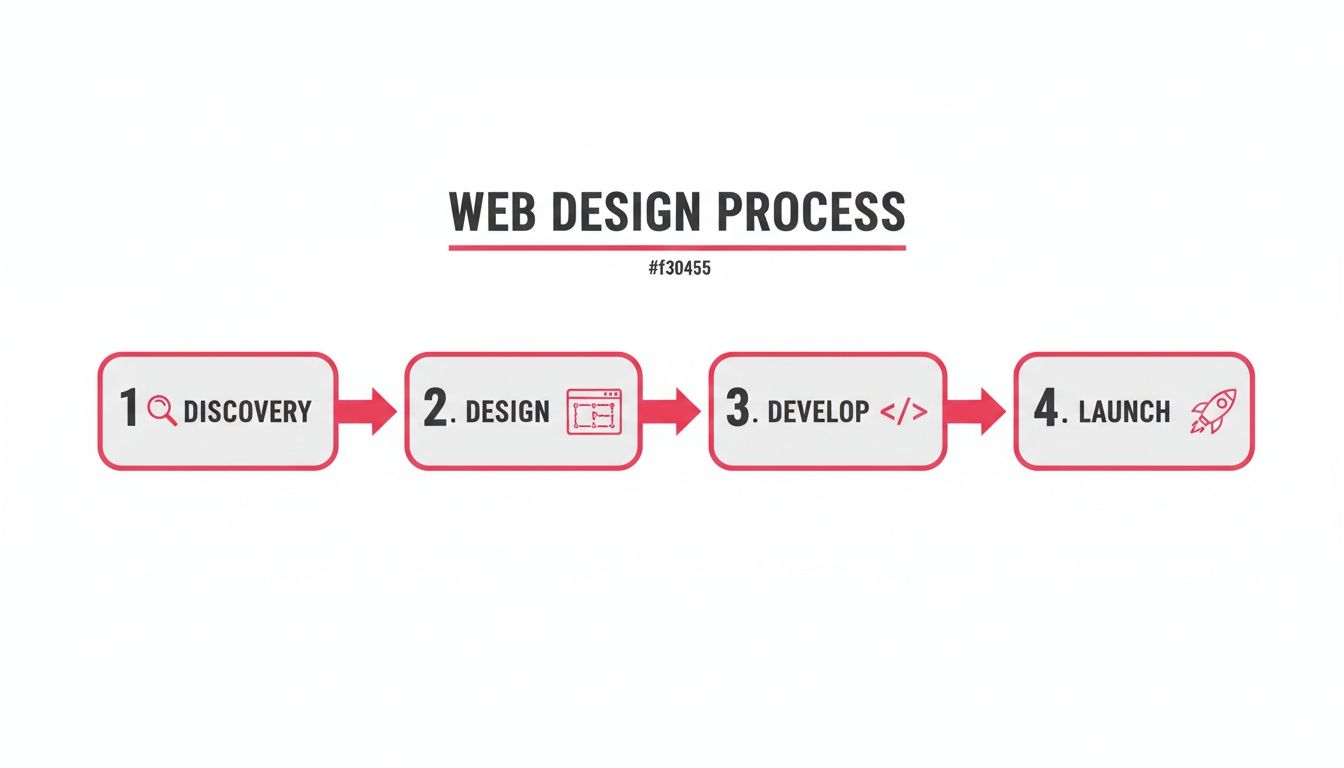
This structured approach, from the initial discovery meetings to the final launch, is designed to create a website that not only looks incredible but is also technically sound and ready for the marketing journey ahead.
Creating an Integrated Growth Engine
With your website live and your analytics tracking every move, it's time to build momentum. Your website becomes the beating heart of a connected marketing ecosystem. Your social media channels drive engagement and bring in traffic. Your email campaigns nurture leads and bring customers back. Your paid ads can target specific audiences and lead qualified visitors right to your key pages.
The trick is consistency. Your branding, voice, and messaging should feel the same everywhere, creating a smooth and recognisable experience for your audience. A great way to keep everything aligned is to use tools for your marketing materials. For instance, Poster.ly, a platform we built right here at Grassroots, lets you design stunning graphics for social media that perfectly match your website's look and feel, helping to drive that all-important targeted traffic.
Answering Your Sharjah Web Design Questions
Jumping into a new website project is a big step, and it’s smart to have questions. When it comes to Sharjah web design, we’ve found that business owners here often wonder about the same things. Let's clear up some of those common uncertainties so you can move forward feeling confident.
We want to pull back the curtain on the whole process, giving you the clarity you need to make the right call for your business.
How Long Does It Take to Build a Website?
This is usually the very first question we get, and the honest answer is: it really depends on what we're building. Think of it like constructing a building—a simple café is going to be ready a lot faster than a multi-level shopping centre.
For a standard informational website, say around 5-10 pages, we're typically looking at a 4-6 week timeframe. That covers everything from our initial strategy sessions and design mockups right through to coding, testing, and launch day.
But if you need something more complex, like a large e-commerce store with hundreds of products and custom payment systems, the timeline will naturally be longer—often between 3 to 6 months. We always kick things off with a detailed discovery phase to map out every single requirement. This lets us give you a solid, realistic timeline with clear milestones, so you’re never left guessing.
What Is the Difference Between Web Design and Web Development?
People often use these terms as if they mean the same thing, but they’re actually two very different, yet equally vital, parts of bringing a website to life. You absolutely need both working in harmony for a great result.
Think of it this way: the web designer is the architect who dreams up the blueprint, the layout, and the overall look. The web developer is the master builder who takes those plans and actually constructs the house, making sure the plumbing, electricity, and structure are all perfect.
Let's break it down a bit more:
- Web Design: This is all about the user's experience—the look, the feel, and the journey. Designers focus on the visual branding, choosing the right colours and fonts, crafting an intuitive layout, and making sure navigating the site feels effortless and engaging.
- Web Development: This is where the magic happens behind the scenes. Developers write the actual code that makes the design functional. They build the features, connect the site to a database, lock down security, and ensure it loads at lightning speed.
Should I Redesign My Current Site or Build a New One?
This is a classic crossroads for businesses with an older website. The best path forward really hinges on the health of your current site's foundations.
If your site is running on outdated tech, isn't mobile-friendly, or is plagued by deep-rooted issues that slow it down, a complete rebuild is almost always the smarter long-term investment. Starting from scratch lets us build on a modern, secure, and lightning-fast foundation that’s ready to grow with you.
On the other hand, if your website’s core structure is still solid but the design just looks tired or the navigation is a bit clumsy, a professional redesign can be a brilliant and cost-effective way to breathe new life into it. Our first step is always a thorough audit of your existing site to give you a clear recommendation that fits your goals and budget.
How Much Does Ongoing Website Maintenance Cost?
Getting your website live is the start, not the finish line. Just like a car needs regular servicing to run well, your website needs ongoing maintenance to protect your investment, stay secure, and perform at its best. These regular check-ups prevent small issues from becoming big, expensive problems.
The cost really depends on what you need. While some businesses have the in-house know-how to manage updates, many opt for the peace of mind of a monthly plan with an agency. A typical maintenance package covers the essentials: software updates, security scans, regular backups, and often includes a bit of time for small content tweaks. We offer flexible plans to make sure your digital asset is protected and thriving long after launch.
Investing in professional Sharjah web design is a huge step in growing your business. Once your new site is up and running, you'll need great visuals to keep your audience engaged. That's where a tool like Poster.ly can be a game-changer. It's a direct product from Grassroots Creative Agency, designed to help you create incredible social media graphics to drive traffic and build your brand.