Think of service video production as the "done-for-you" approach to creating video content. It’s a comprehensive service where a professional agency takes your project from a simple idea all the way to a finished, ready-to-use video.
It’s like the difference between trying to cook a gourmet meal with whatever’s in your fridge, and hiring a top chef who sources the ingredients, crafts the menu, and presents a perfect dish. You get the incredible result without having to learn the complex techniques yourself.
Unpacking the Value of Full Service Video Production
Let's go deeper than that simple definition. A full service production isn't just about hiring someone to shoot and edit. It's about commissioning a strategic business asset. You bring the business goal, and a team of specialists—from strategists and writers to directors and editors—handles every single creative and technical step.
This is all about turning your concept into a powerful communication tool designed to hit specific targets. In a competitive market like the UAE, a DIY video or a fragmented approach cobbled together with freelancers often misses the mark. Working with a professional agency like Grassroots Creative means you're getting more than just a video file; you're gaining a partner dedicated to delivering a final product that actually performs.
To better understand what goes into this comprehensive process, here’s a breakdown of the typical stages and what you can expect.
The Core Components of Full Service Video Production
| Production Stage | Key Activities | Typical Deliverables |
|---|---|---|
| Strategy & Pre-Production | Concept development, scriptwriting, storyboarding, location scouting, casting, scheduling. | Creative brief, final script, storyboard, production schedule, shot list. |
| Production (The Shoot) | On-location or in-studio filming, directing talent, sound recording, lighting setup. | Raw video footage, audio recordings. |
| Post-Production | Video editing, colour grading, sound design and mixing, adding graphics and animation. | First draft (rough cut), subsequent revisions based on feedback. |
| Final Delivery & Distribution | Final video rendering in various formats, asset management, distribution strategy support. | Final high-resolution video files, optimised versions for web and social media. |
As you can see, a full-service package covers every detail, ensuring a smooth and cohesive process from start to finish.
The Strategic Edge of a Professional Partnership
The real magic of full service video production is the seamless fusion of strategy, creativity, and technical execution. Instead of you having to juggle multiple freelancers or get bogged down in learning complex software, one dedicated partner manages the entire workflow. This frees up an enormous amount of your time and energy, so you can stay focused on your business.
This partnership also opens the door to a level of expertise that’s almost impossible to build in-house overnight. Professionals live and breathe the nuances of lighting, sound engineering, and visual storytelling that separate amateur content from truly exceptional work. They bring years of experience to the table, helping you sidestep common mistakes and ensuring your message lands with clarity and impact.
Access to Industry-Standard Tools and Technology
Professional agencies arrive with an arsenal of high-end equipment—cinema cameras, advanced lighting kits, professional-grade audio gear, and powerful editing suites—that are incredibly expensive for a single business to purchase and maintain. This isn't just about making things look pretty; it's about producing a level of quality that builds immediate credibility and trust with your audience.
A polished, well-produced video signals professionalism and quality. It tells potential customers that you invest in your brand and, by extension, that you will invest in delivering a quality experience to them.
What’s more, a full-service team knows exactly which tool is right for the job. Whether it’s using a drone to capture a breathtaking aerial shot of your Dubai headquarters or deploying specialised software for a complex animated explainer video, they have the resources to bring any creative vision to life. This technical prowess guarantees a final product that is not only effective but also has a much longer shelf life.
Navigating a Booming Market
The demand for high-quality video is more than just a fleeting trend; it’s a fundamental shift in how businesses communicate. This is especially true here in the Middle East and Africa (MEA), where the video streaming market is seeing massive growth.
According to recent research, the MEA video streaming market generated around $7.0 billion in 2024 and is projected to grow at a compound annual rate of 22.3% through to 2030. This surge is driving client budgets for professional production, highlighting just how crucial it is to invest in quality to stand out. You can discover more insights about this growing market and what it means for businesses in the region.
Once the video is done, the work isn't over. Smart management and distribution are essential to get the most out of your investment. This is where modern tools become indispensable. For example, platforms like Poster.ly help businesses organise, store, and share their valuable video assets, making sure your new content gets seen by the right people across all your channels. It’s the final piece of a truly comprehensive video strategy.
Choosing the Right Video for the Job
Picking the right video format is a bit like choosing the right tool. You wouldn't try to saw a plank of wood with a hammer, would you? It’s the same with video. The format you choose has to line up perfectly with what you’re trying to accomplish. This isn't just about making a video; it's about making the right one to get the results you're after.
Every type of video in service video production has a specific, strategic job to do. So, the first question to ask isn't "what video should we make?" but rather "what do we want this video to do?" Nailing that down from the start gives you a clear path and makes sure your investment actually pays off.
Getting this strategy right is especially important in a fast-moving market like the UAE. The region's hunger for video is growing like crazy, thanks in large part to the boom in streaming services. Both the UAE and the wider MENA market have seen a massive jump in subscription-video-on-demand (SVOD) subscribers, which in turn fuels the demand for all kinds of professional video. In fact, projections show SVOD subscriptions in MENA will hit 27 million by the end of 2025, and the online video market is expected to balloon to around $8.4 billion by 2029. This is a huge opportunity for businesses to connect with their audience through video, and you can read more about the MENA streaming market growth.
Connect With Brand Story Videos
When you need to build a genuine, emotional bridge between your brand and your audience, a brand story video is your best bet. Forget the hard sell. This is all about sharing your "why"—your mission, your values, and the people who make your company tick.
A great brand story brings your business to life, turning it from a faceless logo into a personality people can connect with. It builds a kind of loyalty and trust that goes beyond a simple purchase. Think of a luxury hotel in Dubai creating a cinematic film about its heritage and deep-rooted commitment to hospitality—that’s a brand story.
Explain With Explainer Videos
Is your service a bit complex, technical, or just hard to understand at first glance? An explainer video is purpose-built to make the complicated simple. Using animation, clean graphics, and a clear voiceover, these short videos break down what you offer into easy-to-follow steps.
They get straight to the point, answering the big questions: what problem do you solve, how do you do it, and why should someone choose you? Explainer videos work wonders on landing pages and in sales meetings. For example, a FinTech startup in Abu Dhabi could use a snappy animated explainer to show potential users exactly how its new investment platform works, no jargon required.
Explainer videos don't just tell people what you do; they show them how it makes their life better. This clarity is often the final push a potential customer needs to convert.
Prove It With Testimonials and Case Studies
If your goal is to build rock-solid credibility and show undeniable proof, nothing works better than letting your happy customers do the talking. Testimonial videos capture authentic, unscripted praise from real clients, adding a layer of trust that no marketing copy can ever match.
Case study videos go one step deeper. They're structured stories that walk through a specific customer's journey: the challenge they were facing, the solution your service provided, and the fantastic results that followed. For a B2B software company in the UAE, a case study showing how they helped a major local retailer boost efficiency is infinitely more powerful than a brochure. Once you have these assets, keeping them organised is key. A tool like Poster.ly can help you manage and share your video testimonials and case studies, making sure your team always has the right proof point ready for any sales or marketing moment.
The Three Phases of Production: From Idea to Final Cut
Taking a video from a simple idea to a polished, final product can feel like a bit of a black box. But in reality, service video production follows a surprisingly logical, three-phase process. Knowing how this works takes the mystery out of it all, giving you a clear roadmap of what to expect when you partner with a production team.
Think of it like building a house. You don't just show up with a pile of bricks and hope for the best. First, you need a detailed blueprint (Pre-Production). Then comes the actual building work (Production). Finally, you handle all the interior design, painting, and finishing touches (Post-Production). Each step builds on the last, and skipping one can compromise the entire project.
Phase 1: Pre-Production – Where the Blueprint is Drawn
This is, without a doubt, the most important phase. It's where all the strategic thinking and meticulous planning happens, laying the groundwork for everything that follows. Trying to rush through pre-production is a classic mistake that almost always leads to budget blowouts, frustrating delays, and a video that just doesn't hit the mark. It’s the old "measure twice, cut once" principle in action.
During this stage, we nail down all the creative and logistical details. It's a highly collaborative process designed to get everyone on the same page before a single camera is even switched on.
Key activities during pre-production usually include:
- Concept & Scripting: This is where we figure out the core message and how to tell the story. The script becomes the foundation for the entire video, outlining every piece of dialogue, voiceover, and on-screen action.
- Storyboarding & Shot Lists: We then turn that script into a visual plan. A storyboard is like a comic-strip version of your video, while a shot list is a detailed breakdown of every single camera angle and scene required.
- Casting & Location Scouting: Here, we find the right talent to represent your brand and scout the perfect locations to bring the story to life.
- Logistics & Scheduling: This is the nitty-gritty of coordinating the crew, booking equipment, sorting out any necessary permits, and creating a watertight schedule for the shoot days.
Pre-production is where 90% of the problem-solving happens. A solid plan here means the production phase can be all about creative execution, not putting out fires.
Phase 2: Production – Bringing the Vision to Life
This is the part everyone imagines when they think of video production—the buzz of being on set and filming. With the detailed roadmap from pre-production in hand, the crew gets to work capturing all the footage and audio needed to tell your story.
It’s a high-energy, collaborative environment. The director guides the talent, the cinematographer crafts the shots, and the sound engineer makes sure the audio is perfect. While the actual shoot might only last a day or two, its efficiency is a direct reflection of the planning that came before it. A good plan frees up the team to be creative and confident, knowing every shot is accounted for. For anyone curious about how the pros handle it, seeing how a top production house in Dubai manages its workflow on set offers a great look into professional execution.
The goal here is straightforward: capture all the high-quality raw ingredients—video and audio—that the post-production team will need to work their magic.
Phase 3: Post-Production – Where the Story Comes Together
Once the shoot wraps, we move into the final stage. Post-production is where all that raw footage is shaped into a powerful, cohesive story. It's a delicate dance between technical skill and creative intuition.
This is where the editor pieces together the best takes, the colourist sets the mood, and the sound designer creates an immersive audio landscape.
The key steps in post-production are:
- Editing: The raw footage is cut and sequenced according to the script and storyboard to build the narrative and establish the right pace.
- Colour Grading: We adjust the colour and tone of the video to create a specific feel and ensure a consistent, professional look across every scene.
- Sound Design & Mixing: All audio elements—dialogue, music, sound effects—are balanced and mixed to create a clean, impactful soundscape.
- Graphics & Effects: Any animations, on-screen text, or visual effects are added to enhance the storytelling and highlight key information.
- Review & Revisions: You’ll receive a "rough cut" for your feedback. This is a crucial back-and-forth process, allowing us to refine the video until it’s perfect.
This flowchart offers a simple way to think about your video's purpose, a decision that’s locked in during pre-production.
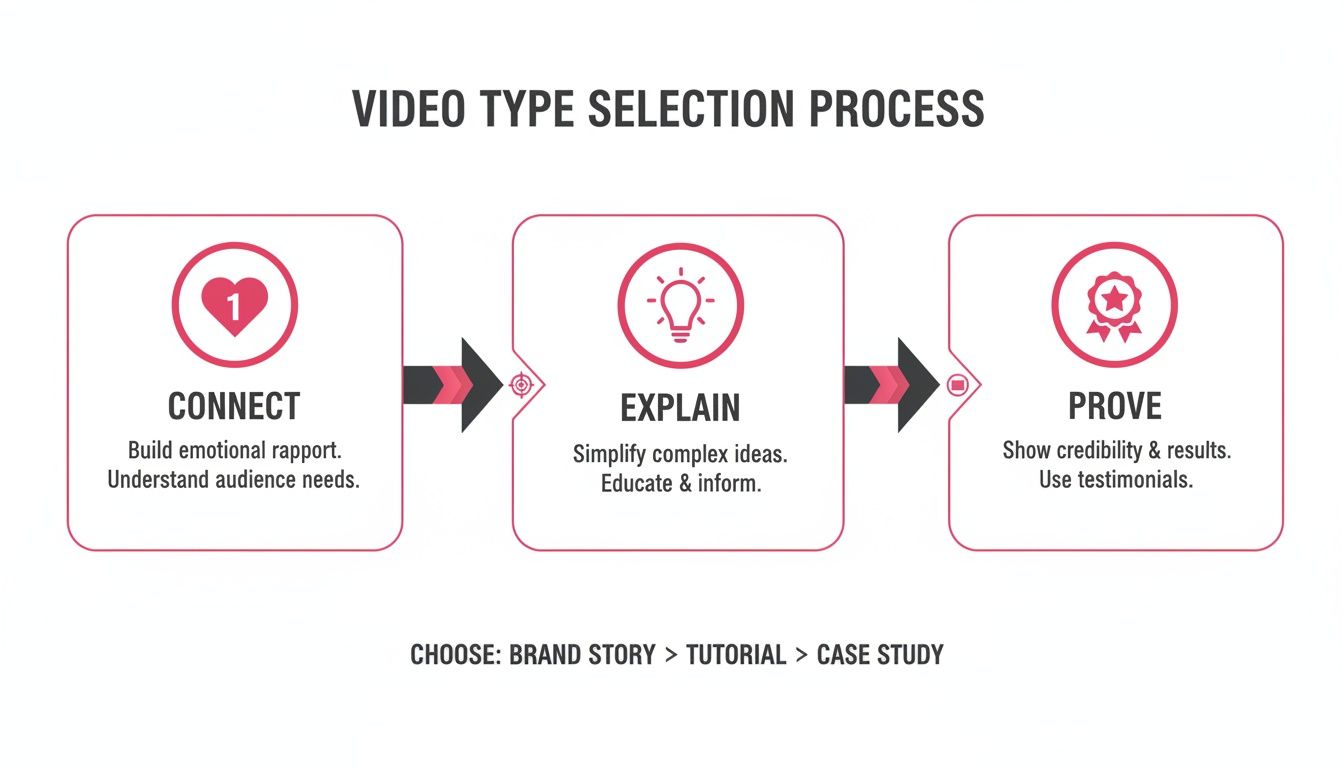
It reminds us that every video should start with a clear goal, whether it’s building an emotional connection, explaining a complex idea, or proving your value to a potential customer.
What Does Video Production Actually Cost? A Look at Budgets
Let's get straight to the point. The first question on everyone's mind is, "How much is this going to cost?" With service video production, there’s no simple answer or a standard price list. Think of it like commissioning a custom suit; the final cost depends entirely on the fabric, the complexity of the cut, and the tailor's expertise.
Getting a handle on the key variables will help you review proposals with a critical eye and make smart financial decisions that line up with your business goals. Several core factors will shape your budget, turning a creative idea into a practical financial plan.
The Main Things That Influence Your Video Budget
The biggest driver of your budget, by far, is the scope of the project. A straightforward testimonial video shot in one location with a small crew is a completely different beast from a multi-day brand film shot across Dubai with a full cast and production team.
Here’s a breakdown of what really shapes the final number:
- The Creative Idea: A simple interview setup is far less resource-intensive than a scripted story with actors, props, and custom-built sets. The more complex and creative the concept, the more it will cost to bring to life.
- Shoot Days and Video Length: While longer videos often mean more editing, the real cost factor is the number of shooting days. Each day adds up with crew wages, equipment hire, and location fees.
- Crew and Expertise: A basic shoot might get away with a three-person crew. But a high-end commercial could easily require a director, a cinematographer, a sound engineer, a gaffer (the lighting guru), and several production assistants—each an expert in their field.
- The Magic of Post-Production: This is a huge variable. Simple editing is one thing, but if you need custom motion graphics, 2D or 3D animation, professional colour grading, or a bespoke sound design, the hours and costs in post-production will climb.
It helps to see your video budget as a direct investment in quality and impact. A well-funded project doesn't just look slicker; it's built from the ground up to perform better and deliver a much stronger return.
A Practical Look at Budget Tiers
To give you a clearer picture, let's walk through a few common budget scenarios. These aren't exact quotes, but they illustrate what you can expect at different investment levels. Nailing down your budget is a key first step, and if you need more guidance, our guide on building a marketing budget for a small business is a fantastic resource.
Tier 1: The Social Media Content Package
This is perfect if you need a steady stream of short, punchy videos for platforms like Instagram Reels or LinkedIn. The whole process is built for efficiency, usually involving a single location, a nimble crew, and a streamlined editing process to get multiple pieces of content out of a single day's shoot.
Tier 2: The Polished Explainer or Testimonial
Stepping up a level, this budget accommodates a high-quality, single-purpose video like a detailed explainer for your service or a professionally shot customer testimonial. Here, you can afford a more experienced crew, better gear, and more time for post-production touches like custom graphics and clean sound mixing. The result is a sharp, credible asset for your website or sales presentations.
Tier 3: The Flagship Brand Film
This is the top end of the scale, reserved for those big, cinematic brand stories or hero campaign commercials. This budget supports a full-scale production team, high-end cameras and lighting, multiple locations, professional actors, and extensive post-production, including advanced colour grading and visual effects. You’re not just making a video; you're creating a powerful film designed to leave a lasting impression.
How to Measure the ROI of Your Video Content
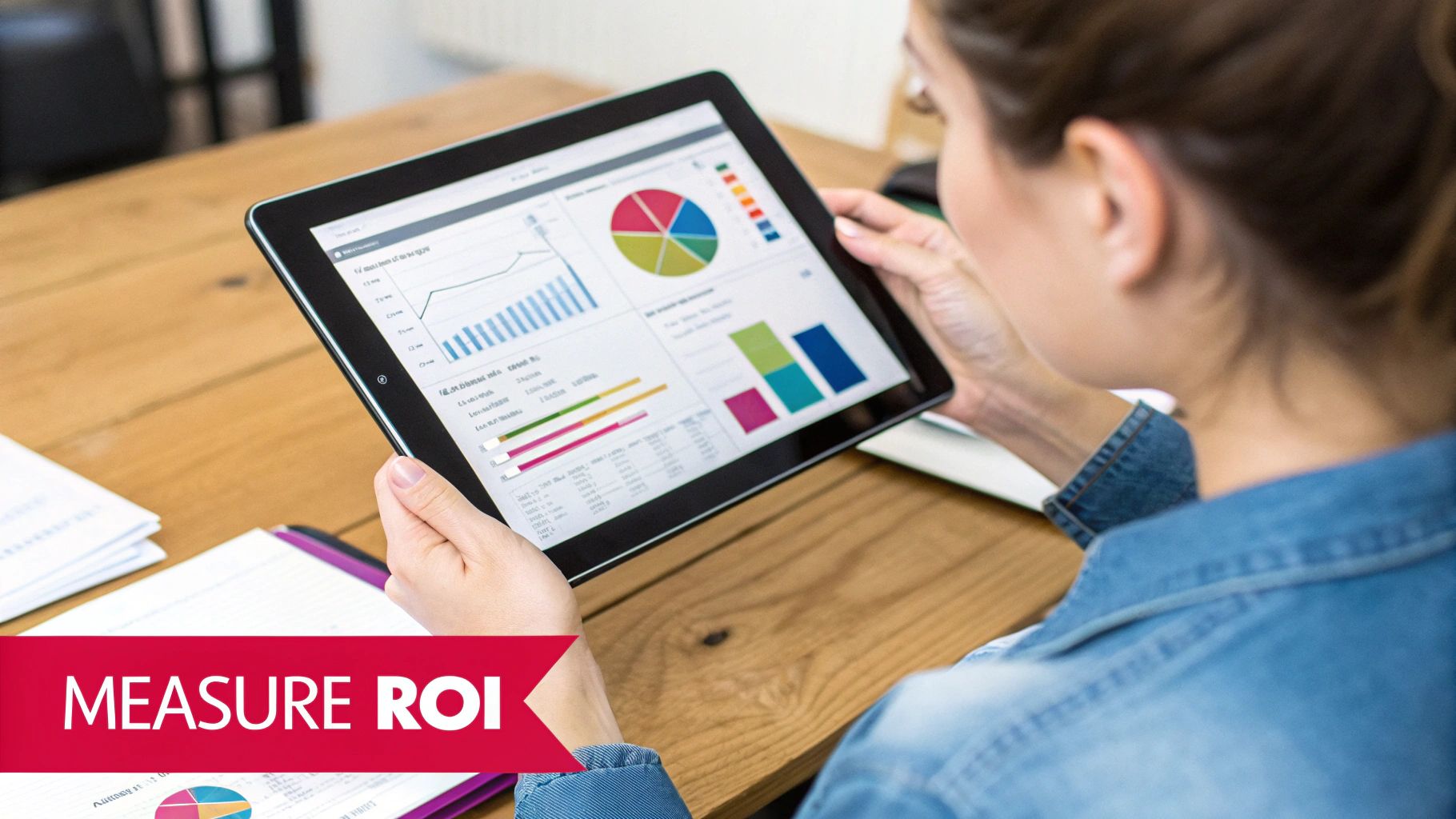
It’s one thing to create a visually stunning video, but the real test is what it does for your business. A successful service video production project doesn’t just end with the final cut; that’s actually where the real work begins. To understand the true impact of your investment, you need to get serious about measuring its return on investment (ROI).
Measuring ROI isn’t about vague feelings or guesswork. It’s about tracking specific, hard numbers—key performance indicators (KPIs)—that tie directly back to the goals you set at the very beginning. Without clear metrics, you’re essentially flying blind. You won't be able to justify the spend or know how to improve your next project.
Aligning Metrics with Your Goals
First things first: you have to match your KPIs to your video's purpose. It sounds obvious, but it’s a common mistake. A video designed to build brand awareness should be measured differently from one meant to capture sales leads. If you try to track everything at once, you’ll just end up with a confusing mess of data.
Let's break it down with a few examples:
- For Brand Awareness: Your main aim is simply to get your brand seen and remembered. Here, you’ll focus on metrics like view count, reach (the number of unique people who saw your video), audience retention (how long people actually stick around to watch), and view-through rate (the percentage who watch it all the way through).
- For Engagement: If you want to build a community and spark conversations, you need to look at the social signals. Track things like likes, comments, shares, and brand mentions. These tell you if your content is actually connecting with people on a level that makes them want to interact.
- For Lead Generation: When your goal is to drive action, the only numbers that really matter are your click-through rate (CTR) on any calls-to-action and the conversion rate on your landing page. This shows you exactly how many viewers took that all-important next step.
Measuring video ROI is about connecting creative work to commercial outcomes. It’s the process of translating views and shares into tangible business growth, proving that your video is not just a cost but a revenue-driving asset.
Using the Right Tools to Track Performance
To get your hands on this data, you'll need the right tools. Most social media platforms, like YouTube and LinkedIn, have surprisingly detailed native analytics that offer a goldmine of information on audience demographics and viewing habits.
For videos hosted on your own website, a tool like Google Analytics is essential. If you need a hand with the setup, our team can show you how to set up Google Analytics to track your website performance.
As you build out your video library, keeping everything organised becomes a challenge. That’s where a good asset management platform comes in. A tool like Poster.ly lets you organise, distribute, and track all your video assets from one central dashboard. This makes it so much easier to see which videos are working best on which channels, helping you connect your creative efforts directly to business results.
The Bigger Picture in the UAE Market
It’s also worth noting that professional video services in the region are expanding far beyond traditional marketing. Video production expertise in the UAE is now in demand for large-scale surveillance and video analytics projects, which create steady, long-term revenue streams for providers.
The wider Middle East & Africa video surveillance market was projected to be worth around $4.32 billion by 2025, which shows just how much is being invested in advanced video technologies. This diversification highlights how professional video skills are becoming a core part of long-term, high-value contracts across different sectors.
Common Questions About Video Production Services
Thinking about commissioning a professional video for the first time? It's natural to have a few questions. From how long it all takes to who actually owns the final cut, getting clear answers is key to feeling confident about your investment.
This section tackles the most common queries we hear from businesses just like yours. Think of it as a no-nonsense guide to the practical side of video production, making sure you and your production partner are on the same page from the very beginning.
How Long Does a Typical Video Project Take?
This is probably the number one question we get, and the honest answer is: it depends entirely on the creative scope. There's no one-size-fits-all timeline.
A straightforward project, like filming a customer testimonial in one location, can be turned around in as little as 2-3 weeks. But for something more ambitious, like a full-scale brand film with multiple locations, actors, and complex animations, you could be looking at a 2-3 month timeline from start to finish.
To give you a better idea, here’s how the time usually breaks down:
- Pre-production: This is the planning stage, and it’s arguably the most important. It covers everything from scriptwriting and storyboarding to casting and logistics. This can take anywhere from 1 to 6 weeks.
- Production: The actual shoot is often the shortest part of the whole process. For most corporate videos, filming is wrapped up in just 1 to 3 days.
- Post-production: This is where the magic really happens. Editing, colour grading, sound design, and incorporating your feedback takes time. This phase can easily last another 1 to 4 weeks.
Any professional agency will give you a detailed production schedule upfront, so you'll always know what's happening and when.
How Involved Does Our Team Need to Be?
We know you're busy. A great production partner does all the heavy lifting, but they’ll need your input at key moments to make sure the final video truly reflects your vision.
Your involvement is most critical during pre-production. This is when you'll approve the big-ticket items: the core concept, the script, and the storyboard. Getting your sign-off here ensures the project is on the right track before a single frame is shot.
When it comes to the actual filming days, you're always welcome on set, but it’s not essential if all the key decisions have been locked in. During post-production, your main role is to review the edits and provide clear, consolidated feedback. It’s a collaborative loop that continues until you’re thrilled with the final cut.
Who Owns the Rights to the Final Video?
This is a crucial point that should always be spelled out in your service agreement. Getting clarity on ownership from the get-go prevents any future confusion about how you can use your new video.
As a rule of thumb, your company will own the full and unlimited rights to the final, delivered video. This means you’re free to use it on any platform, in any campaign, for as long as you want.
Where it can get a bit different is with the raw, unedited footage (the original files from the camera). Some agencies hold onto these, while others might offer to transfer them for an additional fee. It's also standard practice for the production company to be able to use the finished video in their own portfolio. Just make sure you clarify these details in the contract before work begins.
What Is the Best Way to Distribute Our Video?
Creating an amazing video is only half the battle. Getting it in front of the right eyeballs is what actually drives results. Your distribution strategy should be built around the video's original goal.
If you’re aiming for broad brand awareness, platforms like YouTube, LinkedIn, and Instagram are fantastic choices. Their algorithms are designed to help your content find new audiences. For something more focused, like lead generation, it's often best to embed the video on a dedicated landing page and drive traffic there with targeted ads.
A vital part of any good distribution plan is simple asset management. You need to keep your video files organised and easy to access.
A tool like Poster.ly can be a lifesaver here. It gives you a central hub to store, organise, and share all your video assets with your team. This keeps your branding consistent and makes it easy for sales and marketing to grab the right content for any situation, ensuring you get the most out of your service video production investment.
At Grassroots Creative Agency, we specialise in creating high-impact video content that tells your brand’s story and drives measurable results. If you are ready to bring your vision to life, let's connect and discuss your next project.