If you think you can copy-paste a global SEO checklist and expect it to work in the UAE, you're in for a rude awakening. I've seen it happen time and time again: businesses apply a standard approach and wonder why they're getting nowhere. The truth is, search engine optimisation here is a different beast entirely.
You have to get granular and really understand the local user. We're talking about a market defined by heavy mobile use, a fluid mix of English and Arabic searches, and purchasing decisions deeply rooted in cultural context. To get any real traction, your strategy has to be built from the ground up for the UAE.
Why Generic SEO Fails in the UAE Market
The biggest mistake I see companies make is treating the UAE like a simple extension of their global marketing plan. They take what worked for them in Europe or North America, drop it into the local market, and expect the same results. It’s a costly error that completely ignores what makes the digital environment here so unique.
Let's be clear: consumer behaviour in the UAE is distinct. The population is a vibrant mix of locals and expats, creating a complex language dynamic where people flip between English and Arabic without a second thought. If your keyword strategy only focuses on one language, you’re instantly cutting out a huge chunk of your potential audience.
Understanding Local Search Intent
On top of the language mix, the intent behind searches is intensely local. The UAE’s economy is powered by services, retail, and hospitality—sectors where proximity and immediate availability are everything. This is where mastering Google becomes non-negotiable.
With a staggering 95.98% market share in the UAE, Google is the only game in town. What’s more, a massive 46% of all Google searches here have local intent. This is precisely why Dubai-based firms like Grassroots Creative Agency build hyper-local strategies for their clients—it’s how you attract people who are ready to buy. You can dig into the UAE's search engine trends and market share data here.
This local focus means your SEO has to go way beyond generic keywords. You need to be targeting location-specific phrases, getting a feel for regional dialects, and aligning your content with local holidays and cultural events.
The Amplification Effect of Local SEO
When you nail search engine optimisation in the UAE, it does more than just boost your organic rankings. It acts as a powerful amplifier for every other marketing channel you're using. A strong organic presence builds a foundation of trust that makes your paid ads and social media campaigns work that much harder.
Think about how it all connects:
- Paid Ads: A user sees your ad, then they see you ranking at the top of the organic results. That double-whammy of visibility reinforces your credibility and can seriously bump up your click-through rates.
- Social Media: Strong SEO funnels traffic to your site. From there, you can capture leads and retarget them on social platforms. Using a tool like Poster.ly to keep your social content flowing ensures this synergy is always working for you.
- Brand Authority: When you consistently show up in local searches, you become the go-to authority in your industry. It’s as simple as that.
A one-size-fits-all SEO plan is like using a map of London to navigate Dubai—the landmarks are wrong, the language is incomplete, and you will inevitably get lost. Success requires a locally drawn map.
Laying the Groundwork with Technical SEO
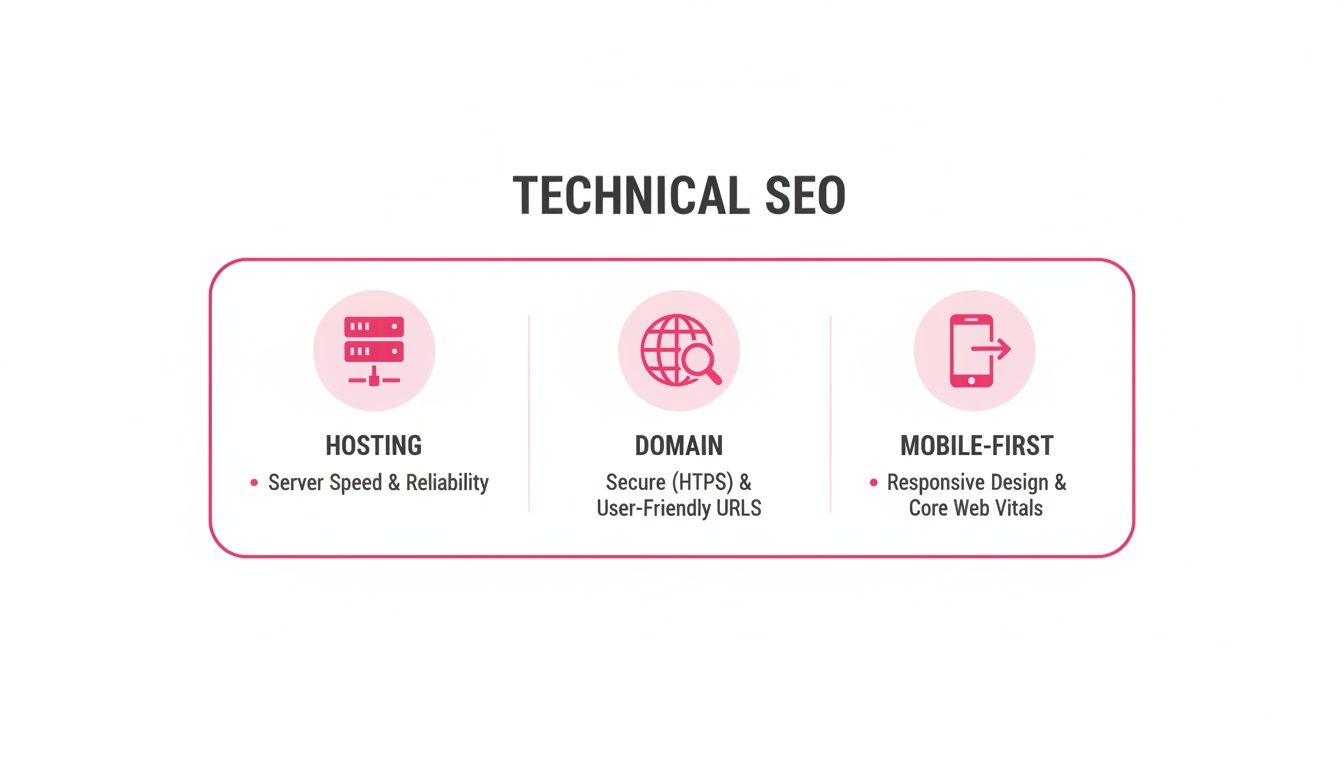
Before we dive into keywords and crafting compelling content, we need to talk about the foundations of your website. Think of it like building a house – you wouldn't start putting up walls on shaky ground. Technical SEO is that solid foundation, ensuring search engines can easily crawl, understand, and ultimately, rank your site. Getting this right from day one is non-negotiable for any serious search engine optimisation in uae and will save you a world of pain later on.
The first piece of the puzzle is your website's home: its hosting and domain. For businesses laser-focused on the UAE, choosing a local hosting provider is a smart play. Why? Because having your site's data stored on servers within the region often means faster load times for your local customers, and speed is a massive factor in how Google sees your site.
Choosing Your Digital Address: .ae vs .com
This is a question I get all the time. Should you go for a .ae or a .com?
A .ae domain is an immediate, powerful signal. It tells both users and search engines that you are a UAE-based business, serving a UAE audience. This can give you a definite nudge in local search rankings.
On the other hand, a .com is the global standard. If you’ve got ambitions beyond the Emirates, it offers more flexibility for international expansion. There’s no single "right" answer here; it all boils down to your business goals. If you're all-in on the local market, .ae is a fantastic choice.
Once you've picked your domain, you need to explicitly tell Google who you're trying to talk to. This is where geotargeting settings in Google Search Console come in. It’s a free, indispensable tool that gives you a direct line of sight into your site's performance.
Setting up geotargeting in Google Search Console is like giving Google a precise map to your target audience. You're removing all guesswork and telling it to prioritise showing your website to people right here in the UAE.
To really get to grips with this platform, take a look at our in-depth guide on Google Search Console. Properly configuring your target country here reinforces all the other local signals you're sending.
Speed and Mobile are Everything
In a market like the UAE, where nearly everyone is on their smartphone, a "mobile-first" website isn't a bonus feature—it's the only way to operate. Your site has to be flawless on a mobile screen. Period. This is how the vast majority of your customers will find you.
Closely tied to this is site speed. People are impatient. A website that takes more than a couple of seconds to load will bleed visitors. You can get a handle on your site speed by focusing on a few key areas:
- Image Compression: Use tools to shrink your image file sizes without turning them into a pixelated mess.
- Code Minification: Clean up your site's HTML, CSS, and JavaScript by removing unnecessary characters and spaces that slow things down.
- Content Delivery Network (CDN): A CDN stores copies of your website on servers across the globe, serving your content from the location closest to the user for maximum speed.
Structuring Your Site for a Bilingual Audience
One of the unique technical hurdles here in the UAE is managing a website in both English and Arabic. This is where you need to get hreflang tags right. These are small snippets of code that tell Google which language a specific page is written in. It’s crucial for showing the correct version to the right user and, importantly, for avoiding penalties for what Google might otherwise see as duplicate content.
Schema markup is another technical tool you should have in your arsenal. It’s a specific type of code that gives search engines deeper context about what’s on your page. For a local business, this is gold. You can use it to highlight:
- Your exact business address
- Your opening and closing hours
- Customer reviews and ratings
- Phone numbers and contact details
This information can then be pulled directly into the search results as "rich snippets," making your listing far more eye-catching and useful than a standard blue link.
Finally, don't sleep on the impact of social signals. Consistent, engaging activity on your social media channels creates a buzz around your brand. This activity sends positive signals back to search engines, reinforcing your relevance and authority. Using a social media management tool, like the one from Poster.ly, can help you maintain that crucial consistency, ensuring your social presence is always working to support your SEO efforts.
Crafting Content for a Multilingual Audience
Creating great content is the core of any solid SEO strategy. But here in the UAE, "great" means being truly bilingual. To genuinely connect with the region's diverse population, you need to speak fluently to both English and Arabic searchers. This isn't about a simple translation—it’s about crafting distinct, culturally relevant messages for each audience.
Think of it as running two parallel strategies. Direct translation is a common mistake and almost never works. Why? Because English and Arabic search behaviours are fundamentally different. English queries are often direct and transactional, while Arabic searches can be more conversational and vary wildly by dialect. Ignoring one language means you're intentionally ignoring a massive slice of the market.
Uncovering High-Intent Keywords in English and Arabic
The first real task is building two separate keyword lists. An English-speaking user might search for "best coffee shop Dubai Marina," a very direct query. The Arabic equivalent, "أفضل مقهى في دبي مارينا," is a start, but you also need to account for the rich tapestry of dialects spoken across the Emirates.
You have to get inside the user's head. What are they really asking? What problem are they trying to solve? Tools like Google Keyword Planner are a decent starting point, but they won't give you the full picture. You need to immerse yourself in the local culture.
- Listen in on social media: Pay close attention to the actual language people use when talking about your industry. What phrases pop up again and again?
- Spy on your competitors: See what keywords the top-ranking English and Arabic sites are targeting. There's no need to reinvent the wheel.
- Just ask your audience: Use simple surveys or social media Q&As to understand their search habits and pain points directly.
This isn’t just about collecting words. It's about understanding the intent behind them. An Arabic searcher might have completely different expectations or cultural reference points than someone searching for the same product in English.
Your content's job is to answer the user's question in the language they asked it, with the cultural context they expect. Anything less feels disconnected and untrustworthy.
The Nuances of Arabic SEO and Cultural Relevance
When optimising for an Arabic audience, you need to think well beyond keywords. A crucial technical consideration is implementing a right-to-left (RTL) design. Your website's layout has to literally flip to accommodate how Arabic is read. This impacts everything—text alignment, menus, navigation, even image placement. Get this wrong, and your site is immediately jarring and looks unprofessional.
Beyond the code, your content has to be culturally aware. This means understanding local holidays like Ramadan, national events, and social norms. For example, a marketing campaign around Ramadan requires a tone of community and respect, which is worlds away from a New Year's sale. I always advise clients to build a content calendar that maps out these key local dates to stay relevant all year round.
To see how these two sides of the coin—English and Arabic—differ in practice, it’s helpful to compare the research approach directly.
English vs Arabic Keyword Research Approach
The way you hunt for keywords changes significantly between the two languages. One is often linear and data-driven, while the other requires a much deeper dive into cultural and linguistic subtleties.
| Aspect | English Keyword Strategy | Arabic Keyword Strategy |
|---|---|---|
| Search Behaviour | Tends to be more direct and transactional (e.g., "buy iPhone 15 Pro Dubai"). | Often more conversational and long-tail. May use colloquialisms and dialect-specific terms. |
| Tool Reliance | Standard SEO tools (Ahrefs, SEMrush) provide reliable data and volume estimates. | Standard tools can be less accurate. Volume data is often underestimated or incomplete. |
| Dialect Consideration | Minimal variation. UK vs. US English is a minor factor for most businesses here. | Critical. You must account for Gulf Arabic (Khaleeji), Egyptian, Levantine, and other dialects. |
| Competitive Analysis | Straightforward. Analyse top-ranking pages for keyword gaps and content structure. | Requires a native speaker to understand nuances, slang, and cultural context in competitor content. |
Ultimately, a successful bilingual strategy requires you to treat each language as its own unique project, not just a translation of the other.
Practical On-Page SEO for Bilingual Pages
Once you have your content and keywords, the on-page optimisation begins. This is where you signal to search engines (and users) exactly what each page is about, in its specific language.
For every English page that has an Arabic counterpart, you need to localise all the key SEO elements. Think of your title tags, meta descriptions, and headers—they are your digital storefront window.
Take a luxury car rental company, for example:
- English Page H1: Find Your Dream Car
- Arabic Page H1: ابحث عن سيارة أحلامك
- English Title Tag: Luxury Car Rental Dubai | Supercar Hire
- Arabic Title Tag: استئجار سيارات فاخرة في دبي | تأجير سوبر كار
- English Meta Description: Rent the latest supercars with free delivery across Dubai. Instant online booking.
- Arabic Meta Description: أجر أحدث السيارات الخارقة. توصيل مجاني في جميع أنحاء دبي. احجز الآن.
Each element must be meticulously crafted for its target language. This is your first, and sometimes only, chance to earn a click from the search results page.
Finally, none of this matters without E-E-A-T (Experience, Expertise, Authoritativeness, and Trustworthiness). In the UAE market, trust is everything. Showcase your local expertise by creating content that genuinely helps your audience. Feature local case studies, share insights relevant to businesses in the region, and offer real advice. Consistency is key here. By regularly publishing valuable content, you establish your brand as a credible authority, which is the end goal of any great SEO strategy.
How to Dominate Local Search Across the Emirates
When someone in the UAE pulls out their phone to search for "best karak chai near me" or "car wash in Abu Dhabi," they aren't just browsing. They have a specific need, and they're ready to act. A huge number of searches here carry this kind of immediate, local intent. If your business isn't showing up in these moments, you're practically invisible to a customer who's ready to buy.
Mastering local search goes way beyond just having a website. It’s about claiming your digital territory in the specific cities and neighbourhoods you serve. This is where your search engine optimisation in uae strategy gets hyper-focused, turning your online presence from a generic billboard into a local landmark that pulls in foot traffic and phone calls.
Your Google Business Profile is Your Digital Front Door
Your Google Business Profile (GBP) is, without a doubt, the most powerful tool in your local SEO arsenal. Think of it as your business’s digital storefront. It's often the very first interaction a potential customer has with your brand. Just creating a profile and then forgetting about it is a massive missed opportunity.
To really make it work for you, you need to treat it like a living, breathing part of your business. This means going far beyond just listing your name, address, and phone number (NAP).
- Fill Out Every Single Section: Don't skip anything. Add your service areas, precise opening hours, attributes (like 'Wi-Fi available' or 'outdoor seating'), and write a detailed, keyword-rich business description.
- Use the Q&A Feature Proactively: Don't wait for customers to ask questions. Populate this section yourself with the most common queries you receive. This provides instant answers and lets you naturally include important local keywords.
- Publish Regular Updates with Google Posts: Share special offers, announce new products, or highlight company events. This constant activity signals to Google that your business is active, relevant, and engaged.
Getting a steady stream of authentic customer reviews is also vital. Positive reviews build trust and are a huge ranking signal for Google. Make it incredibly easy for happy customers to leave feedback by sending them a direct link right after they've made a purchase or used your service.
Build Your Authority with UAE-Specific Directories
Beyond Google, your business needs to be listed consistently across other relevant online directories. These listings are called citations, and they're essentially mentions of your business's core NAP details. Consistency is everything here—even a small variation in your business name or address can confuse search engines and weaken your local authority.
While global directories have their place, you need to focus your energy on the platforms that really matter in the UAE market.
- Yellow Pages UAE
- Daleel
- Zawya
- Local Chamber of Commerce websites
Each consistent citation acts as another vote of confidence, reinforcing your location and legitimacy. It builds a web of trust that Google rewards with better local rankings. For a closer look at these tactics, our comprehensive guide to local SEO in Dubai provides even more actionable strategies.
Think of local SEO as a system of interconnected signals. Your Google Business Profile is the central hub, but every consistent citation on a local directory is another signpost pointing customers—and search engines—directly to your door.
Create Hyper-Local Landing Pages
If you serve multiple areas, a one-size-fits-all approach to your website content simply won't work. To capture that highly targeted traffic, you have to create location-specific landing pages. For example, having a single page for "digital marketing in UAE" is far less effective than having separate, highly optimised pages for "digital marketing agency in Dubai" and "social media support in Abu Dhabi."
Each of these pages should feel like it was written specifically for that location. Mention local landmarks, include testimonials from clients in that area, and use the keywords and phrases that residents of that particular Emirate would actually use. This hyper-local approach proves to Google that you are a genuine authority in that specific area, massively boosting your chances of ranking for those valuable "near me" searches.
Finally, don't forget to amplify these local signals through your social media. Using tools like Poster.ly lets you share location-tagged content and engage with local community groups. This consistent social activity reinforces your connection to the area, adding another powerful layer of credibility to your local SEO efforts and driving real-world results.
Building High-Quality Backlinks in the UAE
Think of backlinks as a vote of confidence in the world of SEO. When a respected local website links to yours, it's like a referral, telling Google your business is a credible authority. But earning these valuable endorsements here in the UAE isn't a numbers game; it requires a smart, ethical approach that understands the local digital scene.
Let’s be clear: buying a package of cheap, low-quality links is a relic of the past. It’s a surefire way to get penalised by Google, which can completely wipe out your rankings. Your focus should be on earning links from sources that are actually relevant to your audience in the Emirates.
Fostering Local Digital Partnerships
One of the best ways to build a healthy backlink profile is to collaborate with other businesses and publications right here in the UAE. This isn't about sending out hundreds of generic emails asking for a link. It’s about building real relationships.
Start by looking for high-quality, non-competing local businesses that cater to the same people you do. Imagine a boutique hotel in Jumeirah partnering with a popular local food blogger. Together, they could create a guide to the area's best hidden-gem cafes. The blogger gets fantastic, useful content for their readers, and the hotel earns a perfectly natural, context-rich backlink.
The most powerful backlinks are the ones that come from genuine, mutually beneficial relationships. Focus on creating real value for your partner's audience, and the link will come naturally from that collaboration.
Strategic Outreach to Local Media and Blogs
The UAE is home to a bustling media landscape, with publications like Gulf News and Khaleej Times holding significant authority. Getting your business featured or your expertise quoted in one of these outlets is a massive win for your SEO.
So, how do you make that happen? You need a compelling reason for them to talk about you.
- Offer Unique Data: People love fresh insights. Run a small survey or compile industry data specific to the UAE market. Journalists are constantly searching for new statistics to anchor their stories.
- Provide Expert Commentary: Make yourself the go-to expert in your niche. Connect with journalists who cover your industry and offer to provide a quick quote or some insight for a story they're working on.
- Develop Guest Features: Find industry-specific blogs or business publications that are open to guest articles. Pitch them a well-researched piece that offers genuine, actionable advice to their audience—not just a thinly veiled advertisement for your company.
Remember, personalisation is everything. A generic email blast will end up in the bin. Show them you've done your homework by referencing a recent article they published and explaining precisely why your story idea is a great fit for their readers.
Leveraging Community Engagement for Natural Links
Sometimes, the best links aren't a result of online outreach at all. Getting involved in your local community can lead to valuable online mentions and backlinks that feel completely authentic—because they are.
Sponsoring a local charity run, a community sports team, or a business networking event usually gets you a link back from the organisation’s website. These links, especially from .org or respected community sites, are highly trusted by search engines.
You could also host a free workshop or webinar on a topic you're an expert in. This can attract attention from local event directories, bloggers, and even news outlets looking for community stories. The goal is to create an event that delivers real value. This approach builds incredible goodwill and creates organic opportunities for people to talk about—and link to—your business. Plus, it gives you fantastic content to share across social media, which you can manage with a tool like Poster.ly to keep the momentum going.
Measuring Your SEO Success and Planning for Growth
SEO isn't a "set it and forget it" task. Think of it as a continuous cycle: you act, you measure, and you refine. This is the only way to justify the investment and make intelligent decisions that actually grow your business. You need to look past the vanity metrics and focus on the numbers that truly matter.
Your two best friends on this journey are Google Search Console and Google Analytics 4 (GA4). Search Console is your window into how Google views your website—what keywords people use to find you and where you rank. GA4 picks up the story from there, showing you what people do once they land on your site, from how they arrived to how they behave.
Key Performance Indicators to Track
To get a real sense of how your SEO is performing, you need to focus on a handful of crucial metrics. These are the indicators that tell you if your strategy is actually bringing in leads and sales.
- Organic Traffic Growth: This is the big one. Are more people finding you through search engines over time without you paying for ads? This is the clearest sign your SEO efforts are gaining traction.
- Keyword Ranking Improvements: Are you moving up the search results for the keywords that matter most to your business? Keep a close eye on your top 10-20 commercial keywords.
- Conversion Rate from Organic Traffic: What percentage of your organic visitors are taking a valuable action, like filling out a contact form or buying a product? This metric directly connects your SEO work to your bottom line.
Tracking this data is non-negotiable. For a deeper dive into setting this up properly and making sense of the numbers, you might find our guide to Google Analytics helpful.
Budgeting for SEO Services in the UAE
Planning for sustainable growth means understanding the investment involved. In a competitive market like the UAE, especially Dubai, SEO costs in 2025 can swing from AED 1,500 to well over AED 15,000 per month.
That's a huge range, I know. It all comes down to how aggressive you need to be and the scope of work. For a startup or small business, a package between AED 1,500 and AED 3,000 will usually cover the essentials like keyword research and on-page tweaks, which is a great starting point for building a local presence. You can get more details on the breakdown of SEO costs on digializer.com.
Your data is your roadmap. Consistently monitoring your KPIs allows you to double down on what’s working, fix what isn’t, and adapt your strategy to stay ahead of the competition.
At the end of the day, SEO is a long game. Use the data you collect not just to look back at what happened, but to actively shape your future content and strategy. This ongoing process of refinement, often supported by smart social media management with tools like Poster.ly, is what creates measurable and continuous growth.
Common Questions About SEO in the UAE
Let's tackle some of the most common questions business owners ask when they're trying to get their brand seen on search engines here in the Emirates.
How Long Does It Take to See SEO Results in the UAE?
There's no magic wand for SEO. You'll typically start to see some positive movement in your rankings and a bit more traffic within three to six months. It's a good sign that things are heading in the right direction.
But for the kind of results that really impact your bottom line? That usually takes six to twelve months of consistent, focused work. How fast you get there really depends on how competitive your industry is, where you're starting from, and the quality of the strategy you're executing.
Do I Really Need Arabic SEO for My Business?
For almost any business operating in the UAE, the answer is a definite yes. While English is very common, a massive part of the population is searching for products and services in Arabic every single day.
If you skip Arabic SEO, you're essentially ignoring a huge chunk of your potential customers. A smart, bilingual approach—with culturally relevant content for both English and Arabic speakers—gives you the best shot at reaching everyone.
Can I Just Do SEO Myself?
It's certainly possible to handle some of the basics on your own, like simple on-page tweaks and managing your Google Business Profile, especially if you're a small business just starting out.
However, proper search engine optimisation in the UAE requires some specific technical know-how, deep local market knowledge, and a serious time commitment. As competition gets tougher, working with an agency that lives and breathes this stuff often gets you better, more lasting results, faster.
The money being spent on SEO tools and expertise is climbing fast. The UAE SEO software market hit USD 1.2 billion in 2024 and is on track to reach USD 2.4 billion by 2030, all because of the intense digital competition. While big companies used to be the main spenders, it's now small and medium-sized businesses that are catching on the quickest. You can dive deeper into this growing market on grandviewresearch.com.
Ready to turn your online presence into a powerful growth engine? Grassroots Creative Agency develops data-supported, content-driven marketing strategies that deliver real results. To get your brand noticed, start with our powerful social media management tool, Poster.ly.