At its core, a PPC ads agency is your dedicated team of experts for all things paid advertising. Think of them as your strategic partner for claiming prime digital real estate, making sure your brand shows up exactly when potential customers are ready to pull out their wallets.
What a PPC Ads Agency Actually Does for Your Business
Imagine trying to navigate a sprawling, hyper-competitive city without a map. You might eventually find your way, but you'd waste a lot of time and money. A PPC ads agency is your expert guide in the complex world of online advertising. While anyone can boost a post or launch a simple campaign, an agency brings a level of strategic depth and data-driven precision that's incredibly difficult to replicate in-house.
Their main job is to take your advertising budget and make every dirham count. This isn't just about buying ads; it's about building a finely tuned engine designed to attract, engage, and convert your ideal customer. They handle the nitty-gritty work, from deep-dive keyword research and spying on competitors to crafting ad copy that grabs attention and building landing pages that close the deal.
Beyond Clicks to Conversions
The real magic of a great PPC ads agency is its obsession with results. It's easy to get fixated on vanity metrics like clicks and impressions, but a true expert knows the only thing that really moves the needle is your bottom line.
Their day-to-day work is focused on activities that drive tangible outcomes:
- Data Analysis: They live in the data, constantly digging through performance reports to figure out what's working, what's not, and where the next opportunity lies.
- Audience Targeting: They build detailed profiles of your best customers, using demographics, interests, and online behaviour to ensure your ads are only shown to people who are likely to buy.
- Conversion Rate Optimisation (CRO): The journey doesn't end with a click. They meticulously test and tweak your landing pages to make the path from visitor to customer as smooth as possible.
- Creative Development: They continuously experiment with different ad formats, images, videos, and headlines to find the perfect combination that resonates with your audience. Some agencies even use specialised creative tools like Posterly to quickly produce and test visual assets for display and social media ads.
Driving Growth in the UAE Market
In a fast-paced and competitive market like the UAE, having a specialist agency is less of a luxury and more of a necessity. The advertising market in the Middle East and North Africa (MENA) is booming, projected to hit USD 8.48 billion in 2025.
What’s really telling is that digital advertising—the very channels a PPC agency masters—is expected to make up a massive 65.9% of that total spend. This shift highlights just how critical expert management is for any business looking to win. You can dig deeper into this trend by exploring MENA advertising market growth data on Campaign Middle East.
Ultimately, bringing in a PPC ads agency frees up your time, helps you avoid expensive rookie mistakes, and gives you the firepower you need to scale. They are an extension of your team, completely focused on delivering measurable growth.
Understanding the Core Services of a Modern PPC Agency
Think of a PPC agency as a specialised marketing team, a group of experts who know how to use different types of paid advertising to hit specific business goals. Their job goes way beyond just "placing ads." It's a strategic game of choosing the right platform, crafting the right message, and making sure it lands in front of the right person at the exact moment they’re ready to act.
Each service they offer is a different tool in their toolkit, designed to connect with a customer at various points in their journey. Whether it's catching someone actively searching for what you sell or gently reminding a past website visitor about your products, these services work in concert to create a powerful engine for growth. A top agency knows precisely which mix will work for your business, whether you're a local Dubai retailer or a B2B firm with global ambitions.
This diagram really simplifies the core value an agency brings to the table, breaking it down into three key benefits every business owner can appreciate.
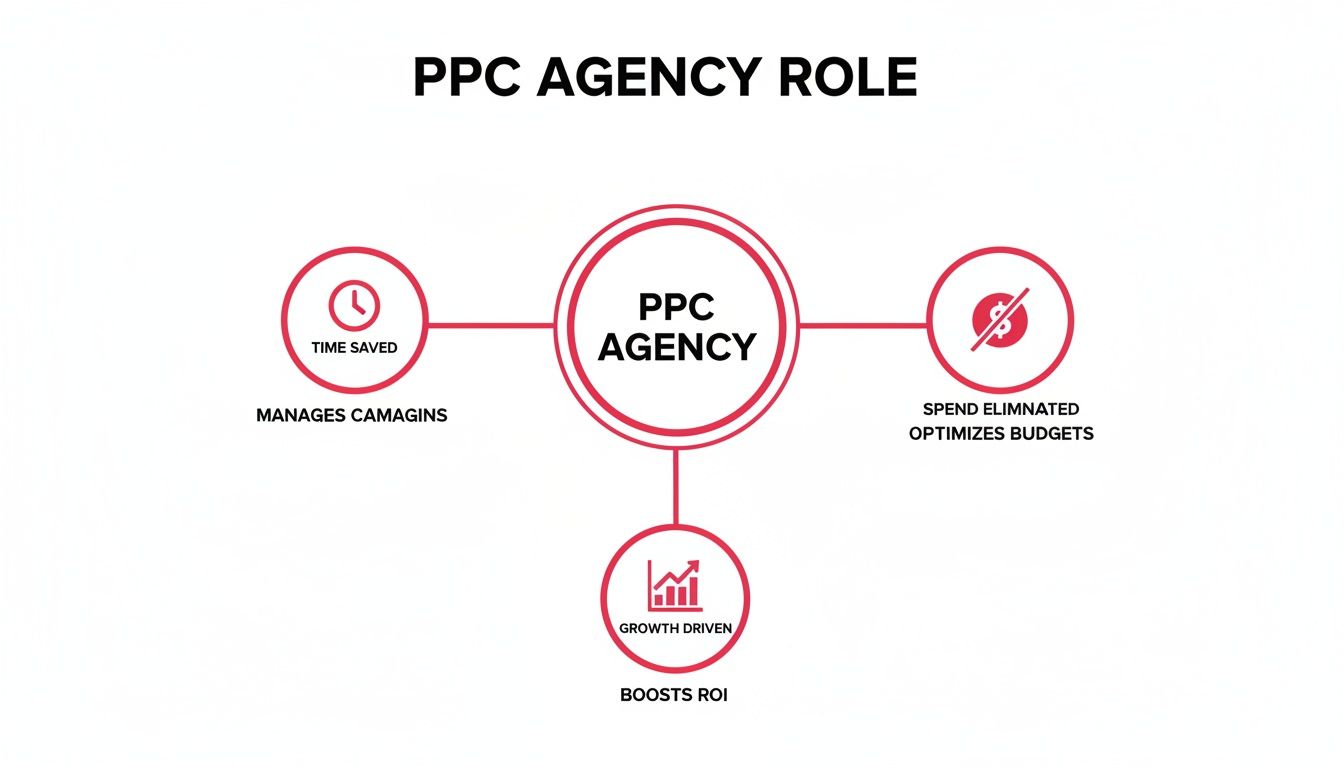
As you can see, their role isn't just about managing campaigns. It's about freeing up your time, making sure every dirham of your budget works harder, and ultimately, delivering real, measurable growth for your business.
H3: Search Ads: Capturing Active Demand
Search ads are the bread and butter of most PPC strategies. You know them well—they're the text ads that pop up at the top of Google or Bing when you search for something specific, like "best karak chai near me." Their power lies in one simple fact: they capture people with high intent. These users aren't just browsing; they are actively looking for a solution you provide, right now.
A good PPC agency handles the whole nine yards. They dive deep into keyword research to find the most profitable search terms and write compelling ad copy that practically begs to be clicked. They make sure your business shows up in that prime digital real estate, just as a potential customer is pulling out their wallet.
H3: Display Ads: Building Brand Awareness
Now, let's switch gears. Unlike search ads, display ads are the visual banners you see on websites, apps, and across the vast Google Display Network. Think of them as digital billboards. Their main job isn't always to get an immediate click or sale; it’s about building brand recognition and keeping your business at the forefront of your audience's mind.
For example, a new luxury property developer in Dubai could place striking display ads on high-end lifestyle blogs and financial news sites. People might not click to book a viewing that very second, but the constant exposure builds a sense of prestige and familiarity. When they are ready to look at properties, that brand will be the first one they remember. A skilled agency uses sophisticated targeting to get these ads in front of the perfect audience based on their demographics, interests, and online habits.
H3: Social Media Ads: Targeting Niche Audiences
Platforms like Meta (which owns Facebook and Instagram), LinkedIn, and TikTok have changed the game with their incredible targeting options. Social media advertising lets an agency zero in on users with laser precision, reaching them based on demographics, job titles, hobbies, major life events, and so much more.
Imagine a UAE-based startup that sells organic baby clothes. They could run a Meta Ads campaign targeting new parents living in specific Dubai neighbourhoods who've also shown an interest in sustainable products. The ads, featuring cute videos or happy customers, can drive sales directly while building a dedicated community around the brand.
H3: Shopping Ads: Driving E-commerce Sales
For any online store, Google Shopping ads are non-negotiable. These are the product listings—complete with images and prices—that appear right at the top of the search results when you look for a physical item, like "buy noise-cancelling headphones in UAE." They create a seamless, visual shortcut from search to purchase.
A local online fashion boutique in the UAE could use Shopping ads to showcase its new collection directly to people searching for similar styles. One click takes the user straight to the product page, slashing the number of steps it takes to make a sale. A great PPC agency will meticulously manage your product feed, optimise every listing, and fine-tune bidding strategies to squeeze the highest possible Return on Ad Spend (ROAS) out of your budget.
To make sense of it all, it helps to see how each ad type aligns with a specific business objective.
PPC Ad Types and Their Primary Business Goals
| Ad Type | Primary Platform(s) | Best For… | Example Use Case in the UAE |
|---|---|---|---|
| Search Ads | Google, Bing | Capturing immediate, high-intent demand and lead generation. | A plumber in Sharjah bidding on "emergency plumbing services" to get immediate calls from homeowners in need. |
| Display Ads | Google Display Network | Building brand awareness, remarketing to past visitors, reaching broad audiences. | A new restaurant in Abu Dhabi showing visual ads on food blogs and local news sites to build name recognition. |
| Shopping Ads | Google, Bing | Driving direct e-commerce sales for physical products. | An online electronics store in Dubai showcasing its latest smartphones with prices directly in search results. |
| Social Media Ads | Meta, LinkedIn, TikTok | Precise audience targeting, community building, brand engagement, lead gen, and sales. | A financial advisor targeting high-net-worth individuals in the DIFC with sponsored content on LinkedIn. |
| Video Ads | YouTube, Meta | Storytelling, product demonstrations, and building an emotional connection with an audience. | A travel agency promoting a "Discover Oman" package with a captivating video ad on YouTube targeting UAE residents. |
Ultimately, a successful strategy rarely relies on just one of these. The real magic happens when an agency skillfully blends them together, creating a comprehensive plan that meets customers wherever they are in their buying journey.
How PPC Agency Pricing Models Actually Work
Figuring out how a PPC agency charges can feel a bit like decoding a secret language. But once you understand the core models, you can set a realistic budget and find a partner whose goals genuinely line up with yours. Most agency fees fall into one of three buckets.
The right choice really depends on your business's size, your goals, and how much risk you're comfortable with. It's a bit like hiring a personal trainer: do you pay them a percentage of your prize money, a flat fee for their time each month, or a bonus every time you smash a personal record? Let's break down what these look like in the paid ads world.
Percentage of Ad Spend
This is probably the most common model you'll come across, especially for businesses that are already spending a decent amount on ads. The agency simply takes a slice of your monthly ad spend as their management fee. This cut is usually somewhere between 10% and 20%.
So, if you spend AED 50,000 a month on Google Ads and the agency’s fee is 15%, you'll pay them an extra AED 7,500 for their work. This structure is popular because it ties the agency's revenue directly to your growth. When you're successful enough to spend more, they earn more. Simple as that. It gives them a real incentive to scale your campaigns.
- The upside: It’s straightforward, easy to budget for, and connects the agency's success to your campaign growth.
- The catch: There can be a temptation for an agency to push for a higher spend, even if it doesn't improve your efficiency or Return on Ad Spend (ROAS).
This model is a great fit for established businesses with a product that's already selling well and a solid grasp of what they get back on their ad investment.
Flat Monthly Retainer
This one is as simple as it sounds. You pay a fixed, predictable fee every single month, no matter what happens with your ad spend or performance. The price is set based on the amount of work involved—how complex your campaigns are and how big your account is.
The biggest win here is predictability. For a startup or a small business watching every dirham, knowing exactly what your agency bill will be is a huge relief. It makes financial planning a whole lot easier. That fee covers the team's time, their expertise, and all the resources they put into managing your ads.
A flat retainer is all about stability. It’s the perfect choice when you need consistent, expert management to build your foundation without any surprise costs.
If you’re just starting out or have a smaller, steady ad budget, this model offers expert help without the fluctuating costs.
Performance-Based Pricing
Welcome to the high-risk, high-reward option. With a performance-based model, the agency only gets paid when they deliver specific, pre-agreed results. This could be a fixed price for every lead they generate, a percentage of every sale they drive, or hitting another important goal (what we call a Key Performance Indicator, or KPI).
For example, an e-commerce brand might agree to give its agency 5% of all revenue that comes directly from their PPC ads. This is the ultimate alignment of interests—the agency only makes good money when you do. But, it absolutely depends on rock-solid tracking and a crystal-clear agreement on what counts as a "win."
This approach works best for businesses with a very straightforward and measurable sales process, like online stores or companies focused purely on lead generation. It requires a massive amount of trust and totally transparent data sharing to work.
Measuring the Metrics That Truly Matter for PPC Success
Running a PPC campaign without tracking the right numbers is like trying to navigate a ship in a storm without a compass. Sure, you're moving, but are you heading towards your destination or just drifting further out to sea? A professional PPC ads agency knows to look past the surface-level vanity metrics, like raw clicks and impressions. Instead, they focus on the Key Performance Indicators (KPIs) that tell you the real story of your campaign's health and, most importantly, its profitability.
These aren't just numbers for a spreadsheet; they're the vital signs of your advertising efforts. They show you what's working, what's falling flat, and where your biggest growth opportunities are hiding. Getting a handle on these KPIs is the first step in turning your ad budget from a simple expense into a predictable, powerful investment that actually fuels your business.
Click-Through Rate (CTR)
Let's start with a foundational metric: Click-Through Rate (CTR). Put simply, this is the percentage of people who saw your ad and were interested enough to actually click on it. The formula is straightforward: (Total Clicks ÷ Total Impressions) x 100.
A strong CTR is a fantastic sign. It tells you that your ad copy, visuals, and targeting are all hitting the mark with your audience. For platforms like Google Ads, a high CTR signals relevance, which can improve your Quality Score and ultimately lower your advertising costs. While global benchmarks suggest an average CTR for search ads is around 1.91% and for display ads is about 0.35%, a good agency never settles for average. Their goal is always to beat these numbers by constantly testing and refining every element of your campaigns.
Cost Per Acquisition (CPA)
Getting clicks is one thing, but what happens next is what really counts. This is where Cost Per Acquisition (CPA)—also known as Cost Per Conversion—comes in. This metric calculates the average cost to land one paying customer or generate one qualified lead from your campaign. To figure it out, you divide your total campaign spend by the number of conversions.
CPA is your campaign’s reality check. You could have an amazing CTR, but if your CPA is higher than the profit you make from a new customer, you're essentially paying to lose money.
A low CPA is the hallmark of an efficient, profitable campaign. It proves your agency isn't just driving traffic; they are driving tangible business results that directly impact your bottom line.
By keeping a close eye on CPA, an agency can make smart, data-backed decisions, like shifting budget away from underperforming keywords and doubling down on the ones that deliver a better return.
Return on Ad Spend (ROAS)
Now for the metric every business owner wants to know: Return on Ad Spend (ROAS). It answers the most critical question of all: "For every dirham I put into advertising, how many dirhams am I getting back?" The calculation is simple: (Total Revenue from Ads ÷ Total Ad Spend).
For example, if you spend AED 1,000 on a campaign and it generates AED 5,000 in sales, your ROAS is 5x (or 500%). This KPI gives you a crystal-clear view of your advertising's profitability and financial impact. A healthy ROAS doesn't just justify your marketing spend; it gives you the confidence to scale up your budget and grow. For a closer look at tracking these kinds of results, you can learn more about how to use Google Analytics to your advantage.
Ultimately, a top-tier PPC agency doesn't just use these KPIs to fill out a monthly report. They are active tools in a constant feedback loop of testing, measuring, analysing, and optimising. This data-driven cycle ensures your campaigns are always improving, adapting to market shifts, and delivering the maximum possible value for your business.
How to Choose the Right PPC Agency for Your Business
Picking the right PPC agency is one of the most critical marketing decisions you'll make. It’s not about just hiring another vendor; you’re bringing on a partner who will manage a serious chunk of your marketing budget and, ultimately, help drive your growth. A great agency feels like an extension of your own team. The wrong one? It can burn through your budget and leave you with nothing but missed opportunities.
The whole process needs to be deliberate and thoughtful. You have to look past the slick sales pitches and big-name client logos. The real work is digging into their actual processes, gauging their expertise—especially in a unique market like the UAE—and making sure their communication style clicks with yours. This framework will help you find a genuine partner who’s as invested in your success as you are.
Evaluating Potential Agencies
Before you even start writing a brief, you need a solid checklist to vet potential partners. Any reputable PPC ads agency will be an open book about their experience, who's on their team, and how they actually get results for clients like you.
Here are the essentials to zero in on during your evaluation:
- Relevant Experience and Case Studies: Don't get star-struck by flashy client names. Ask for case studies from businesses that are similar to yours—in size, industry, and what you’re trying to achieve. Proof of success in the competitive UAE market is a huge bonus, as it shows they get the nuances of local consumer behaviour.
- Team Expertise and Structure: Find out who will actually be working on your account every day. You want to make sure your campaigns are guided by seasoned strategists, not passed off to a junior account manager. Ask about their certifications (like Google Ads or Meta) and how they keep their skills sharp.
- Communication and Reporting: This is non-negotiable. You need clarity. Ask how often they report, what the reports actually show, and who your go-to person will be. A great partner gives you more than just data; they deliver insights and clear, actionable recommendations you can actually use.
- Tools and Technology: You don’t need to be an expert on their entire tech stack, but it’s smart to ask what tools they use for research, campaign management, and reporting. It shows they're committed to working efficiently and staying on top of industry standards.
Creating an Effective Agency Brief
Once you've got a shortlist, the next step is to give them a detailed brief. A well-written brief is the bedrock of a great partnership. It gets every agency on the same page, bidding on the same clear objectives, which makes it much easier for you to compare their proposals apples-to-apples. Think of it as the blueprint for your campaign.
A powerful brief should always include:
- Clear Business Goals: Get more specific than just "we want more traffic." What does success actually look like? Are you targeting a certain number of leads each month, a specific Cost Per Acquisition (CPA), or a desired Return on Ad Spend (ROAS)?
- Target Audience Profile: Paint a picture of your ideal customer. Include demographics (age, location in the UAE), psychographics (their interests, what keeps them up at night), and their online habits. The more detail you give, the better an agency can nail its targeting strategy.
- Realistic Budget: Be straight up about what you can spend, including both the ad budget and their management fees. This lets an agency craft a realistic strategy that can hit your goals without making empty promises.
- Competitor Landscape: Name your main competitors. This gives the agency crucial context about the market you're fighting in and helps them shape a smarter competitive strategy.
Insightful Questions to Ask Your Shortlist
Now for the final stage: the interview. This is where you find out if the chemistry is right and get to poke around their strategic thinking. The right questions can quickly show you whether an agency is a true partner or just a campaign executioner. As a leading PPC advertising firm, we know that total transparency at this stage is what makes or breaks a future relationship.
To help you get past the surface-level answers, we've put together a list of essential questions. These are designed to reveal an agency's problem-solving skills, honesty, and genuine interest in your business.
Essential Questions to Ask a Potential PPC Ads Agency
| Category | Question to Ask | What a Good Answer Looks Like |
|---|---|---|
| Strategy & Onboarding | "Based on our brief, what’s the single biggest opportunity you see for us?" | A specific, data-informed idea, not a generic "we'll increase your ROAS." They should connect a market insight to a tangible action. |
| Strategy & Onboarding | "How would you structure our account and campaigns in the first 90 days?" | A clear, phased plan. It should mention audits, research, campaign builds, and an initial optimisation period with clear milestones. |
| Problem-Solving | "Tell me about a campaign that didn't work out. What went wrong, and what did you learn?" | Honesty is key. A great answer shows they take ownership, analyse failures to find lessons, and have a process for course-correcting. |
| Expertise & Proactivity | "How do you stay on top of all the changes on platforms like Google and Meta?" | They should mention specific sources (blogs, industry leaders, platform updates) and talk about a culture of continuous learning and testing. |
| Client Relationship | "Who will be my main point of contact, and how much experience do they have?" | You want a dedicated contact with proven experience. Avoid vague answers about "the team" handling your account. |
| Reporting & KPIs | "What metrics will you focus on to measure success for our specific goals?" | Their answer should go beyond vanity metrics like clicks and impressions. They should focus on business outcomes like CPA, ROAS, or Lead Value. |
Asking these questions will tell you far more than any polished presentation ever could.
You're not just looking for a technically proficient agency; you're looking for a partner. The best answers will be filled with honesty, sharp strategic thinking, and a real, demonstrated interest in solving your business's unique challenges.
PPC Strategies That Actually Work in the UAE
Running paid ads in the UAE isn't like anywhere else in the world. A strategy that crushes it in Europe or North America can completely miss the mark here. To get results, you have to understand the local culture, consumer habits, and the unique digital pulse of the region. It's that simple.
A top-tier PPC ads agency with real-world UAE experience gets this. They know this market is overwhelmingly mobile-first and driven by powerful visuals. Campaigns need to be designed for small screens right from the start, using eye-catching imagery and sharp, concise copy.
And it's about more than just translating your ads. True localisation means crafting messages in both Arabic and English that resonate with local traditions and social norms. This is what separates an ad that connects from one that gets scrolled past in a heartbeat.
Building Campaigns for a Mobile-Obsessed Audience
The statistics don't lie. We're talking about a hyper-connected audience that lives on their smartphones. Consider this: the programmatic ad market in the Middle East and Africa is expected to hit a staggering USD 30.10 billion by 2030.
This growth is being fuelled by consumers in the GCC, where an incredible 70% of UAE shoppers use AI assistants and spend, on average, 3.5 hours every single day on social media. For any PPC agency worth its salt, this data is a flashing neon sign: the battle for customer attention is won and lost on mobile.
So, what does this mean for your strategy?
- Vertical Video Rules Everything: On platforms like Instagram and TikTok, your ads must be vertical. They need to fill the entire screen and grab attention instantly.
- Landing Pages Must Be Lightning-Fast: Mobile users have zero patience for slow-loading pages. If your site takes more than a couple of seconds to appear, you've lost them.
- Visuals Have to Stop the Scroll: In a crowded, fast-moving feed, your creative has to pop. High-quality, vibrant visuals aren't just nice to have; they're essential for survival.
Strategies for Different Business Types
A good agency won't give you a cookie-cutter plan. They'll dig into your business model and build a strategy that fits your specific goals. After all, a B2B firm needs something completely different from a new e-commerce store.
For Startups
Your main goal is probably building awareness and getting those first crucial leads, all without burning through your budget. The smart play is to focus on tightly targeted social media ads and hyper-local search campaigns. This helps you gain early traction without wasting money on an audience that's too broad.
For E-commerce Businesses
It’s all about direct sales and a solid Return on Ad Spend (ROAS). This calls for a sophisticated blend of Google Shopping ads to show off your products, dynamic remarketing to win back shoppers who abandoned their carts, and beautiful social media campaigns designed to trigger impulse buys.
For B2B Companies
Here, it's about quality over quantity. You need high-value leads, not just a ton of clicks. That means LinkedIn Ads are your best friend for targeting specific job titles, industries, and company sizes. Your search ads should also target long, specific keywords that professionals use when they're actively researching a solution.
In the UAE, genuine connection is everything. A great agency knows how to speak to a diverse audience of locals and expats, blending modern marketing with a deep respect for the culture. This is the secret to building trust and getting results that matter.
By tailoring every strategy to the unique character of the UAE, a PPC agency can deliver campaigns that don't just perform—they build a real, lasting presence for your brand. To get a feel for how these ideas look in action, check out our guide to effective PPC in Dubai.
Your PPC Agency Questions, Answered
Stepping into the world of paid advertising can feel like learning a new language. If you're thinking about bringing a PPC ads agency on board, you probably have a lot of questions. Let's tackle some of the most common ones to give you the clarity you need to move forward with confidence.
How Long Until I See Real Results From PPC?
You'll see something happening almost instantly—impressions, clicks, and traffic will start rolling in. But the results that actually move the needle, like qualified leads and sales, take a bit more time. You should realistically expect to see a meaningful impact within three to six months.
This initial phase isn't just a waiting game. It's a critical period where your agency is gathering data, running tests, and figuring out what truly resonates with your audience. Any agency promising instant riches is selling a fantasy; a true partner focuses on building a strategy for sustainable, long-term growth.
What's the Minimum Budget I Need to Work With an Agency?
There's no single magic number here. The right budget really depends on how competitive your industry is, what you're trying to achieve, and the agency's fee structure. What's crucial is having a budget that can comfortably cover both the agency's management fee and the actual ad spend.
Most good agencies will have a recommended minimum ad spend. This isn't an arbitrary figure—it's the amount they need to collect enough data to make smart, statistically-backed decisions to improve your campaigns. The best approach is to have a frank conversation about your budget and goals from the get-go.
"PPC and SEO are not competitors; they are partners. PPC offers immediate, targeted visibility, while SEO builds long-term, organic trust and authority. Using them together creates a powerful, resilient online presence that dominates search results from every angle."
If I'm Doing PPC, Do I Still Need to Bother With SEO?
Yes, you absolutely do. It's a classic mistake to view PPC and SEO as an either/or decision. Think of them as two different, but complementary, tools in your marketing toolbox. They work best when they work together.
PPC gives you that instant visibility and allows you to laser-target specific audiences right away. At the same time, a strong SEO strategy is busy in the background, building your website's organic authority and credibility for the long haul. A truly powerful digital strategy uses both to make sure you're visible to customers at every single stage of their journey.
At Grassroots Creative Agency, we know that great paid advertising is about more than just managing bids—it's about having a strategic partner who's fully invested in your growth. To take your campaigns to the next level, you can even integrate powerful creative tools like Posterly to make designing high-impact ad visuals a breeze.