Think of a specialist PPC ad agency as more than just a media buyer. They’re a strategic partner, a team whose entire focus is to turn your ad spend into real, measurable business growth. In a crowded marketplace, their know-how in data analysis, creative optimisation, and multi-platform management is what turns simple clicks into loyal customers and delivers a strong return on your investment.
Why Partnering with a Specialist PPC Agency Is Crucial
In a fast-moving market like the UAE, just running ads on Google or Meta isn't going to cut it any more. The old days of just bidding on keywords are long gone. Today's ad platforms have incredibly sophisticated algorithms that do most of the technical heavy lifting, so winning isn't just about who can manage bids the best.
The real competitive edge now comes from human expertise—the strategy, the creativity, and the deep understanding of what happens after the click. Choosing to work with a specialist PPC ad agency is a direct investment in that expertise. It's about bringing on a team that gets the subtle complexities of advertising across multiple platforms.
The Power of Data-Driven Creativity
Any seasoned pro will tell you that the ad creative itself is responsible for the lion's share of a campaign's success. You can nail your targeting, but if the ad is bland, no one will notice.
A skilled agency brings a methodical approach to creativity. They will:
- Run structured creative tests to find out what actually connects with your audience.
- Dig into performance data to figure out why certain headlines, images, or calls to action are hitting the mark.
- Build out cohesive creative assets that keep your brand looking sharp and consistent everywhere.
This is where having the right tools makes a huge difference. For example, creating a full suite of visually aligned ad assets with a tool like Poster.ly—which comes directly from our team at Grassroots Creative Agency—ensures your paid campaigns look professional and unified, grabbing attention and driving real engagement from the first glance.
A great ad can’t save a weak landing page. The most successful campaigns are those where the user journey is seamless from the initial click to the final conversion, requiring optimisation at every step.
Beyond Clicks to Conversions
A top-tier agency doesn't just chase traffic; they chase profitable actions. They know that a high click-through rate is useless if those visitors leave without converting.
This is where their role expands into conversion rate optimisation (CRO). They analyse and fine-tune your landing pages to make every single click more valuable. This approach shifts the conversation away from vanity metrics and toward what really matters to your business: Return on Ad Spend (ROAS) and Cost Per Acquisition (CPA).
By partnering with a dedicated digital marketing company, you get a team that's obsessed with your bottom line, not just your click count. That strategic alignment is what turns a simple advertising budget into a powerful engine for growth.
So, What Does a Modern PPC Agency Actually Do?
If you think a PPC agency just manages bids on Google Ads, you’re about a decade behind. That model is dead. These days, ad platforms have automated so much of the technical bidding that the playing field for just buying media is pretty much level.
The role of a top-tier agency has completely transformed. They aren't just media buyers any more; they're full-funnel growth partners. Their job isn't to buy clicks—it's to deliver profitable outcomes, focusing on everything from the first ad a person sees to the final sale and beyond.
They Obsess Over Creative, Not Just Keywords
In today's super-crowded ad space, the ad creative itself is the single most important piece of the puzzle. You can have the most perfect keyword strategy in the world, but if your ad is boring, nobody's going to click it. A modern agency gets this. They know that creative quality is the new competitive advantage.
This means they're heavily invested in:
- Structured Creative Testing: They aren't just guessing what works. They’re running systematic A/B tests on every part of the ad—the copy, headlines, images, and videos—to find out what truly connects with your audience. Data drives every creative decision.
- Message and Brand Alignment: Every ad needs to feel like it comes from you. It has to nail your brand voice while speaking directly to the specific problems your customers are trying to solve.
- Asset Production: They build out a whole suite of high-quality, visually consistent ads that grab attention, whether it's on a search results page, a social feed, or a display network.
For instance, a specialist team might use a tool like Poster.ly, which is a Grassroots Creative Agency product, to design a whole set of campaign visuals that look and feel cohesive. That kind of professional presence builds trust from the very first impression.
They Master the Post-Click Experience
Getting the click is only half the battle. If that click sends someone to a slow, clunky, or irrelevant landing page, you just threw your ad spend in the bin. Any agency worth its salt knows the real magic happens after the click.
This is why their work extends deep into Conversion Rate Optimisation (CRO). They dig into how users behave on your landing pages to find and fix anything causing friction. It's often the small tweaks—improving page speed, simplifying a form, or rewriting a headline for clarity—that can literally double or triple your conversion rates.
An agency’s value is no longer measured by how low they can get your Cost Per Click (CPC). It’s measured by how high they can get your Return On Ad Spend (ROAS) and how low they can push your Cost Per Acquisition (CPA).
They Think Full-Funnel, Not Just Clicks
A truly great agency never looks at PPC in a vacuum. They see how it fits into your entire marketing ecosystem, understanding how paid campaigns support—and are supported by—channels like SEO and social media. They map out the entire customer journey, from the moment someone first hears about you to when they become a loyal fan.
This means you’ll see them building distinct strategies for each stage of the funnel:
- Top of Funnel: Using display and social ads to introduce your brand to people who aren’t even looking for a solution like yours yet.
- Middle of Funnel: Hitting people who are weighing their options with ads that compare features or offer valuable content.
- Bottom of Funnel: Closing the deal with highly specific, action-driven search ads that target people ready to buy now.
This big-picture approach is absolutely essential in rapidly growing markets. Take the MENA region, where digital advertising is exploding. Projections show that by 2025, digital ads will account for 65.9% of all ad revenue there. That’s a huge shift, and it shows why businesses need a partner who can navigate the entire digital journey to win.
At the end of the day, a modern agency helps you build a sustainable growth engine, not just run a few campaigns. They are strategists, creatives, and data analysts all rolled into one. For anyone looking to break into this dynamic market, a deep understanding of PPC in Dubai is the only way to get ahead.
How to Vet and Shortlist Potential PPC Partners
Picking the right PPC agency can feel overwhelming. You're flooded with options, and everyone claims to be the best. But with the right approach, you can cut through the noise and find a team that’s a genuine partner for your business.
The secret is to look past the slick sales deck. You need to dig into how they work, who they’ve worked with, and what they’ve actually accomplished. A great agency doesn't just promise the world; they show you how they've delivered it for businesses just like yours.
Look for Proof of Performance
Anyone can talk a good game. The best agencies let their results speak for them. Your first move should be to ask for case studies and client testimonials, but don't just accept anything they send over.
Look for examples relevant to your business. If you're a small e-commerce brand, a case study about doubling ROAS for another local online store is infinitely more valuable than a vague success story about a Fortune 500 company. You want proof they can solve your kind of problems.
When you're reviewing their work, keep these points in mind:
- Industry Relevance: Have they played in your sandbox before? An agency that gets the long sales cycle of B2B SaaS will have a completely different playbook from one that specialises in impulse-buy consumer products.
- Challenge and Solution: A good case study isn't just a victory lap. It should clearly lay out the client's initial problem, the strategy the agency developed, and the specific tactics they used to get there. Details matter.
- Measurable Results: Clicks and impressions are vanity metrics. Look for numbers that impact the bottom line: Cost Per Acquisition (CPA), Return On Ad Spend (ROAS), and lead-to-customer conversion rates.
Here's a pro tip: Ask every potential agency this question: "Tell me about a campaign that didn't go as planned and what you did to turn it around." How they answer will tell you more about their problem-solving skills, honesty, and character than any list of successes ever could.
This decision tree can help you visualise if hiring an agency is the right move based on whether you're chasing leads or driving direct sales.
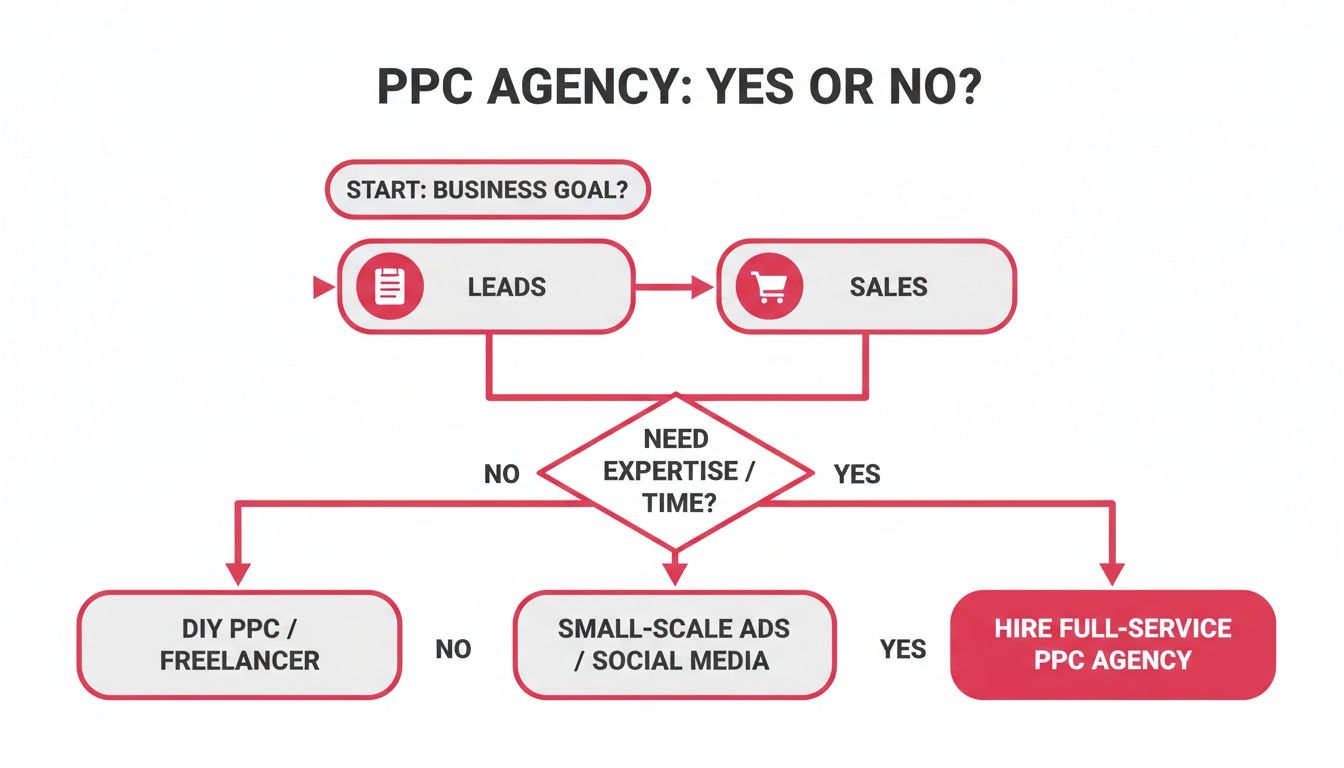
As the flowchart shows, the journey starts by defining your main objective. That single decision will guide the level of expertise and time you'll need to commit to see real success.
Understand Their Pricing Model
Agency pricing isn't one-size-fits-all, and it's critical to find a model that aligns with your budget and goals. There’s no single "best" option; it all depends on your business's scale and what you're trying to achieve.
You'll generally run into three common pricing structures:
- Percentage of Ad Spend: This is a classic model where the agency takes a cut of your monthly ad budget, typically between 10-20%. It’s straightforward, but be aware that it can incentivise agencies to simply spend more, not necessarily smarter.
- Flat Monthly Fee: You pay a fixed retainer every month. This gives you predictable costs, which is great for budgeting, and it works well for businesses with a steady ad spend.
- Performance-Based: Here, the agency's fee is tied directly to results, like the number of leads generated or a slice of the revenue they drive. It sounds perfect in theory, but it usually comes with higher potential costs and requires crystal-clear definitions of success to avoid disputes.
The global pay-per-click advertising market is projected to hit $2,466.3 million by 2025, which shows just how powerful this channel is when managed correctly. With an average Google Ads CPC around $2.69 and a conversion rate of 6.96%, an experienced hand at the wheel can deliver a solid return on your investment.
Having an open conversation about these models is key. You want to find a partner whose financial incentives are directly tied to your growth.
Assess Their Strategic and Creative Capabilities
In today's competitive ad space, just knowing how to navigate the Google Ads platform is the bare minimum. The real magic happens when an agency brings sharp strategic thinking and compelling creative to the table. The best campaigns aren't just built on keywords; they're built on a deep understanding of your customer.
During your conversations, push beyond the technical talk. Ask them about their creative process. How do they come up with ad copy that grabs attention? What's their approach to ad visuals? Do they use specialised tools like Poster.ly to create ads that are both beautiful and effective? This isn't fluff—strong creative can make or break a campaign.
A truly great agency will be just as curious about your business as you are about them. They should be asking you tough questions about your customers, your profit margins, and your five-year plan. That's the sign of a team that wants to be a growth partner, not just another vendor.
Your First 90 Days with a New Agency

So, you’ve signed the contract. This isn't the finish line; it’s the starting gun. Those first 90 days with your new PPC agency are the most critical part of the entire relationship. This is where the foundation gets laid, expectations are managed, and you establish a real, collaborative partnership.
A structured onboarding process is the mark of a top-tier agency. It shows they’re serious about understanding your business from the ground up before they even touch your ad budget. If an agency wants to dive in and launch campaigns in the first week without this deep dive? That’s a massive red flag.
The Kick-off and Discovery Phase
Everything should start with a formal kick-off meeting. This isn't just a "get to know you" chat; it's a structured session to get key people from both sides of the table aligned on goals, communication rhythms, and timelines. The agency should drive this with a clear agenda, prepared to listen far more than they talk.
In this initial phase, expect your agency to get incredibly nosy about your business. They should be asking some tough, specific questions about:
- Your Business Goals: They need to go beyond "we want more leads." They’ll want to know about your revenue targets, profit margins, and what a customer is actually worth over their lifetime (LTV).
- Your Ideal Customer: Who are they, really? What keeps them up at night, and where do they hang out online?
- Your Brand Voice: How do you want to sound? What makes you different from everyone else (your unique selling proposition)?
This deep dive is everything. A great agency knows they aren’t just running ads for a product; they’re solving problems for a specific type of person. Without this context, every campaign is just a shot in the dark.
Technical Setup and Audits
While you’re having these strategic conversations, a technical track needs to be running in parallel. This is where the agency gets under the hood to make sure every click and conversion can be tracked accurately.
This process involves a few critical to-dos:
- Gaining Access: You’ll need to securely grant them access to your ad accounts (like Google Ads or Meta Business Manager), your analytics platforms (Google Analytics), and maybe even your website's backend.
- Tracking Audit: The agency should perform a meticulous audit of all your tracking pixels and conversion tags. They need to ensure everything is installed correctly and firing when it should. Bad tracking is a silent killer for campaigns because it feeds the ad platforms garbage data.
- Account Review: They'll also dig through any past campaign data you have. This isn’t about judging past efforts; it's about finding what worked, uncovering what didn't, and making sure they don't repeat old mistakes.
A partner that skips a detailed technical audit is flying blind. Accurate data is the bedrock of any successful PPC campaign; without it, every decision is a gamble rather than a calculated move.
Getting this technical foundation right is non-negotiable. It means that when the campaigns finally go live, you can trust the data you're seeing to make smart optimisation decisions.
Strategy Development and Initial Campaign Build
Once they have a solid grasp of your business and a technically sound setup, the agency can finally start building your strategy. This is where they translate all that discovery work into an actual plan.
You should expect to see a clear strategy document that outlines their proposed approach. This could cover things like campaign structures, audience targeting, keyword themes, and ad creative concepts. This should feel like a collaboration. It’s your chance to give feedback and make sure their vision aligns with your brand. For example, they might suggest using a tool like Poster.ly to create a batch of high-quality ad visuals that are consistent with your brand from day one.
This 90-day period is all about methodical preparation. The goal isn't to break records overnight. It's to build a scalable, data-driven machine that will fuel sustainable growth for years to come. By the end of this phase, you should feel confident, informed, and completely in sync with your new agency partner, ready for a launch built on true strategic insight.
Measuring Real Success Beyond Vanity Metrics
Here's a hard truth: clicks and impressions don't pay the bills. The real measure of a great PPC campaign is its direct impact on your bottom line. When you bring on a PPC agency, the conversation has to move past these surface-level numbers and get straight to business outcomes.
It's easy to get excited about a high click-through rate (CTR), but if those clicks aren't converting, you're just paying for website traffic. A true agency partner helps you zero in on the key performance indicators (KPIs) that actually matter and tell the real story of your business's growth.
Shifting Focus to Actionable KPIs
Vanity metrics like impressions, clicks, and even Cost Per Click (CPC) can be incredibly misleading on their own. They offer a piece of the puzzle, but they don’t show you if your campaigns are actually profitable. A skilled agency will immediately shift your focus to the metrics that are directly tied to revenue and growth.
Here are the KPIs that should be at the heart of every performance discussion:
- Return on Ad Spend (ROAS): This is the gold standard. For every pound you put into your ads, how many pounds are you getting back in revenue? A strong ROAS is the clearest possible sign that your campaigns are working.
- Cost Per Acquisition (CPA): How much does it cost, on average, to get a new customer or generate a solid lead? Keeping this number low means your campaigns are efficient and effectively turning clicks into valuable actions.
- Lead Quality: Not all leads are created equal. A good agency doesn't just chase a high volume of leads; they help you track their quality. Are these leads turning into sales-qualified opportunities and, ultimately, paying customers?
- Customer Lifetime Value (LTV): This metric provides a long-term view, showing the total revenue a customer generates over their entire relationship with your business. The best agencies build campaigns that attract high-LTV customers, not just one-time buyers.
When you start tracking these actionable KPIs, every decision becomes about boosting profitability, not just generating empty activity. This is where tools like Google Analytics are absolutely essential for tracing the user journey from the first click to the final conversion. If you need to brush up on your analytics skills, our guide to understanding Google Analytics is a great place to start.
It's crucial to distinguish between metrics that make you feel good and metrics that actually drive your business forward. One group looks nice on a report, while the other gives you the insights you need to make smarter decisions.
PPC KPI Comparison: Vanity Metrics vs Actionable Metrics
| Metric Type | Example Metric | Why It's Important (or Isn't) |
|---|---|---|
| Vanity Metric | Clicks/Impressions | Shows visibility and traffic volume but doesn't tell you if the right people are clicking or if they're converting. |
| Actionable Metric | Cost Per Acquisition (CPA) | Directly measures the cost-effectiveness of your campaigns in generating new customers or leads, tying ad spend to results. |
| Vanity Metric | Click-Through Rate (CTR) | Indicates how compelling your ad copy or creative is, but a high CTR with low conversions means you're attracting the wrong audience. |
| Actionable Metric | Return on Ad Spend (ROAS) | The ultimate measure of profitability. It directly answers the question: "Is my advertising making me money?" |
| Vanity Metric | Cost Per Click (CPC) | Useful for managing budgets, but a low CPC is meaningless if those cheap clicks never turn into revenue. |
| Actionable Metric | Customer Lifetime Value (LTV) | Provides insight into long-term profitability and helps you acquire customers who will deliver sustained value over time. |
Focusing on the actionable column is what separates agencies that just manage accounts from partners that grow businesses.
What an Insightful Performance Report Looks Like
Transparent reporting is non-negotiable. You should expect reports that are far more than just a data dump. A quality report tells a story, offering context, sharing key learnings, and outlining a clear path forward.
A great report doesn’t just show you what happened; it explains why it happened and what the agency is going to do about it next. It should clearly highlight which campaigns and ad groups are driving results and which are falling short. Most importantly, it should include a dedicated section on insights and an action plan for the coming weeks.
For instance, an agency might use a creative tool like Poster.ly to A/B test different ad visuals. Their report wouldn't just state which visual performed better; it would offer a hypothesis as to why and detail how that learning will be applied to the next round of creative.
Watch out for reports that only highlight the wins. A true partner is transparent about both successes and failures, using every piece of data as an opportunity to learn, adapt, and drive better performance tomorrow.
Ultimately, measuring success is all about connecting your ad spend to real, tangible business outcomes. A competent agency will give you the data and insights you need to see their value, ensuring your PPC investment becomes a powerful engine for sustainable growth.
Spotting Red Flags and Dodging Common Agency Pitfalls
Finding the right PPC agency can feel a bit like navigating a minefield. You're looking for a true partner, but it's easy to get sidetracked by a slick sales pitch. Knowing what warning signs to look for will save you a world of headaches, wasted ad spend, and frustration down the line.
The biggest red flags often come disguised as the most appealing promises. If an agency guarantees you the #1 spot on Google or a specific Return on Ad Spend (ROAS) before they’ve even looked under the bonnet of your account, you should be very sceptical.
Think about it: PPC is a live auction. Countless factors are at play, from competitor bids to a sudden shift in consumer behaviour. No one can truly guarantee a specific outcome. A good agency talks about data-driven projections and realistic targets, not unbreakable vows.
When Communication and Transparency Break Down
Another massive pitfall is poor communication. If getting a straight answer feels like pulling teeth, or if the agency is cagey about giving you direct access to your own ad accounts, that’s a serious problem. You’re not just another name on a client list; you're a partner, and you deserve to know exactly what’s happening with your money.
Keep an eye out for these communication breakdowns:
- Fluffy, Vague Reporting: Reports that fixate on vanity metrics like clicks and impressions are often a smokescreen. You need to see how PPC is impacting real business goals, like leads and revenue. Anything less is just noise.
- The Bait-and-Switch: You were sold by a senior strategist, but after the ink is dry, you're handed off to a junior account manager who's clearly in over their head. This is a classic agency move.
- Dodging Tough Questions: A great partner is upfront about what’s not working and what they’re doing to fix it. If they get defensive or evasive when you ask about poor performance, they’re likely hiding something.
An agency that isn’t transparent with its data is an agency with something to hide. Full access to your own accounts and clear, honest reporting are non-negotiable fundamentals of a healthy partnership.
Strategic Cobwebs and Outdated Tactics
In the world of paid ads, standing still means falling behind. A rigid, "one-size-fits-all" strategy is a fossil from a bygone era. If an agency seems stuck in its ways or resistant to testing new channels, ad formats, or ideas, they lack the agility your business needs to grow.
Be wary of agencies that get lost in technical jargon without tying it back to your business objectives. Yes, they need to be technically sharp, but their primary focus should be on how those skills drive profit for you.
An agency that only ever talks about CPCs and bid management, without getting into creative testing or landing page optimisation, is just a media buyer. In today's market, that’s not nearly enough to win. To keep your creative sharp and consistent, tools like Poster.ly can be a huge help.
Frequently Asked Questions
Hiring a PPC agency is a big move, and it's smart to have questions. Here are some of the most common ones we get from business owners and marketing managers across the UAE, along with some straight-to-the-point answers.
How Much Should I Budget for a PPC Agency in the UAE?
There are two parts to your total cost: what you pay the agency (their management fee) and what you pay the ad platforms (your ad spend).
In the UAE, agency fees usually fall into two buckets: a flat monthly retainer or a percentage of your ad spend. That percentage typically hovers between 10-20%. Your actual ad spend depends heavily on your industry, competition, and how aggressive you want to be. For a small or medium-sized business just getting started, a budget between AED 5,000 and AED 15,000 per month is a realistic place to begin.
A good agency won't just pluck a number out of thin air; they'll work with you to land on a budget that makes sense for your specific revenue goals.
How Long Until We See Results from PPC Campaigns?
You'll see traffic coming in almost as soon as the campaigns go live, but that's just the start. Real, meaningful results take a bit of time to dial in.
Think of the first 30 days as the "data gathering" phase. This is when the agency learns what's working, what's not, and starts testing different approaches with your audience.
By the end of the first 90 days, you should have a solid understanding of performance. You'll be able to see clear trends in important metrics like your Cost Per Acquisition (CPA) and Return On Ad Spend (ROAS). The key is to remember that PPC is a marathon, not a sprint; success comes from consistent, ongoing optimisation.
Is SEO Still Necessary If We Are Running PPC Ads?
Yes, 100%. One of the biggest mistakes we see is treating PPC and SEO as an either/or decision. They're actually two sides of the same coin and are most powerful when they work together. PPC gives you that instant visibility and a firehose of keyword data, while SEO builds your brand's long-term organic credibility and trust.
Here's the real magic: the data you get from your PPC campaigns—like which keywords convert best or what ad copy gets the most clicks—is pure gold for your SEO strategy. It tells you exactly what to focus on. A solid organic presence can even boost your ad Quality Score, which can lead to lower ad costs down the line.
At Grassroots Creative Agency, we know that a winning paid advertising strategy is about more than just managing bids. It's about blending sharp, data-driven insights with creative that actually connects with people to deliver real business growth. Whether it's designing eye-catching ads with tools like our product, Poster.ly, or mapping out a complete full-funnel strategy, we're here to be your partner in growth.