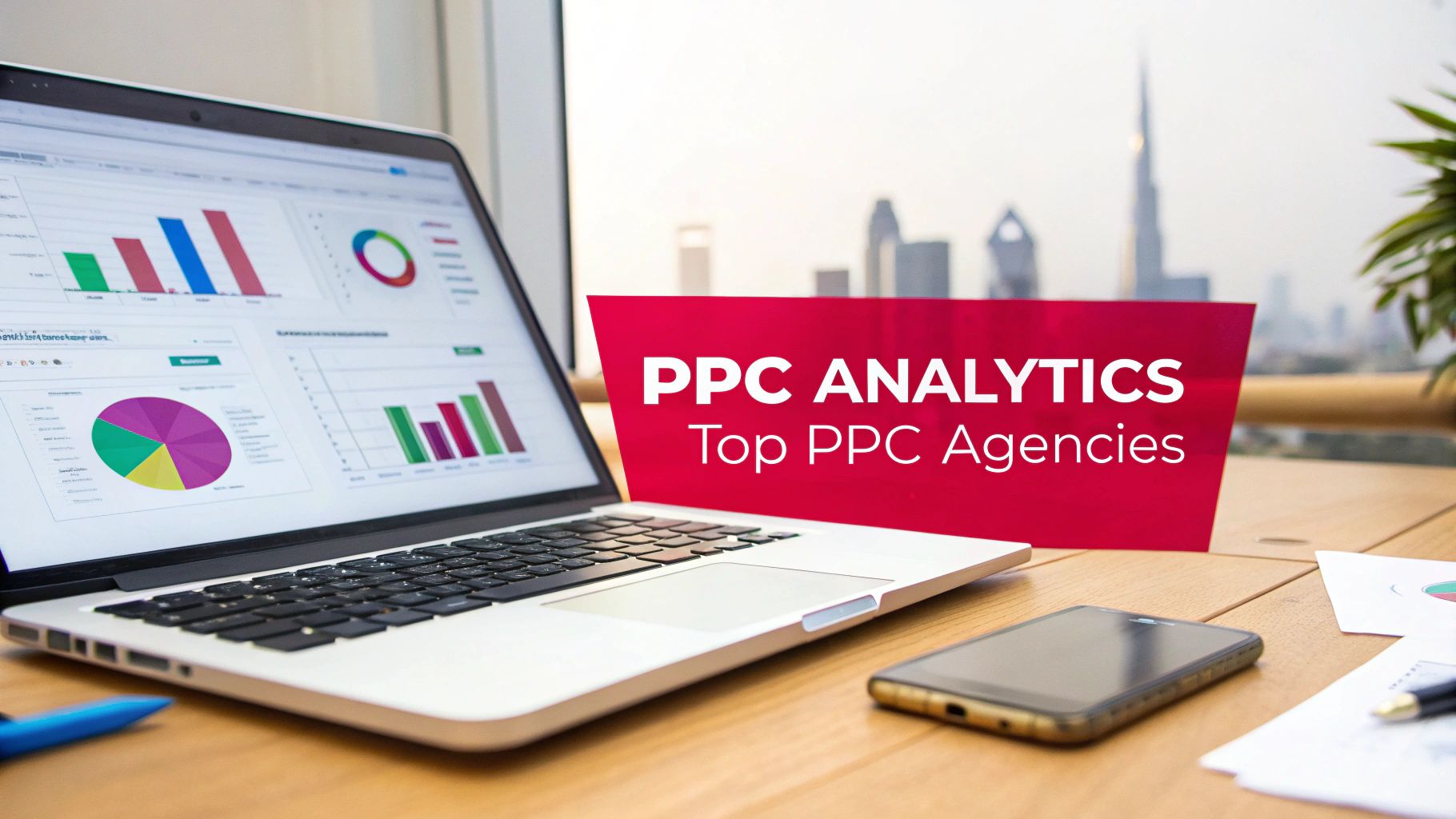
Picking the right pay-per-click company from the sea of options out there feels like a massive decision, and honestly, it is. The right agency becomes a genuine extension of your marketing team, turning your ad budget into real, measurable growth. The wrong one? They can burn through your cash with little to show for it. A top-notch partner offers so much more than just setting up a campaign; they bring strategy, deep market knowledge, and a creative spark to the table. Our in-house product, Poster.ly, for example, allows us to streamline creative production, giving our clients a distinct visual advantage from day one.
Why Your Choice of PPC Partner Is So Critical for Growth

In a fast-paced market like the UAE, choosing a PPC company is about finding a true partner, not just a vendor. Think of it as a strategic alliance. This agency will be responsible for a hefty chunk of your marketing spend, and their job is to turn that investment into tangible results like leads, sales, and a stronger brand presence.
A great PPC partner has that perfect mix of technical know-how and creative thinking. They don't just mindlessly bid on keywords. They build a complete strategy from the ground up, one that’s designed to hit your specific business goals. Doing this right means they need to really get your brand, your customers, and the little details of the local market.
Core Skills of a Top-Tier PPC Agency
So, how do you separate the average from the exceptional? Look for real expertise in these key areas:
- Meticulous Campaign Strategy: They need to lay out a clear, sensible plan that directly connects your business objectives to specific campaign tactics, from which platforms to use to how they'll target your audience.
- Data-Driven Decision Making: The best agencies are obsessed with analytics. They're constantly digging into the numbers, spotting trends, and using that data to tweak every part of your campaigns to squeeze out a better return.
- Creative Ad Development: In today's crowded digital world, a boring ad is an invisible ad. The ability to create ads that stop the scroll and actually connect with your audience is absolutely essential.
The real magic of a great PPC agency is their ability to blend analytical rigour with creative flair. Data shows you what’s working, but it’s the creativity that makes people pay attention. That combination is what fuels sustainable growth.
For example, at Grassroots Creative Agency, we know that killer campaigns need both a smart strategy and amazing visuals. That's why we use specialised tools like Poster.ly to create and launch a high volume of on-brand ad creative quickly and efficiently. This means your campaigns aren't just smartly targeted from day one—they're also visually striking, giving you an instant advantage. Grasping why choosing the right creative partner makes all the difference is the first real step towards building a winning advertising strategy.
Setting Your Campaign Goals and Budget for Success
Before you even start Googling "pay per click companies," you need to get your own house in order. Seriously. Walking into a meeting with an agency without a clear plan is like starting a road trip with no destination in mind—you’ll burn through fuel but probably won't end up anywhere you want to be.
The first step is to get specific. Forget vague wishes like "more traffic." You need to define what a real win looks like for your business. Doing this homework first puts you in the driver's seat. When you know exactly what you want to achieve, you can properly judge whether an agency has the right stuff to get you there. It changes the entire dynamic from a sales pitch to a strategic partnership.
Defining Your Objectives with SMART Goals
The best way I’ve found to do this is by setting SMART goals. It’s a classic for a reason. This simple framework (Specific, Measurable, Achievable, Relevant, and Time-bound) forces you to pin down your ambitions and make them real, accountable targets instead of just fuzzy ideas.
Let’s see what this looks like in practice for common PPC goals:
- For a service business needing leads: Don't just say "get more leads." A proper SMART goal sounds like this: "Generate 50 qualified sales leads through our Google Ads contact form within the next 90 days, with a target cost-per-lead under AED 200." See the difference?
- For an e-commerce store: "Increase online sales" isn't a goal; it's a hope. A SMART goal is: "Achieve a Return on Ad Spend (ROAS) of 4:1 on our Meta Ads shopping campaign over the next fiscal quarter, targeting a 20% increase in total revenue from new customers."
- For launching a brand: Instead of "build brand awareness," try this: "Increase branded search query volume by 30% and achieve 500,000 ad impressions among our target demographic in Dubai Marina and Downtown Dubai within six months."
Establishing a Realistic Campaign Budget
Once your goals are crystal clear, it’s time to talk money. Your budget is the fuel for your PPC engine; it determines how fast and how far you can go. You have to be realistic here.
A classic mistake I see all the time is businesses setting a budget that’s too small to even collect meaningful data. PPC campaigns need a bit of runway for testing and learning. If you choke the budget, the agency can't get enough clicks or conversions to figure out what works. The result? Poor performance and wasted cash.
To set a smart budget, you need a handle on two critical numbers.
Customer Lifetime Value (CLV): How much profit do you make from an average customer over their entire relationship with you? Knowing this tells you exactly how much you can afford to spend to get a new one.
Cost Per Acquisition (CPA): This is your all-in cost to land one new paying customer from a specific campaign. For your ads to be profitable, your target CPA has to be comfortably below your CLV.
If you’re in e-commerce here in the Middle East, you’re in a great spot right now. We're seeing fantastic performance on Amazon PPC campaigns in the UAE and KSA. Average Advertising Cost of Sale (ACoS) is often between 15-20%, and Return on Ad Spend (ROAS) can hit 5x. Why? The competition in the ad auction is lower and consumer demand is high, which means cost-per-click can be 40-60% cheaper than in more saturated markets.
Setting that first budget is a balancing act. For a more detailed breakdown of the financial side, check out our guide on creating a marketing budget for your small business. Nailing down your goals and budget will make those first conversations with potential PPC partners infinitely more productive.
How to Properly Vet Potential PPC Agencies
You’ve done your homework and have a shortlist of pay-per-click companies. Now comes the hard part: separating the real experts from the slick presenters. This is where your preparation truly pays off, as you move past the glossy brochures and sales pitches to dig into what actually matters for your business.
Anyone can put together a polished presentation. What’s much harder is delivering consistent, profitable results. Your vetting process needs to be a systematic look at their track record, their strategic brainpower, and their commitment to being transparent. This is how you find a partner who will guard your ad spend as if it were their own.
Look Beyond the Polished Case Studies
Every agency will show you their greatest hits. Your job is to look behind the curtain and see if their success is even relevant to you. A fantastic result for a huge corporation with a seven-figure budget means very little if you’re a startup trying to make a more modest ad spend work. When you're looking at case studies, you need to ask some pointed questions to get the full story.
Here’s what I always ask about:
- Industry Relevance: Have you actually worked in our sector before? Driving leads for a B2B software company is a world away from selling fashion in B2C e-commerce.
- Budget Alignment: What was the ad spend behind these impressive results? It's crucial they can show you strong performance for clients with budgets similar to yours.
- The Problem & The Fix: What specific challenge was the client up against? I care less about the final numbers and more about the strategic thinking they used to solve the problem.
- Campaign Duration: How long did it take to get there? This grounds your expectations in reality and sets a reasonable timeline.
The point isn't to find a carbon copy of your business in their portfolio. What you're really looking for is solid proof of adaptable, strategic thinking that they can apply to your unique situation.
A good campaign always starts with a solid plan. The best agencies follow a foundational process, even if the tactics change.
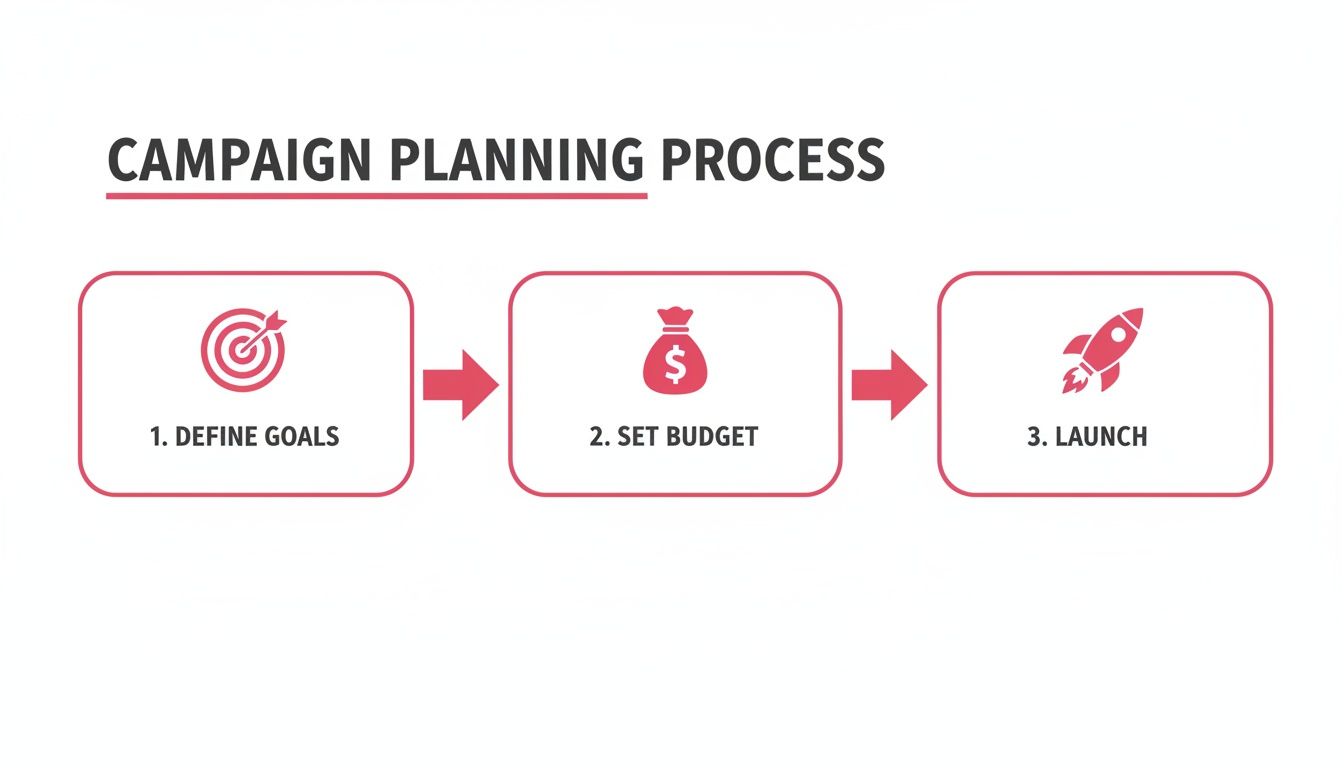
This just hammers home the point: defining your goals and budget are the absolute must-dos before a single dirham is spent. It ensures every action has a purpose.
Crucial Questions for Consultation Calls
Your first calls with potential agencies are your best chance to really interview them. Don’t just let them run through their script. Come prepared with a list of questions that get to the heart of how they operate, who’s on their team, and how they report back to you. This is far more revealing than any sales deck.
Treat it like a strategy session, not a sales pitch. You're trying to gauge their ability to think critically about your brand. If you're based in the region, you can also use this time to learn more about finding the right PPC agency in Dubai that understands the local market.
Here’s a checklist of questions I always have ready:
- Strategic Process: "Walk me through your exact process for building a new campaign strategy for a business like ours, covering both Google and Meta Ads."
- Team Structure: "Who, specifically, would be working on our account? Tell me about their experience level, and will we have a direct line to them?"
- Performance Reporting: "Which KPIs do you focus on, and why? Can you screen-share an example of a real (anonymised) monthly report you send to clients?"
- Optimisation Cadence: "How often are you in the account making adjustments? What does that optimisation process actually look like day-to-day?"
- Creative Development: "How is ad creative handled? Is it done in-house? What tools do you use for creative testing and management?" For visually-driven brands, a platform like Poster.ly can be a huge asset for creating ads at scale, so it’s smart to ask if they use similar tech.
Their answers—or lack thereof—will tell you everything you need to know about their expertise and how they treat their clients.
A great agency won't just tell you what you want to hear. They will ask you tough questions, challenge your assumptions, and focus the conversation on business outcomes, not just vanity metrics like clicks and impressions.
Verifying Testimonials and Ensuring Transparency
Finally, do your due diligence and verify their claims. A few nice quotes on their website are a start, but don’t stop there. Ask if you can speak directly with one or two of their current clients—ideally, a non-competing business in a similar field. An agency with happy, successful clients won't hesitate.
Transparency is the foundation of any good partnership. This covers everything from their pricing and access to your ad accounts to how they deliver bad news. An agency that is open and honest, even when a campaign stumbles out of the gate, is one you can build a long-term relationship with. Trust the evidence, not the promise.
The Technology Powering Modern PPC Campaigns
Behind every successful PPC campaign these days, there's a serious bit of tech doing the heavy lifting. The best PPC agencies aren’t just manually tweaking bids anymore; they’re blending sharp human strategy with sophisticated software to get those top-tier results.
If you’re evaluating an agency, you absolutely need to pull back the curtain on their tech stack. This combination of human insight and machine efficiency is what separates the great agencies from the good. It's how they make smarter decisions faster, whether that’s optimising bids in the blink of an eye or testing hundreds of ad creatives at once.
Programmatic Advertising and RTB: The Engine Room
Much of the display and video advertising you see today runs on programmatic advertising. Think of it as the automated buying and selling of ad space. Instead of weeks of back-and-forth negotiations, software buys ad impressions in milliseconds, zeroing in on specific users based on their data.
A key part of this is Real-Time Bidding (RTB), which is basically a lightning-fast auction. The moment you land on a website, an auction for the ad space on that page kicks off. The whole process—bidding, winning, and displaying the ad—happens in the time it takes the page to load.
This isn't just a niche technology; it's a dominant force, especially here in the MENA region. Programmatic is booming, with RTB grabbing a massive 44.30% share of a market valued at over $20 billion. This explosion is being fed by the digital-first economies in the UAE and KSA, fuelling a huge surge in online shopping. To really get a handle on it, it's worth digging into the Middle East's programmatic advertising market trends.
The Unskippable Need for Solid Analytics and Tracking
You can't improve what you don't measure. It’s a cliché because it’s true. This is why a top-notch analytics and tracking setup is non-negotiable. Your agency must have a rock-solid system for monitoring every click, conversion, and user journey.
Here’s what that looks like in practice:
- Google Analytics 4 (GA4): This is the gold standard for understanding who is coming to your site and what they’re doing. A truly competent agency will be fluent in setting up custom events and conversion tracking to measure the actual business impact of your ad spend, not just vanity metrics.
- Server-Side Tagging: Privacy restrictions and ad blockers are making old-school browser-based tracking less and less reliable. Server-side tagging is the modern solution, moving the tracking process to a secure server. The result? Far more accurate data you can actually trust.
- First-Party Data Integration: With third-party cookies on their way out, an agency's ability to work with your own data—like email lists from your CRM—is a huge differentiator. This is how you build incredibly effective audience segments for laser-focused campaigns.
A PPC company's approach to data tracking speaks volumes about their professionalism. If they're vague about their reporting or can't clearly explain how they collect data while respecting privacy, consider it a major red flag.
Managing a Mountain of Creatives for Visual Platforms
On platforms like Instagram, TikTok, and Snapchat, the creative isn't just part of the campaign—it is the campaign. The ad visual is often the single biggest factor for success. But campaigns can go stale fast, and trying to manually create and test hundreds of ad variations is a recipe for burnout and wasted budget.
This is where creative management platforms come in. A forward-thinking agency will use tools like Poster.ly to get an edge. These platforms allow them to:
- Generate Ad Variations at Scale: They can whip up hundreds of different ad visuals from one template, quickly swapping out headlines, images, and calls-to-action.
- Streamline Testing: They can efficiently run A/B tests to find out precisely which creative elements click with your audience.
- Maintain Brand Consistency: No matter how many variations they pump out, every single ad stays true to your brand guidelines.
When you’re interviewing potential PPC partners, ask them point-blank how they handle creative production and testing for social media. An agency that has invested in tools like this gets what it takes to win on today's most competitive channels. They aren’t just managing bids; they’re managing the entire creative lifecycle to keep performance strong.
Common Red Flags When Hiring a PPC Company

Choosing the wrong PPC partner does more than just drain your bank account. It costs you valuable time and squanders market opportunities you can never get back. As you start evaluating pay per click companies, a healthy dose of scepticism is your best asset. Spotting the warning signs early on is your best defence against a bad partnership.
Knowing what to look for can save you from months of frustration and wasted ad spend. It's really about recognising when a sales pitch sounds too good to be true, because it almost certainly is. A partnership built on unrealistic promises is doomed from the start.
Promises That Can Never Be Kept
One of the oldest and most obvious red flags is the guarantee of a number one ranking on Google. Honestly, any reputable agency knows this is impossible to promise. Search rankings are determined by a complex, ever-changing algorithm and a live auction system. Anyone claiming they have a secret formula for guaranteed top spots is being dishonest.
Another tall tale to watch out for is the promise of instant, astronomical results. Yes, PPC can deliver quick traffic, but building a truly profitable campaign takes time. It requires data collection, rigorous testing, and continuous optimisation. An agency that promises overnight success is ignoring the realities of how digital advertising actually works.
A trustworthy PPC partner will manage your expectations with realistic forecasts based on data, not on wild guarantees. Their confidence should come from their process and expertise, not from making impossible promises.
You should also be wary of any agency that gets evasive or overly technical when explaining its strategy. If you ask how they plan to target your audience and they respond with a cloud of jargon without a clear, logical plan, it's often a sign they don't have one. A good partner can walk you through their approach in a way that you, the business owner, can understand and feel confident in.
Vague Pricing and Lack of Transparency
Your relationship with a PPC company must be built on total transparency, especially when it comes to money. If an agency is cagey about its fee structure or how your ad spend will be allocated, that’s a major cause for concern. You have every right to know exactly where your money is going.
Be on the lookout for these signs of poor financial transparency:
- Hidden Fees: Their pricing model should be straightforward. Unexpected "setup fees" or "reporting charges" that were never discussed upfront are a huge red flag.
- Refusal to Grant Account Access: You must always have administrative access to your own ad accounts (Google Ads, Meta Business Suite, etc.). An agency that insists on keeping you locked out might be hiding poor performance or inefficient management.
- Bundled, Unclear Invoices: Your invoice needs to clearly separate the agency's management fee from the actual ad spend paid to the platforms. If they're lumped together, you have no way of knowing how your budget is truly being used.
The Hidden Threat of Digital Ad Fraud
An often-overlooked but critical red flag is an agency's indifference towards digital ad fraud. Invalid traffic (IVT)—generated by bots and click farms—is a massive problem that can silently chew through your budget with zero chance of a return. How a prospective agency plans to combat this is a key indicator of their expertise.
This issue is particularly severe in the GCC. Projections show digital ad fraud is on track to waste $311.95 million in the region's ad spend, with $190.95 million lost on Google and $121 million on Meta platforms. This means that, on average, 10.25% of all paid traffic is fake, with the problem being even worse in e-commerce (15.42%) and real estate (13.95%). Alarmingly, 82.9% of this fraud is sophisticated, using advanced bots to mimic human behaviour and evade basic detection. You can learn more about how ad fraud drains GCC ad spend in this detailed report.
So, when vetting pay per click companies, ask them directly: "What specific tools and strategies do you use to detect and prevent invalid traffic and click fraud?" A competent agency will have a clear answer, likely involving third-party verification tools and proactive monitoring. If they dismiss the concern or don't have a plan, they are not equipped to protect your investment in today's market.
Your Top PPC Questions Answered
When you're about to invest your hard-earned budget into a PPC agency, you’re bound to have questions. And you should. Getting clear, honest answers is the only way to find a partner you can trust. Let's tackle some of the most common questions we hear from business owners here in the UAE.
Think of this as a no-fluff guide to help you cut through the noise and make a decision you feel good about. We'll cover everything from what you can expect to pay, to how long it really takes to see a return.
How Much Does a PPC Agency in Dubai Actually Cost?
There’s no one-size-fits-all price tag, and any agency that gives you one without knowing your business is a red flag. The cost really depends on how complex your campaigns need to be, the scope of the work, and the agency's own level of expertise.
That said, you'll generally come across a few common pricing models:
- A Slice of Your Ad Spend: This is the most popular model. The agency takes a percentage of your monthly ad budget, typically between 10% and 20%. So, if your ad spend is AED 20,000, a 15% management fee would come out to AED 3,000.
- A Flat Monthly Fee: Many agencies, especially when working with established budgets, charge a fixed monthly retainer. This is great for predictability and makes budgeting a breeze. The fee is set based on the expected workload.
- Pay-for-Performance: This one sounds tempting. The agency's fee is tied directly to results, like leads or sales. But be careful here. You need to have crystal-clear definitions of what a "good" lead is to avoid paying for low-quality contacts.
A quick word of advice: don't just jump at the cheapest offer. A rookie agency can burn through your ad spend faster than their low fee could ever save you. Focus on the total return you stand to gain and look for an agency with a proven track record. Many firms, including our team at Grassroots Creative Agency, create tailored packages for start-ups and SMEs, so you can find a solution that grows with you.
How Long Until I See Real Results from PPC?
PPC is fast, but it isn't magic. While you can get traffic flowing the moment a campaign goes live, turning that traffic into profitable, predictable results takes a bit of time and patience. It's less like flipping a switch and more like tuning an engine.
Here’s a realistic timeline for what to expect from a brand-new campaign:
Month 1: The Foundation. This is all about setup and research. We’re digging into keywords, sizing up the competition, setting up all the tracking, and writing that first batch of ad copy. The goal here isn't profit; it's getting clean data.
Months 2-3: Learning and Refining. Now that data is coming in, the real work starts. This is where we analyse what’s hitting the mark and what’s not. We’re tweaking audiences, A/B testing ad creative, adjusting bids, and pruning the parts of the campaign that are wasting money.
Month 3 Onwards: Scaling and Growing. By now, the campaign should be a much more stable and efficient machine. You should see a consistent, positive return on your investment. The focus shifts from broad testing to scaling up what's proven to work and hunting for new opportunities.
This methodical approach is what separates campaigns that last from those that fizzle out. Be wary of anyone promising you the world in the first few weeks. True, sustainable growth is built on data. And to drive that growth, you need a constant stream of fresh ad creative. A tool like Poster.ly can be a game-changer for quickly creating and testing ad visuals, which is a huge part of the optimisation work in months two and three.
If I'm Doing PPC, Do I Still Need SEO?
Yes, a thousand times yes. Thinking of SEO and PPC as an either/or decision is one of the biggest mistakes a business can make. They aren’t rivals fighting for your budget; they’re two essential tools that work together to completely dominate the search results page.
PPC is your sprinter. It’s fantastic for getting immediate, highly-targeted traffic to your site. You can launch a campaign and have motivated buyers clicking through within hours. It’s perfect for testing new offers, pushing a sale, or just being there the moment someone is ready to buy.
SEO, on the other hand, is your marathon runner. It's a long-term play to build organic authority and trust with both Google and your customers. This creates a powerful, sustainable stream of "free" traffic that builds brand credibility in a way paid ads simply can't.
Here’s where the magic happens when they work together:
- PPC Feeds SEO: The keyword data from your PPC campaigns is pure gold. It shows you precisely which search terms convert into actual customers, letting you aim your long-term SEO efforts with laser precision.
- Owning the Page: When you show up in the paid ads and the top organic results, you build massive authority and visibility. This "double-dip" pushes your competitors further down the page and has been shown to boost click-through rates for both your ads and your organic listings.
- Better Ad Performance: A strong organic presence and a well-optimised site signal to Google that you're a legitimate authority. This can improve your Google Ads Quality Score, which often leads to better ad positions and, crucially, lower costs per click.
The most successful digital strategies don't choose one or the other. They use PPC for its immediate impact and SEO for its lasting authority. This creates a resilient, profitable online presence that isn't dependent on a single source of traffic.
At Grassroots Creative Agency, we believe in building strategies that last. We combine expert PPC management with rock-solid SEO to drive the growth that matters. See how we can build a complete digital plan for your business at https://grassrootscreativeagency.com.