Let's be clear: OpenAI isn't just another tech company making waves. It's the engine driving one of the biggest shake-ups digital marketing has seen in years. For agencies, this isn't about chasing a fleeting trend. It's about getting our hands on a powerful new toolkit that changes how we create content, personalise campaigns, and get real results for clients—faster than ever before.
Why OpenAI is Reshaping the Agency Landscape

In the agency world, standing still means falling behind. The arrival of powerful generative AI from OpenAI isn't just an update; it's a completely new way to strategise, create, and show clients what we're worth. The point isn't to replace human creativity. It’s to amplify it, letting our teams move quicker and think bigger.
Picture your agency's workflow, but on steroids. Those time-sucking tasks—like drafting ten versions of ad copy or brainstorming a month's worth of social media angles—can now be knocked out in minutes, not hours. This frees up your best people to focus on what actually moves the needle: high-level strategy, nurturing client relationships, and cooking up brilliant campaigns. Getting on board with these tools is a serious competitive advantage.
A New Standard for Creativity and Efficiency
The real win in bringing OpenAI into your agency is the ability to hit a higher gear in both creativity and day-to-day efficiency. Don't think of AI as just an automation bot. Think of it as a creative partner that helps you explore ideas you didn't have time for before.
- Kick-start the creative process: Instantly spitball dozens of campaign slogans, blog post outlines, or visual concepts. No more staring at a blank page.
- Personalise everything: Craft unique email copy or ad variations for specific audience segments. This isn't just personalisation; it's hyper-personalisation at a scale that was previously impossible.
- Get smarter with data: Use AI to chew through campaign performance data, spot hidden trends, and deliver clear insights you can actually act on.
This is especially true in fast-moving markets like the UAE, where clients expect big results, yesterday. The generative AI market in the Middle East and Africa is set to rocket from USD 1.5 billion in 2025 to USD 12.9 billion by 2032. This explosive growth, highlighted in research from P.S. Market Research, shows just how quickly the region is adopting these game-changing tools.
By taking the routine work off our plates, OpenAI gives agency pros more time for strategic thinking and building the strong client relationships that truly define long-term success.
The Strategic Imperative for Agencies
For any agency that wants to be around in five years, adopting OpenAI isn't really a choice anymore—it's a must-do. The agencies that weave these tools into their DNA will be the ones who can keep up with client demands, innovate faster, and deliver better work. For example, you could use AI to generate a batch of creative assets, then use a platform like Poster.ly to schedule and manage them across every social channel without breaking a sweat.
Of course, OpenAI isn't the only player out there. To get a feel for the competition, you might want to read our analysis of Google Gemini. At the end of the day, bringing OpenAI into the fold is about future-proofing your business and staking your claim as a leader who knows how to navigate the next chapter of digital marketing.
Understanding the OpenAI Toolkit for Marketers
To really get a handle on OpenAI, it’s best to stop thinking about its products as complex lines of code and start seeing them as highly specialised members of your marketing team. Each tool has a unique job, perfectly suited for tackling specific agency tasks. Let’s ditch the developer-speak and focus on turning this tech into real-world assets that get results for your clients.
To help you see how these pieces fit into a modern agency workflow, here’s a quick-reference table.
OpenAI Tools and Their Marketing Applications
| OpenAI Tool/Model | Primary Function | Example Marketing Application |
|---|---|---|
| ChatGPT | Text generation and conversation | Drafting blog posts, creating social media calendars, brainstorming ad copy. |
| DALL·E | Text-to-image generation | Producing custom visuals for ad campaigns, social media, or website heroes. |
| Fine-Tuning | Model customisation | Training a model on a client's brand voice for perfectly on-brand content. |
| Embeddings | Text similarity analysis | Powering semantic search on a client’s website or analysing customer feedback. |
| APIs | Integration and automation | Building a custom chatbot for lead gen or automating social media responses. |
This table gives you a bird's-eye view, but the real magic happens when you dive into what each tool can do on its own.
ChatGPT: The Content Strategist
Think of ChatGPT as your agency’s tireless junior copywriter and strategist—one that’s on call 24/7. Its true strength isn't just writing; it's the speed at which it can generate and iterate on ideas, smashing through creative blocks and filling up a sparse content calendar. It’s not about replacing your writers; it's about giving them an incredibly powerful starting point.
For example, instead of your team spending an hour brainstorming a dozen blog post titles, you can ask ChatGPT for fifty variations in under a minute. This frees up your human talent to focus their energy on refining the strongest concepts and weaving in the nuance and strategic insight that makes content genuinely connect with an audience. If you want to dig deeper, you can learn more by reading our detailed article about what ChatGPT means for your business.
The key is to view ChatGPT as a force multiplier for your existing talent. It handles the initial heavy lifting of ideation and drafting, freeing up your team to focus on high-value strategic work and creative refinement.
DALL·E: The Instant Visual Creator
Good visuals are everything in marketing, but creating original imagery from scratch can be a slow, expensive grind. DALL·E completely changes the game by acting as your on-demand illustrator. All you need is a detailed text prompt, and you can generate anything from abstract backgrounds for a website to specific product mock-ups for an advertising campaign.
This speed is a massive advantage. Picture this: you need a unique image for a last-minute social media post about a client's summer sale. Instead of scrolling through stock libraries for a generic photo, you could prompt DALL·E to create an image of "a stylised sun lotion bottle on a vibrant, colourful beach, in a pop-art style," perfectly matching the campaign's look and feel.
This capability also makes A/B testing ad creative ridiculously easy. You can generate multiple variations of an image—swapping out colours, backgrounds, or objects—to test which one performs best. This allows for a much more data-driven approach to your visual strategy, all done in a matter of minutes.
Fine-Tuning: The Brand Voice Specialist
Going beyond the ready-made tools, OpenAI offers advanced capabilities like fine-tuning. This is where the technology becomes truly tailored to your clients. Think of it as giving a standard AI model a deep-dive education on a specific brand.
You're essentially teaching the AI to write in a client’s exact tone of voice, using their preferred jargon and sticking to their style guide. By feeding the model examples of their best-performing content—from blog posts and emails to ad copy—it learns to replicate that unique voice with startling accuracy. This ensures every piece of AI-assisted content is perfectly on-brand, maintaining crucial consistency across all channels.
For an agency juggling multiple clients, this is a lifesaver. It’s like having a dedicated AI assistant for each brand, one that already knows all the ins and outs of their communication style. The result is faster content production that never sacrifices the distinct personality that makes a brand memorable.
Putting OpenAI to Work in Your Agency
Okay, so you understand the tech. But what does it actually do for a busy agency? This is where the rubber meets the road—where the theory behind OpenAI translates into tangible results for your clients and your bottom line.
Integrating these AI tools into your daily workflows isn't just about speed. It’s about elevating the quality and scale of your work, achieving a level of output that was once impossible.
Picture this: your team is handling a major product launch. The old way involved days of agonising over ad copy variations. Now, you can spin up dozens of distinct angles for A/B testing in the time it takes to grab a coffee. This lets you skip straight to data-backed optimisation, quickly finding the message that truly connects with the audience without all the upfront grind.
Supercharging Content Creation and Ideation
Content is the engine of any marketing strategy, but keeping it fuelled with high-quality, original ideas is a constant battle. Think of OpenAI's tools as a powerful creative partner, one that can handle the initial heavy lifting so your strategists can focus on what they do best: adding polish, nuance, and brand-specific insight.
And we're not just talking about blog posts. With a tool like ChatGPT, you can:
- Build Out Topic Clusters: Give it a core keyword, and it will map out a whole ecosystem of related sub-topics. Suddenly, you have the blueprint for a killer pillar content strategy.
- Draft Social Media Calendars: Feed it a campaign brief, and watch it generate a month's worth of social posts, complete with copy, relevant hashtags, and even concepts for visuals.
- Script Video Content: From snappy TikTok ideas to detailed outlines for in-depth YouTube tutorials, it can frame a narrative structure in minutes.
The "blank page" problem practically disappears. For a more detailed look at these techniques, check out our guide on AI for content creation. The real trick is using AI to erect the scaffolding, which then allows your team to build something truly special.
The magic of OpenAI in content isn't just about writing faster. It's about handling the volume and variety, freeing up your team to infuse the work with strategic direction and that unique brand voice only a human can deliver.
Personalising Campaigns at Scale
Personalisation isn't optional anymore—it's expected. But manually crafting unique messages for thousands of people? That’s just not feasible. This is precisely where OpenAI gives you an incredible edge, enabling hyper-personalisation without a massive increase in manual labour.
Take email marketing. You can go way beyond just plugging in a first name. By connecting an API to customer data, you could generate email copy that references a subscriber’s past purchases or recent browsing history. Every single person on the list gets a message that feels like it was written just for them. The same logic applies to ad copy, landing pages, and chatbot conversations, making every touchpoint feel relevant and personal.
A Seamless AI-Powered Workflow
The real power move is weaving OpenAI into a cohesive workflow with your other go-to tools. Generating a ton of great creative is one thing; managing and deploying it all efficiently is what separates the pros.
This is where a platform like Poster.ly becomes the perfect partner. Imagine a workflow this smooth:
- Generate with OpenAI: Use DALL·E to create a stunning set of images for a social campaign, then have ChatGPT write all the accompanying post copy.
- Schedule with Poster.ly: Upload all those assets directly into Poster.ly. From there, you can schedule everything to go live across multiple social channels at the perfect times.
- Analyse and Optimise: Use Poster.ly's analytics to see what’s working. Then, feed those insights back to OpenAI to create even smarter, more effective content next time.
By combining the raw creative power of OpenAI with the smart scheduling and management of a tool like Poster.ly, you build a seriously efficient end-to-end system. This synergy doesn't just save time—it creates a more agile, responsive, and data-driven operation for your clients, turning AI from a cool gimmick into a core engine for agency growth.
A Practical Guide to Agency Implementation
Bringing OpenAI into your agency doesn't have to be a massive, disruptive overhaul. The best approach is to start small, empower your team with easy-to-use tools, and build from there. Think of it as a gradual evolution, not a revolution.
The first step is picking your entry point, and you don’t need a crew of developers to get in the game. The simplest path is getting your team on a tool like ChatGPT Plus. This gives your content creators, social media managers, and strategists a powerful playground to start experimenting and seeing immediate productivity gains.
Down the road, you can explore more complex API integrations for custom-built solutions. But for now, the focus should be on getting some quick, tangible wins on the board with minimal friction.
Starting With Pilot Projects
The smartest way to introduce OpenAI is by running a few small-scale pilot projects. This low-risk strategy lets you demonstrate the technology's value to both your team and your clients without having to commit to a sweeping, agency-wide change from day one.
Pick one well-defined task within a single client project. Maybe it's generating a month’s worth of social media content for one brand. Or perhaps it’s creating a dozen ad copy variations for an upcoming A/B test. Keeping the scope tight makes it incredibly easy to measure the real impact on your team's efficiency and the quality of the work.
When these pilots succeed, they become powerful internal case studies. They generate genuine excitement, quiet any scepticism, and build the momentum you need for wider adoption.
Choosing a project with a clear, measurable outcome is key. Aim for something where you can directly compare the time, cost, and quality of the AI-assisted workflow against your traditional methods.
The infographic below breaks down a simple but effective AI-powered workflow into three core stages, from initial generation to final impact.
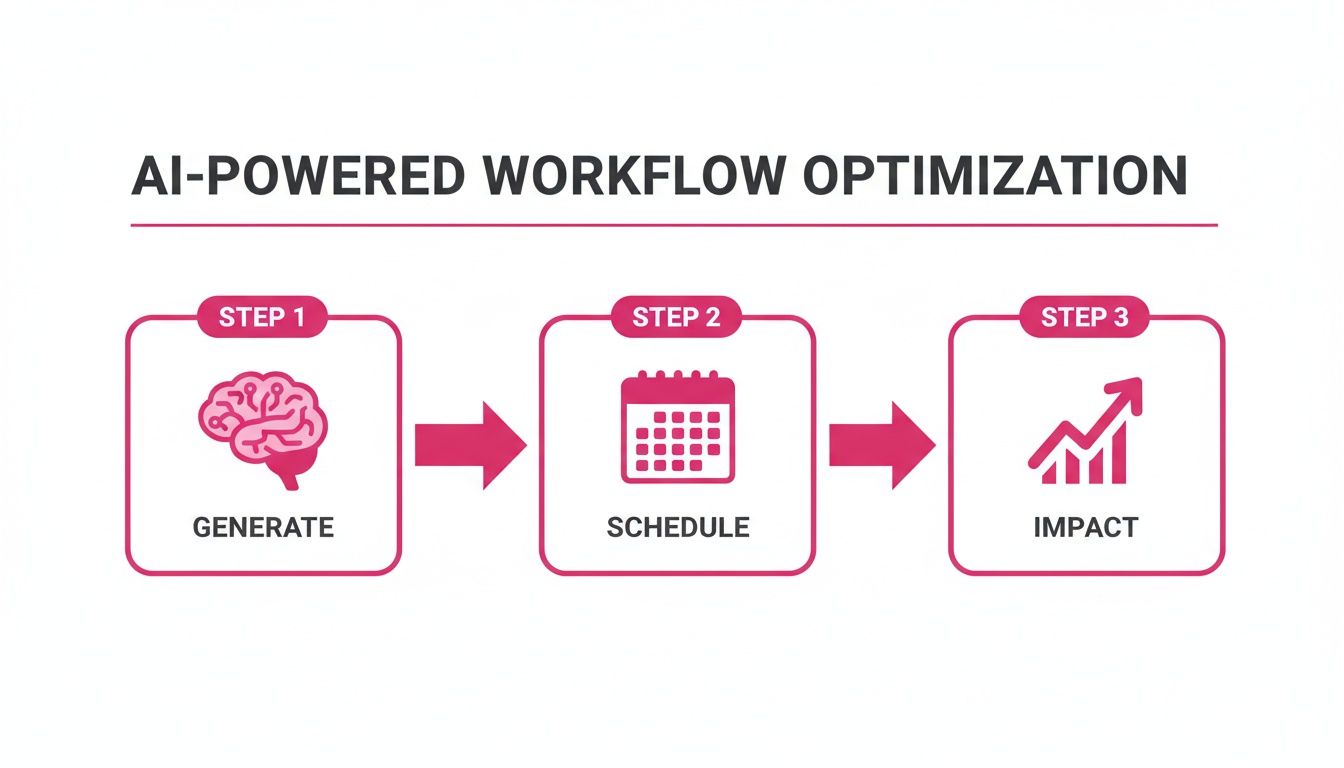
This shows how you can use AI to generate creative assets, feed them into your scheduling and management tools, and ultimately drive measurable results for your clients.
Mastering the Art of the Prompt
Here’s the thing about any OpenAI model: the quality of what you get out is directly tied to the quality of what you put in. This is where prompt engineering becomes one of the most valuable skills your team can learn. A good prompt isn't just a question—it's a detailed brief that steers the AI exactly where you want it to go.
A really effective prompt usually includes a few key ingredients:
- Context: Give it the backstory. Who’s the audience? What’s the goal of this campaign?
- Role: Tell the AI who to be. Assign it a persona, like a "seasoned B2B copywriter" or a "sharp-witted social media manager for a Gen Z brand."
- Format: Be specific about the output you need. Ask for a bulleted list, a comparison table, or exactly three paragraphs.
- Tone: Define the voice. Use descriptive words like "formal," "playful," "inspirational," or "authoritative."
Spending some time training your team on these fundamentals pays off big time. Better prompts mean better outputs, which translates to less time editing and more time executing.
Establishing Clear Internal Guidelines
As OpenAI tools become a regular part of your workflow, it's crucial to set up some clear ground rules. This ensures everyone is on the same page, your quality standards are maintained, and you’re using the technology responsibly.
Your guidelines should touch on a few core areas:
- Fact-Checking: Make it a non-negotiable rule that any AI-generated statistics, facts, or claims must be verified by a human. No exceptions.
- Brand Voice: Document how to use prompting techniques or even fine-tuning to make sure every piece of content perfectly matches each client's unique brand voice.
- Client Data: Set strict policies on what kind of client information can and cannot be put into AI models, especially public tools.
- Workflow Integration: Define where AI fits. For example, you might use OpenAI to create first drafts and then a platform like Poster.ly to schedule and manage the approved content.
By putting these guardrails in place early, you create a safe and productive environment for your team to innovate while upholding the professional standards your clients have come to expect.
Navigating Costs, Privacy, and Client Trust

Bringing any new technology into the fold means taking a hard look at the costs and responsibilities that come with it. For agencies, this isn't just about the financial side of using OpenAI—it's about the non-negotiable duty to protect client data and maintain the trust you've worked so hard to build.
To really make OpenAI work for you, you have to nail two things: keeping a tight rein on costs to show a clear return on investment, and handling data privacy like your reputation depends on it (because it does). Get this right, and you're not just using a tool; you're building a more efficient agency and stronger client relationships.
Understanding the Pricing Model
OpenAI’s pricing is mostly a pay-as-you-go affair based on things called tokens. The easiest way to think of tokens is as pieces of words. Roughly 1,000 tokens shake out to about 750 words. Every single request you send to the API, whether it's writing an email or analysing customer feedback, uses up a certain number of tokens, and that's what you're billed for.
This token-based approach is actually great for agencies. You can start small, run a few experiments, and scale up your usage as you figure out what's delivering value. It means your costs are always directly linked to your activity. It's also worth noting that different models come with different price tags; the more powerful models like GPT-4 cost more per token than older versions.
The key to managing costs is to treat token usage like any other campaign metric. Monitor it closely, connect it to project outcomes, and ensure every pound spent is contributing directly to client goals and agency efficiency.
This granular control is a lifesaver for forecasting. You can estimate how much it'll cost to generate a month of social media content for a client or draft a series of blog posts, which allows you to build these costs transparently into your proposals and retainers.
Upholding Data Privacy and Governance
For any agency, client confidentiality is sacred ground. This is where understanding the difference between OpenAI's products is absolutely critical. Data you submit to the business-focused OpenAI API is handled securely and, importantly, is not used to train their models.
That policy is the foundation of trust for professional use. It ensures your client’s sensitive information, from their next big campaign strategy to their customer data, stays completely private. On the other hand, the free, public version of ChatGPT plays by different rules, and conversations there can be used for model training.
To protect your clients and your agency, you need to set some firm ground rules internally:
- API-First for Client Work: Make it a strict policy that any work involving confidential client information must go through the secure API, never the free public tool.
- Anonymise Sensitive Data: As an extra layer of protection, train your team to strip out any personally identifiable information (PII) before it ever touches an AI tool.
- Educate Your Team: Make sure everyone, from juniors to account directors, understands the data policy differences between OpenAI's consumer and business products.
OpenAI is also serious about building out its infrastructure on a global scale. The company has an ambitious investment strategy that includes a major focus on the Middle East, with plans for a $100 billion data centre in the UAE. This is all part of a larger push to expand its AI capabilities and establish the region as a major tech hub. You can read more about OpenAI's Middle East investment strategy to see how they're planning for the future.
Your Agency's Next Steps in the AI Era
Adopting OpenAI isn't about replacing your team's creative spark; it’s about giving it a major boost. Think of this technology as a powerful co-pilot. It’s here to handle the grunt work—the endless brainstorming sessions and repetitive tasks—freeing up your experts to focus on big-picture strategy and nurturing client relationships. The real goal is to shift from just doing the work to directing it.
When you make this shift, you're not just getting more efficient. You're signalling to clients that your agency is on the front foot. They want a partner who not only gets the latest tools but is already using them to drive better results. It shows you’re serious about innovation and, most importantly, their success.
Charting Your Course
Getting started with AI can feel like a huge undertaking, but it doesn't have to be. A slow and steady approach always wins over a sudden, agency-wide mandate. The key is to start small, build some momentum, and show real value from day one.
Here’s a simple, actionable path to get you going:
Organise a Team Workshop: Education comes first. Get your team together for a hands-on session where they can just play around with ChatGPT and DALL·E. No pressure. Let them see what it can do for everyday tasks, like whipping up a few social media posts or spitballing campaign slogans.
Identify a Pilot Project: Don't try to boil the ocean. Pick one client and one specific task for a trial run. Maybe it’s generating ten different versions of ad copy or outlining a content calendar for the next month. This controlled experiment makes it easy to see exactly what kind of impact you’re having on speed and quality.
Invest in Basic Training: The secret to getting great results from OpenAI is all in how you ask. Spend a little time teaching your team the basics of prompt engineering. A well-written prompt makes all the difference, and this small investment in skills will pay for itself almost immediately in better, more relevant output.
The agencies that win in this new era will be the ones that see OpenAI not as a threat, but as an essential part of their creative and strategic toolkit. It’s about working smarter, not just harder.
Once you’ve run a few successful pilots and your team feels more comfortable, you can start weaving these tools into your daily operations. For example, imagine pairing the content creation muscle of OpenAI with a scheduling tool like Poster.ly. Suddenly, you have a powerful, end-to-end workflow that makes your team more efficient and your results more impressive.
Your Top Questions About Using OpenAI, Answered
As agencies start to dig into what OpenAI can do, a lot of practical questions pop up. Let's clear up some of the most common ones so you can understand what it really means to bring this tech into your agency's workflow.
Is It Plagiarism to Use OpenAI for Client Content?
Short answer: no, it's not plagiarism when you use it correctly. Tools like ChatGPT are designed to generate new, original text based on the patterns they've learnt from a massive amount of data. It's not just copying and pasting from a single source.
But here’s the key: always treat AI-generated text as a first draft. It’s a starting point, not the final product. A human absolutely has to step in to review, fact-check, and mould the content to fit the client’s unique voice and your agency's quality standards. Think of OpenAI as an incredibly fast and creative assistant, not the final author.
Is Our Agency's Confidential Client Data Safe?
This is a big one, and the answer hinges on how you use OpenAI. There's a night-and-day difference between the free, public version of ChatGPT and the paid business-focused API.
Here's the most important thing to remember: data you send through the official OpenAI API is not used to train their models. This is the policy that protects your sensitive client info, whether it's campaign strategies or customer lists. For any agency serious about security, using the paid API is the only way to go. It's built for professional use where privacy is a top priority.
The free version of ChatGPT is a different story. Those conversations can be used for model training. For any and all client work, sticking to the API isn't just a good idea—it's non-negotiable.
Do We Need Developers to Start Using OpenAI?
Not at all. You can get a ton of value out of OpenAI right now, without writing a single line of code. Tools like ChatGPT Plus and DALL·E are made for everyone, not just programmers.
Your creative teams, social media managers, and strategists can jump in today. They can use these tools for brainstorming blog topics, drafting ad copy, or creating unique images for a campaign. While you’ll eventually need developers for custom integrations, the barrier to entry is incredibly low. This means you can start seeing real productivity boosts right away while you plan out bigger, more technical projects for the future.
At Grassroots Creative Agency, we blend powerful tools with smart strategy to get real results for our clients. If you're ready to see how a data-supported, content-driven approach can elevate your brand, find out more about our work.