

So, what exactly is Google Gemini? It’s easy to think of it as just another AI chatbot, but that would be missing the point entirely. At its core, Gemini is a natively multimodal artificial intelligence model.
That’s a bit of a mouthful, but the key word is “multimodal.” It means Gemini was built from the ground up to understand and work with a whole bunch of different information types at the same time—text, images, audio, video, and even code. This isn’t just an incremental improvement; it allows Gemini to tackle far more complex and nuanced problems than older models, making it a seriously powerful tool for businesses trying to solve tough challenges.
Unpacking the Power of Multimodal AI

To really get what makes Gemini a big deal, we need to think beyond simple definitions.
Picture an analyst who can only read spreadsheets. They're good at their job, but their world is limited to columns and rows. Now, imagine another analyst who can read those same spreadsheets, listen to the audio from an earnings call, watch videos on market trends, and analyse photos of a new product—all at once. That second analyst, the one who sees the whole picture, is Gemini.
That's the essence of multimodal AI. It’s not about switching between different types of data; it’s about understanding how they all connect and tell a bigger story. Previous AI models were mostly unimodal, meaning they were text-in, text-out. Gemini was designed from day one to be different, weaving all these data streams together from the start.
This integrated approach means Gemini doesn't just see a picture or read a description. It understands the relationship between them. For any business, this opens up a whole new world of possibilities for everything from automation to customer engagement.
Why Multimodality Matters for Your Business
Moving from a single-mode to a multimodal AI isn't just a technical upgrade—it’s a strategic one. It equips your business to solve problems that were previously out of reach for AI, with practical benefits that can directly boost how you operate and connect with customers.
Just think about some of the applications:
- Customer Support: A customer sends a photo of a broken product. Gemini can instantly identify the part, find the right page in the user manual, and write out clear, step-by-step repair instructions.
- Marketing Content: You give it a single image of your new product. Gemini can then generate a compelling product description, catchy social media posts, and even a draft script for a short promotional video.
- Data Analysis: Instead of just crunching numbers from a report, Gemini can analyse the charts and graphs in a presentation while also processing the spoken commentary from the meeting recording to give you a much richer summary.
Google Gemini’s ability to process and reason across text, images, video, and audio makes it less of a simple tool and more of a versatile digital consultant. It’s designed to understand the complex, multi-layered world your business operates in.
A Strategic Asset for Growth
At the end of the day, Gemini represents a fundamental shift in how we can use AI. It’s no longer just about generating text. It’s about having a strategic partner that can help you solve complex problems. By interpreting all these different data types together, it can spot patterns you’d miss, automate highly sophisticated tasks, and help create more intuitive experiences for your customers.
For start-ups and small businesses, this is a chance to get advanced analytical power without hiring a massive team of specialists. For larger companies, it's a way to streamline complicated workflows and get more value out of the data you already have. As we dig deeper into Gemini’s models and uses, keep this central idea in mind: its real strength is its ability to see the bigger picture, just like your best people do. This also makes visual creation tools, like Posterly, even more powerful when you combine them with Gemini's strategic and creative input.
Getting to Know the Gemini Family
First things first, it's a mistake to think of Google Gemini as a single, monolithic AI. It's much more accurate to picture it as a family of models, each one built for a specific job. This isn't a one-size-fits-all situation; it’s about having the right tool for the task at hand. The family is made up of three main players: Gemini Ultra, Gemini Pro, and Gemini Nano.
Think of it like choosing an engine for a car. You wouldn't drop a Formula 1 engine into a city car, and you wouldn’t expect a hatchback's engine to haul a heavy load. Each Gemini model is engineered with a specific purpose in mind, balancing power and efficiency for different needs.
This tiered approach is what makes Gemini so accessible. Whether you're a massive enterprise needing to crunch huge datasets or a start-up building a slick mobile app, there's a version of Gemini designed for you.
Gemini Ultra: The Heavyweight Champion
Gemini Ultra is the powerhouse of the family. This is the largest, most capable model, built for the kind of highly complex problems that require serious analytical muscle. When you need deep reasoning and the ability to understand multiple data types at once, this is the model you call on.
Its real strength is in its ability to pull together and make sense of information from all over the place—text, code, images, video—and find the patterns that humans would miss. For a business, that could mean conducting a massive market analysis from thousands of different sources or generating highly specialised code for a custom software project.
Gemini Ultra is the top-tier performer, engineered for enterprise-level challenges where state-of-the-art reasoning and understanding across different media types are absolutely essential.
Gemini Pro: The Versatile All-Rounder
Gemini Pro is the workhorse. It finds that sweet spot between high performance and resource efficiency, making it the perfect all-rounder. In fact, it's the model that powers many of Google’s own AI services, including the Gemini chatbot that many of us are already using.
For most businesses, Gemini Pro is the best place to start. It has more than enough power for common applications without the heavy computational cost of Ultra. You'll see it excelling at things like:
- Smarter customer service chatbots: It can field complex customer questions, pull answers from a knowledge base, and reply in a natural, helpful way.
- Content creation assistants: It’s great for drafting marketing copy, brainstorming blog topics, or even creating simple design briefs for tools like Poster.ly.
- Backend development: It can automate workflows, categorise data, and handle complex logic for your business applications.
Gemini Nano: The On-Device Specialist
Gemini Nano is the smallest and most efficient model in the lineup, designed specifically to run directly on devices like smartphones. This is a big deal. It allows AI features to work offline, which means faster responses and better privacy because your data doesn't have to be sent to a cloud server for processing.
While it’s not as powerful as its bigger siblings, Nano is fantastic for on-device tasks like summarising articles, suggesting smart replies in messaging apps, or providing real-time language translation. For companies building mobile apps, Gemini Nano opens up a world of possibilities for creating faster and more private user experiences.
To get a complete picture of what each model can do and how they fit into the larger system, this A Practical Guide to Gemini AI Models is an excellent resource for a deeper dive.
Now that we've met the individual models, it’s easier to see how they fit different business needs. Each has a clear purpose, from heavyweight data analysis to nimble on-device tasks.
Comparing the Google Gemini Models
| Model | Primary Strength | Ideal Business Use Case |
|---|---|---|
| Gemini Ultra | Peak performance and multimodal reasoning | Complex data analysis, scientific research, sophisticated code generation, enterprise-level problem-solving. |
| Gemini Pro | Balanced performance and scalability | Powering chatbots, content creation tools, backend APIs, and general-purpose business applications. |
| Gemini Nano | On-device efficiency and speed | Mobile app features like text summarisation, smart replies, and real-time functions that require low latency and privacy. |
This table helps clarify where each model shines. Your choice really depends on the scale and nature of the problem you're trying to solve.
One of Gemini's key advantages is its sheer global scale and language capabilities. Google has focused on making it work well in over 40 languages, with special attention given to Arabic to better serve the Middle East and North Africa (MENA) region. This effort is paying off. Gemini has been rolled out in 182 countries, and in Africa, where cultural ties to the MENA region are strong, usage has grown by a massive 180% year-over-year. You can read more about Gemini's impressive global stats in this detailed report.
By weaving these models directly into products we already use, like Workspace and Search, Google is making it much easier for businesses to start using powerful AI. You don't need a team of data scientists to get started, making Gemini a practical and scalable choice for companies of any size.
Putting Gemini to Work in Marketing and E-Commerce
Alright, let's move past the technical specs and get to what really matters: how can Google Gemini actually help you? For anyone in marketing or running an e-commerce brand, this is where things get exciting. Gemini’s ability to work with more than just text opens up a whole new playbook for creating campaigns that genuinely connect with people. It’s about working smarter, not just churning out content faster.
Think about it. Instead of staring at a blank page for hours trying to brainstorm, you can now team up with Gemini and get dozens of solid, creative ideas in minutes. This frees up your team to zero in on high-level strategy and execution, completely changing how you tackle everything from social media posts to deep-dive customer analysis.
The different Gemini models are built for different jobs, from heavy-duty analysis with Ultra to quick, efficient tasks with Pro and Nano.
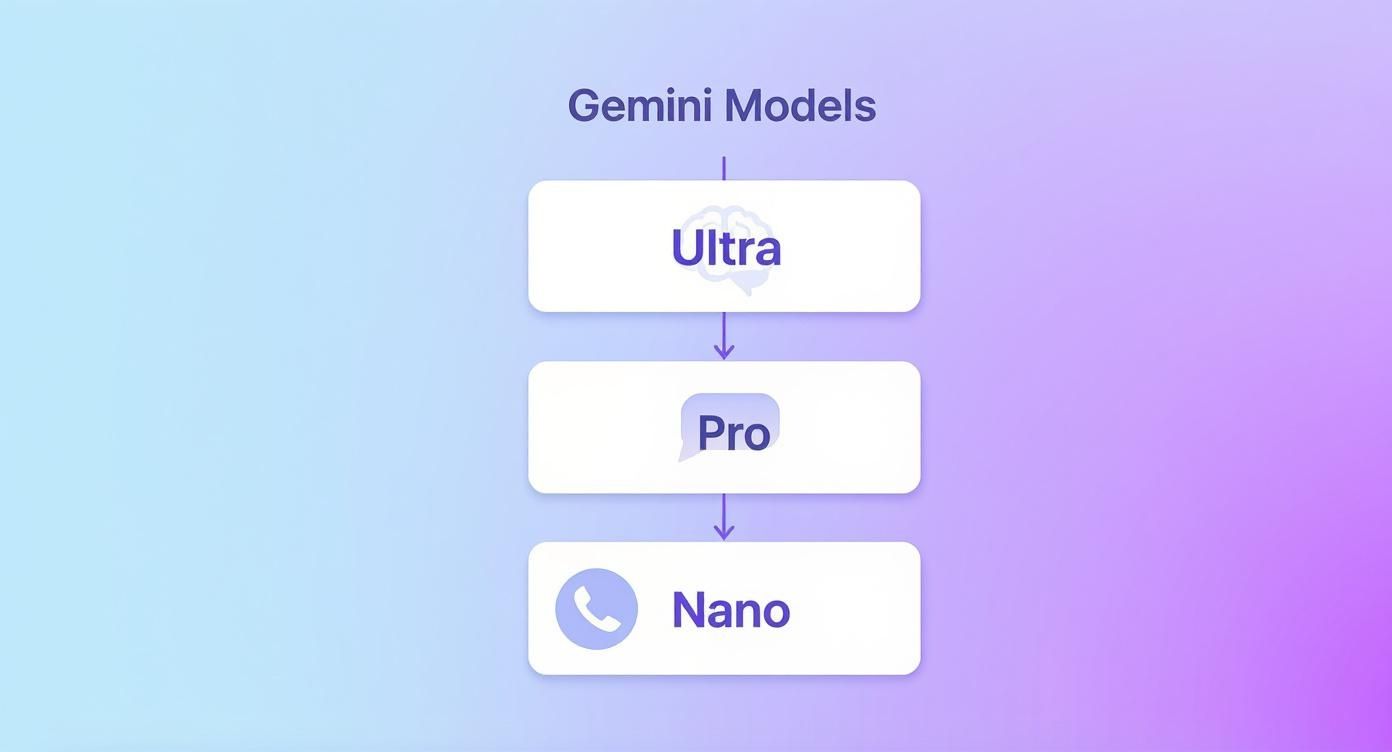
This setup means you can pick the right tool for the task, whether you're crunching massive campaign datasets or just need to power a simple interaction on a customer's device.
Hyper-Personalised Marketing at Scale
One of the most powerful and immediate uses for Gemini is creating marketing copy that feels personal. It can sift through your customer data segments and spin up email campaigns, ad copy, and landing page text that speaks directly to the specific needs of each audience.
For instance, an online store could feed Gemini data on a customer group that buys a lot of running shoes. Gemini could then generate an entire email campaign spotlighting new arrivals, calling out the technical specs that matter to serious runners, and even suggesting products that go well with them, like performance socks.
By understanding nuance and context, Google Gemini allows brands to move beyond generic messaging. It enables the creation of marketing communications that feel like a one-to-one conversation, building stronger customer loyalty and boosting conversion rates.
This kind of detailed personalisation used to take a ton of manual work. Now, it can be automated, letting you connect with customers on a much more meaningful level everywhere they see your brand.
Brainstorming Engaging Social Media Campaigns
We’ve all been there—the pressure to come up with fresh, engaging ideas for social media is relentless. Gemini can be your creative partner, a never-ending source of inspiration to help you dream up campaigns that actually stop the scroll.
Let's say you're launching a new eco-friendly cleaning product. You could ask Gemini to:
- Generate a list of 20 unique Instagram Reel ideas showing off the product in fun, creative ways.
- Draft a few engaging Twitter polls to get people talking about sustainable living.
- Outline a full content calendar for a week-long launch, complete with post copy and visual suggestions.
This AI-powered brainstorming session gets the creative juices flowing fast. From there, you have a clear path forward: use Gemini to nail down the high-level concepts, then use a visual creation tool to bring them to life. For example, you could take a campaign idea from Gemini and jump into a platform like Poster.ly to quickly design the professional, eye-catching social media assets you need to go live. It’s the perfect bridge between AI strategy and real-world execution.
Advanced SEO and E-Commerce Applications
Gemini is more than just a content machine; it’s a seriously powerful analysis tool. The impact of generative AI in e-commerce is already clear, and Gemini's capabilities are a big part of that shift in how online businesses operate.
For e-commerce brands, Gemini can analyse thousands of customer reviews to spot common themes, product complaints, or positive feedback that can guide your next product launch. It can also generate dynamic, SEO-friendly product descriptions that are both persuasive and perfectly optimised to rank for the right keywords. Getting a handle on your market is crucial, and you can learn more about the best ways to approach data analysis for marketing in our detailed guide. This kind of analytical horsepower helps you make smarter, data-driven decisions that fuel real growth.
How Gemini Transforms B2B and Enterprise Operations
While the creative marketing uses get a lot of attention, Google Gemini's real muscle is in transforming B2B and enterprise operations. This is where it stops being just a neat tool and starts becoming a core part of a modern business engine, driving efficiency by automating tough internal processes, making sense of raw data, and putting company knowledge at everyone's fingertips.
Think about how much valuable information is locked away in different silos—spreadsheets, old presentations, meeting notes, and internal wikis. Gemini's native ability to understand various formats allows it to connect those dots, creating a unified view that used to take an enormous amount of manual work. It's about building a smarter, more agile operational backbone for the entire company.

Automating Complex Business Workflows
One of the first places large businesses see a return is in automating workflows that are not only tedious but also prone to human error. We're not talking about simple, one-step automations here. Gemini can handle complex, multi-step processes that require a bit of reasoning.
Here are a couple of real-world examples:
- Invoice Processing: Imagine Gemini receiving an invoice as a PDF. It can "read" it, pull out the vendor name, invoice amount, and due date, then automatically check it against the purchase order in your ERP system. If anything doesn't match, it flags it for a human to review. Simple, but incredibly effective.
- HR Onboarding: It can generate a custom onboarding plan for a new hire by pulling details from their job description, checking the department's calendar, and referencing required training modules. From there, it can draft the welcome emails and even schedule introductory meetings.
By taking over these intricate tasks, Gemini lets your team focus on strategic work instead of administrative quicksand. Integrating these automations is often a central piece of any serious digital transformation consulting effort.
Generating Insightful Business Reports
Data is worthless if you can't understand it. Enterprises are drowning in information, and turning it into clear, actionable insight is a constant battle. This is where Gemini shines. It's brilliant at synthesising massive datasets and spitting out reports in plain English.
Instead of just dumping raw numbers into a chart, Gemini can spot the trends, highlight the weird outliers, and summarise the key takeaways. A logistics manager, for instance, could feed it weekly shipping manifests, fuel cost data, and driver logs.
Gemini could then produce a summary that not only breaks down operational costs but also points out the most (and least) efficient delivery routes. It might even suggest ways to save money or flag early warning signs of a supply chain problem. This shifts data analysis from a backward-looking chore to a forward-looking strategic advantage.
Real-World Impact in Finance and Logistics
The tangible benefits of this are especially clear in data-heavy sectors like finance and logistics. In the financial world, it's being put to work on sophisticated fraud detection, analysing millions of transaction patterns in real-time to spot odd behaviour that could signal a security breach.
Meanwhile, logistics companies are using Gemini to fine-tune their entire supply chain. By feeding it data on weather forecasts, current traffic, and warehouse inventory levels, the AI can predict potential delays and proactively suggest alternate routes. This helps ensure goods arrive on time while cutting down on fuel costs and headaches. These aren't abstract benefits; they deliver measurable returns through lower costs, smarter decisions, and a more resilient operation.
This trend is playing out globally. The Middle East, especially the UAE, has seen enterprise adoption of Google Gemini explode, with a staggering 240% year-over-year jump. This surge has been particularly strong in finance and logistics, proving that businesses in these critical industries are actively putting Gemini to work to get a real competitive edge. You can find more details about this regional AI growth on sqmagazine.co.uk.
Getting Your Gemini Implementation Right
Bringing a tool like Google Gemini into your business isn't just a tech project; it’s a strategic move. For any business leader, getting it right means thinking through a few key areas before you even start. We're talking about protecting your data, managing costs, and making sure your team is actually ready for this shift. It’s all about balancing the incredible power of AI with the practical realities of your business.
If you plan this rollout carefully, you can unlock some serious advantages. Rush it, and you’re just creating future headaches. The trick is to ask the tough questions right at the start to build a solid foundation for using AI effectively and responsibly.
First Things First: Data Privacy and Security
The second you plug an AI like Gemini into your company’s data, privacy and security have to be your top priority. You absolutely need clear rules about what information the model can touch and how it gets used. This isn't just an IT checklist item; it's about maintaining trust with your customers and staying on the right side of regulations like GDPR.
Before you go any further, get clear answers to these questions:
- What specific data will Gemini be using? Define the boundaries from day one, giving it access only to what it truly needs to do its job.
- How are you protecting sensitive customer data? You should be looking at techniques like data anonymisation to strip out personal details wherever possible.
- Who owns this process? Designate a person or a team to be the clear point of contact for overseeing AI data governance and ensuring compliance.
Don’t make the mistake of treating data security as an afterthought. A proactive approach here protects your business and shows everyone you’re using AI the right way.
What’s This Going to Cost?
As powerful as Gemini is, it doesn't come for free. You have to get a handle on the pricing models to budget properly and avoid any nasty surprises down the line. Google usually has a few options, from pay-as-you-go API access that’s great for smaller tests, all the way up to dedicated enterprise plans for heavy-duty, large-scale work.
Your final bill will come down to how you use it. For instance, a start-up using the API for a simple customer service chatbot will see a very different cost structure than a larger company using Gemini Ultra for deep, complex data analysis. The key is to map out your expected usage and pick a plan that fits both your technical needs and your budget. That’s how you ensure you’re getting a real return on this investment.
Adopting AI is a journey of continuous learning and adaptation. The most successful implementations are those that balance ambitious goals with a pragmatic understanding of the associated costs, risks, and ethical responsibilities.
Getting Past the Pilot Phase: Common Hurdles
It's one thing to run a small, successful pilot project. It's another thing entirely to scale AI across your entire organisation. One of the biggest roadblocks is often an internal skills gap. Your team might not have the expertise to properly prompt, manage, and interpret what a model like Gemini produces. This is where investing in training becomes non-negotiable.
Another common challenge is getting Gemini to play nicely with your existing (and often messy) IT infrastructure. This takes real planning to make sure data flows smoothly between the AI and the software you already rely on. A good strategy is to start with smaller, more focused projects. This lets you learn the ropes, build up in-house expertise, and demonstrate clear value, which makes getting buy-in for bigger initiatives much easier.
This kind of strategic thinking is paying off in markets that are quick to embrace new technology. Just look at the UAE, which has jumped ahead as a world leader in AI adoption. An incredible 59.4% of the working-age population there are already actively using AI tools like Gemini. You can get more insights on the region’s incredible AI uptake in this detailed report on consultancy-me.com. It just goes to show that with the right game plan, widespread adoption isn't just possible—it's already happening.
Your Step-by-Step Gemini Integration Checklist
Alright, so you see the potential of Google Gemini. But how do you go from simply understanding it to actually using it to make a real difference in your business? The key is having a clear plan.
This checklist is designed to walk you through a successful integration, step-by-step. We'll break down what could be a really complex process into manageable stages, so you can build momentum without getting bogged down.
Phase 1: Define Your Objectives
Before you write a single prompt or touch an API, you have to know what you’re aiming for. Vague goals like "improving efficiency" won't cut it. You need to get specific about the exact problems you’re trying to solve.
1. Identify a Business Problem
First, pinpoint a specific, high-impact challenge. Are your customer response times dragging? Is your content team struggling to keep up? Do you have a mountain of sales data you can't make sense of? Start with one clear pain point.
2. Set Measurable KPIs
Next, decide how you'll know if you're winning. This means setting concrete goals. Think in terms of reducing customer ticket resolution time by 20%, boosting content output by 50%, or pulling three actionable insights from your sales data every week.
3. Start with a Pilot Project
Resist the temptation to boil the ocean. Instead, pick a small, contained project to test the waters with Gemini. This approach minimises risk and lets you demonstrate value quickly, which is crucial for getting buy-in from the rest of the team. A successful pilot is your best argument for expanding your AI efforts later on.
Phase 2: Prepare and Execute
Once your goals are crystal clear, it’s time to get into the technical side of things and prepare your team. This phase is all about picking the right tools and giving your people the skills they need to use them well.
- Select the Right Gemini Model: Not all Gemini models are created equal. You need to match the tool to the job. For versatile tasks like chatbots or content generation, Gemini Pro is a great starting point. For deep, complex data analysis, Gemini Ultra might be the better fit.
- Organise Your Data: An AI is only as smart as the data you feed it. Make sure the information you plan on using is clean, organised, and easy for the system to access. This isn't the most glamorous step, but it’s absolutely critical for getting accurate and relevant results.
- Train Your Team: You can't just drop a new tool on your team and expect magic. Invest time in training them on the basics of prompt engineering and help them understand what the AI can and can't do. A team that knows how to use the tool properly is essential for getting a real return on your investment.
A thoughtful rollout is the core of any successful AI initiative. It’s not just about technology; it’s about aligning that technology with clear business goals and preparing your people for a new way of working.
Following this checklist helps structure your approach, ensuring each step builds logically on the last. This kind of methodical process is a cornerstone of any good digital transformation strategy, helping you turn that initial spark of curiosity into tangible business results.
Frequently Asked Questions About Google Gemini
It's only natural to have questions when a technology like Google Gemini enters the scene. Let's break down some of the most common things business leaders are asking as they figure out how to put this AI to work.
How Does Gemini Differ from Other AI Models?
The biggest difference is that Gemini was built from day one to be natively multimodal. Think of it this way: many other AI models started out as text-only engines, and then had capabilities for images or audio bolted on later. Gemini, on the other hand, was designed from the ground up to think in terms of text, images, audio, video, and code all at once.
This gives it a much richer, more intuitive grasp of context. It's not just processing words on a page; it can look at a sales chart, listen to the audio from the presentation, and read the slide notes to give you a genuinely insightful summary. For a business, this opens the door to solving messy, real-world problems that involve multiple types of information.
What Are the Data Privacy Implications?
This is a big one, and rightly so. When you're using the Google Gemini APIs through a business platform like Vertex AI, Google gives you specific data governance controls. The key takeaway is that your business data isn't used to train their public models.
That said, the responsibility is still on you to have solid internal policies. You'll want to:
- Clearly define what company data the model is allowed to touch.
- Make sure any sensitive customer info is anonymised before being sent for processing.
- Put someone in charge of AI data security to keep an eye on compliance with rules like GDPR.
What Is the Best Way for a Small Business to Start?
The smartest approach for a small business is to start small. Don't try to boil the ocean and reinvent your entire company with AI overnight. Instead, find one specific, nagging problem where AI could score you a quick and measurable win.
A great way to dip your toes in is with the Gemini Pro API. You could spin up a pilot project, like a simple chatbot to field basic customer service questions or a creative assistant for your marketing team to brainstorm social media posts. This lets you learn the ropes, show a clear return on the effort, and build momentum before you tackle more ambitious projects.
Ready to turn AI-driven ideas into compelling visual content? Grassroots Creative Agency can help. After using Gemini to generate your campaign concepts, use a powerful tool like Posterly to create stunning, on-brand social media assets quickly and efficiently.