Building an e-commerce website that thrives in Dubai isn't about using a generic template. It’s about crafting a digital experience that understands the local pulse—the unique customer habits, cultural subtleties, and market rhythms that define the UAE. A one-size-fits-all approach just won't cut it here.
Building Your E-Commerce Foundation in Dubai
So, you're ready to launch an online store in Dubai. Think of this guide as your strategic roadmap, designed to help you build a digital storefront that genuinely connects with customers in one of the world's most exciting retail markets.
The e-commerce scene in the UAE isn't just growing; it's booming. Forecasts predict the market will hit around $17 billion by 2025 and keep climbing to an impressive $21.18 billion by 2030. This incredible growth is powered by a hyper-connected population, with 99% internet penetration and a truly mobile-first culture, where over 72% of all web traffic comes from smartphones.
Understanding the Local Landscape
Before a single line of code is written, it's worth taking a step back to think strategically. If you're still weighing the options, there are great resources for understanding the necessity of an e-commerce website for smaller businesses.
A successful Dubai-based e-commerce site needs to be built from the ground up with a few local realities in mind:
- Cultural Nuances: Your design, photos, and even the tone of your text need to resonate with a diverse, multicultural audience while always respecting local traditions.
- Consumer Behaviour: Shoppers here have high expectations. They want fast delivery, a flawless mobile shopping journey, and flexible payment methods like cash on delivery or "Buy Now, Pay Later".
- Bilingual Audience: Offering a seamless experience in both English and Arabic isn’t a bonus feature; it's an absolute must-have to capture the entire market.
Think of your website not as a global template, but as a bespoke local boutique. Every detail, from the currency displayed to the holidays you acknowledge, contributes to building trust and fostering a connection with your customers.
Once your site is live and fine-tuned for the local market, the next chapter is all about getting the word out. This is where your marketing efforts really kick in. To make sure you’re consistently engaging your new audience, you could use a social media automation tool like Poster.ly to manage and schedule your content effectively. This helps turn your beautifully designed website into a real sales engine right from day one.
Picking the Right E-Commerce Platform for Your UAE Store
Choosing your e-commerce platform is like picking the engine for your car. It determines your speed, your power, and how far you can go. Get it right, and you're set for smooth sailing. Get it wrong, and you'll be stuck on the hard shoulder while your competitors race past. For a store in the UAE, this choice is absolutely critical and will shape everything from your day-to-day operations to your ability to handle the massive traffic spikes during Ramadan or the Dubai Shopping Festival.
This isn't just about tech; it's a core business decision. The platform you build on directly impacts your customer's experience, how effectively you can market your products, and, ultimately, how much you sell. You need a solution that understands the local landscape, not just a generic, one-size-fits-all option.
Sizing Up the Main Players in Dubai
While there are many options out there, the Dubai market generally revolves around a few key players: Shopify, WooCommerce, and Magento. Each one strikes a different balance between ease of use, creative freedom, and raw power.
-
Shopify: This is the undisputed champion of getting online fast. As a fully hosted platform, Shopify takes care of all the tricky technical stuff—security, servers, and updates—so you can focus on selling. It’s perfect for startups and small businesses that need a reliable, professional-looking store without a big technical team.
-
WooCommerce: If you're already familiar with WordPress, WooCommerce is a natural fit. It’s a hugely flexible plugin that transforms your website into a powerful online store. You get total control over the design and functionality, but that freedom comes with responsibility. You'll need to manage your own hosting and security.
-
Magento (Adobe Commerce): This is the heavyweight champion. Magento is built for large-scale operations with complex product catalogues and sophisticated needs. It’s incredibly powerful and can be customised to do almost anything, but it comes with a steep learning curve and higher costs. It's the go-to for established retailers with serious ambitions.
For businesses looking to push the boundaries of design and functionality, hiring specialists for Shopify development services can unlock the platform's full potential, creating a truly unique storefront.
To help you visualise the trade-offs, here’s a breakdown of how these platforms stack up for the Dubai market.
Comparing E-Commerce Platforms for the Dubai Market
| Platform | Best For | Ease of Use | Dubai-Specific Features | Estimated Cost |
|---|---|---|---|---|
| Shopify | Startups, SMEs, and direct-to-consumer brands looking for a quick launch. | Very High | Excellent integration with local payment gateways (Tabby, Tamara) and good RTL support. | Low to Medium (Monthly subscription + transaction fees) |
| WooCommerce | Businesses with existing WordPress sites or those wanting full design control. | Medium | Highly customisable. RTL and local payment integrations require specific plugins and setup. | Low to Medium (Mainly hosting and plugin costs) |
| Magento | Large retailers and B2B businesses with complex catalogues and custom requirements. | Low | Extremely powerful for localisation, multicurrency, and complex logistics, but requires expert development. | High (Requires significant investment in development and maintenance) |
| Custom | Enterprises with unique business models that no off-the-shelf platform can support. | Very Low | Built from scratch to meet every specific need, including deep local integrations. | Very High (The most expensive and time-consuming option) |
Ultimately, the best platform is the one that aligns with your specific business goals, budget, and technical comfort level.
Must-Have Features for the UAE Market
A slick design is great, but a platform’s real worth in Dubai comes down to how well it handles the local essentials. Forget the fancy bells and whistles for a moment; if it can't do these things well, it's not the right choice.
Here's what you absolutely must check for:
-
Flawless Arabic & RTL Support: Your platform has to do more than just translate words. It needs to fully support right-to-left (RTL) layouts. This means the entire user interface—menus, buttons, images, and text—flips to create a natural and intuitive experience for your Arabic-speaking customers. A shoddy implementation is an instant deal-breaker.
-
Local Payment Gateway Integration: How easily can you connect to local heroes like Telr and PayFort? Even more important is seamless integration with "Buy Now, Pay Later" (BNPL) services like Tabby and Tamara. These are no longer optional; they are conversion-driving machines in the UAE.
-
Rock-Solid Scalability: Your site must be able to handle a sudden flood of traffic during major sales events. If your website crashes or slows to a crawl during White Friday, you're not just losing sales; you're losing customer trust for good.
The right choice boils down to matching a platform's strengths to your business's reality. A startup will value Shopify's simplicity, while a major retailer with a massive inventory will need the sheer power of Magento.
Making this decision requires careful thought. You can find a more detailed breakdown of the whole process in this complete guide to ecommerce website development in Dubai.
And remember, launching the site is just the beginning. As your store grows, you'll need to keep your customers engaged. A tool like Poster.ly, created by our team at Grassroots Creative Agency, can help automate your social media marketing, ensuring your brilliant new platform is backed by equally powerful promotion.
Designing a User Experience That Connects with Local Shoppers
A slick-looking website is great, but it’s only the beginning. For a successful e commerce website design in Dubai, your store needs to do more than just impress visually—it has to feel natural and intuitive for shoppers in the UAE. This is all about crafting a user experience (UX) and user interface (UI) that speaks their language, literally and culturally.
Think of it this way: your website should feel like a welcoming, local boutique, not a generic, faceless international chain. It’s the small things—the language, the imagery, the subtle cultural cues—that tell a customer they’ve come to the right place. From the moment they arrive on your site to that final click to buy, the entire journey needs to be smooth, respectful, and reassuringly familiar.
Mastering the Multilingual Experience
A truly local feel in the UAE starts with getting your bilingual support absolutely right. And no, just running your content through a translator for Arabic won’t cut it. The entire design needs to intelligently adapt to a right-to-left (RTL) layout. This isn’t a nice-to-have; it's a fundamental requirement for a huge part of your audience.
-
Flawless RTL Implementation: When a user switches to Arabic, your whole site layout has to flip like a mirror image. Menus, navigation, product images, and buttons must all realign from right to left to create a natural reading experience. A clunky or broken RTL layout is a dead giveaway of an amateur setup and will kill trust instantly.
-
Culturally Resonant Typography: The fonts you pick have a bigger impact than you might think. You need typefaces that are clear and look good in both English and Arabic. A font that looks sophisticated in English can often look awkward or be hard to read in Arabic script, so you have to test both to get that polished, unified feel.
-
Imagery That Connects: Your photography should mirror the modern, diverse culture of Dubai while being mindful of local values. Use images that your customers can relate to, where they can see themselves. Steer clear of anything that could be seen as culturally insensitive. Authenticity is what makes your brand feel real and approachable.
This flowchart maps out how your budget and tech skills can guide you to the right e-commerce platform for the UAE.
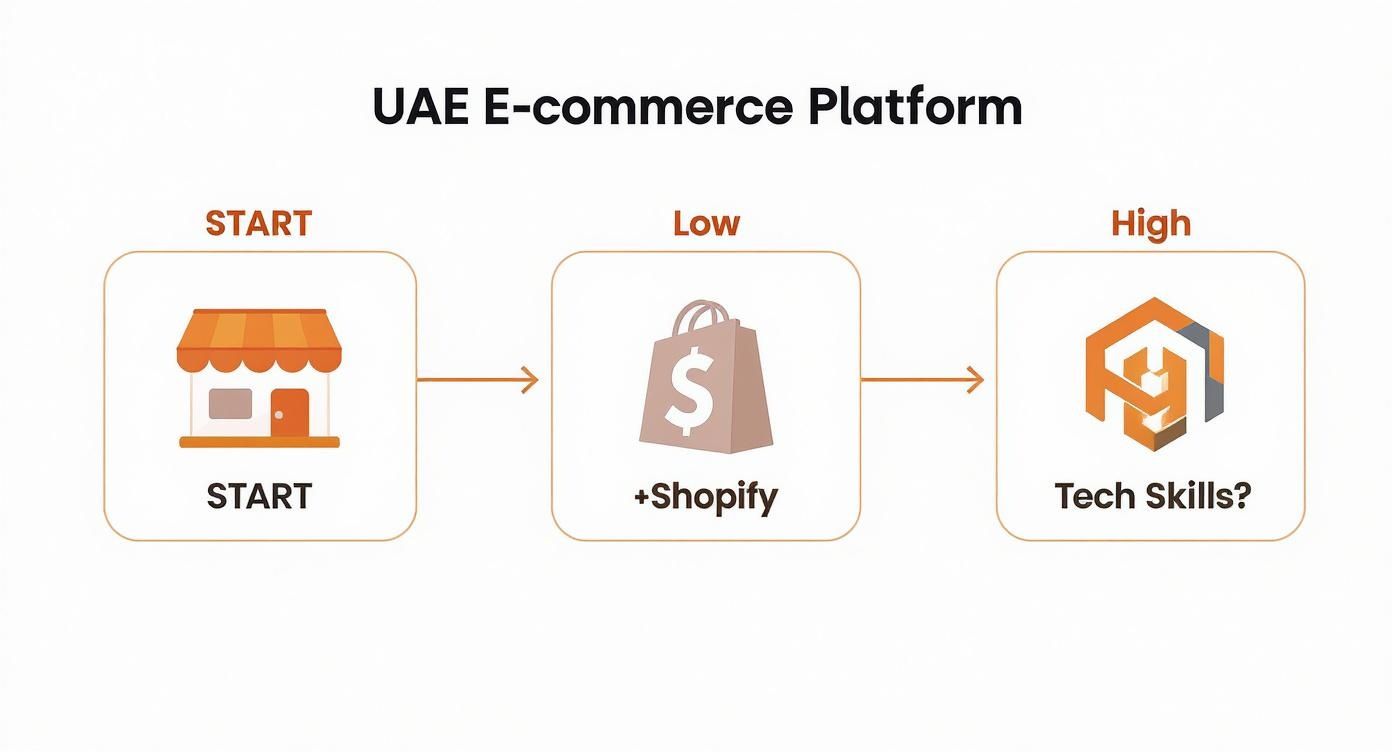
As you can see, a platform like Shopify is a fantastic starting point for those on a tighter budget, whereas something like Magento is better suited for businesses that already have strong technical teams.
Building Trust Through Design and Content
Shoppers here are savvy and they value transparency. Your website’s design needs to actively build their confidence with every click. Vague policies, hidden shipping costs, or a hard-to-find contact page are guaranteed ways to lose a sale.
It’s been shown that a visitor forms an opinion about your website in just 50 milliseconds. In that blink of an eye, your design has to scream professionalism, security, and trustworthiness.
The best way to do this is by making sure all your information is clear, detailed, and easy to find. Local shoppers do their homework before they buy, and they expect to find all the details they need.
-
Detailed Product Descriptions: Don't just list the basic specs. Write rich, compelling descriptions and include multiple high-quality photos, videos, and clear size guides. The more information you give them, the more confident they'll be in their purchase.
-
Prominent Trust Signals: Your return policy, shipping details, and contact information shouldn't be buried. Place links to them right in your header or footer where they can’t be missed. It shows you’re a real business that stands behind what you sell.
-
Authentic Customer Reviews: Nothing builds confidence like social proof. Integrate a system for genuine customer reviews and testimonials, ideally with photos or videos. Seeing that other people have already bought from you and had a great experience is one of the most powerful trust signals there is.
At the end of the day, a great user experience comes down to empathy. If you can put yourself in your local customer’s shoes, you can build a digital storefront that doesn’t just make sales but creates real, lasting loyalty.
Integrating Local Payments and Logistics
A stunning website is a great start, but it's only half the story. The real test of your e-commerce business happens behind the scenes. How you handle payments and deliveries is what truly defines your brand's reliability in a customer's mind. For any e-commerce website design in Dubai, a frictionless checkout and dependable delivery aren't just nice-to-haves; they're the bedrock of customer loyalty and repeat sales.
Think about it from the customer's perspective. They've found a product they love, your site looks incredible, and they’ve hit 'Add to Cart'. This is the make-or-break moment. If the payment process is a hassle or their preferred option is missing, you've just lost a sale. It’s that simple. And if the delivery is late or the tracking is a mess, you've lost them for good.
Streamlining Payments for the Dubai Market
Getting your payment options right is all about removing barriers and building trust. Of course, you need to accept international credit cards, but the secret to unlocking higher conversions in the UAE is to embrace the local payment methods that shoppers here use every day.
Your payment gateway is the secure link between your store and your customer’s bank account. You absolutely must partner with providers that have a strong, trusted presence in the region.
- Telr: A go-to gateway in Dubai, Telr supports all the major cards and digital wallets people expect, backed by serious security.
- Amazon Payment Services: As one of the biggest names in MENA, Amazon Payment Services offers rock-solid, scalable solutions that won't buckle during your biggest sales events.
But today, traditional gateways are just one piece of the puzzle. The real game-changer in Dubai’s payment scene has been the rise of 'Buy Now, Pay Later'.
Embracing Buy Now, Pay Later
BNPL isn’t a fad; it’s a core expectation for a huge chunk of UAE shoppers. Services like Tabby and Tamara let customers split their purchase into interest-free instalments, which dramatically lowers the hesitation for buying higher-priced items.
Integrating BNPL can directly boost your average order value and conversion rates. It offers the financial flexibility customers are actively looking for, encouraging them to buy now instead of "thinking about it."
If you’re not offering these options, you're leaving money on the table. They are powerful sales tools that show you get how modern consumers in the region shop. For a deeper dive into these local nuances, our guide to creating an e-commerce website in the UAE covers how to properly tailor your store for local success.
Mastering Logistics and Fulfilment
As soon as that payment goes through, the customer’s mind shifts to a single question: “When is my stuff getting here?” Nailing the delivery experience is how great e-commerce brands are made. In a fast-paced market like Dubai, where convenience is king, your logistics strategy has to be airtight.
You’ve got a few main ways to get your products into your customers' hands.
Your Fulfilment Options Compared
| Fulfilment Model | Best For | Key Advantages | Key Considerations |
|---|---|---|---|
| In-House Fulfilment | Start-ups and small businesses with manageable order volumes. | Total control over branding, packing, and quality. Lower upfront cost. | Becomes overwhelming quickly. Requires storage space and time you might not have. |
| Third-Party Logistics (3PL) | Growing businesses ready to scale without the headaches. | Outsources storage, picking, packing, and shipping. Unlocks better shipping rates. | Less hands-on control. Finding the right partner is crucial. |
| Dropshipping | Entrepreneurs who want to test the market without inventory risk. | No need to buy stock upfront. Can offer a massive product range. | Slim profit margins. You're at the mercy of your supplier's stock and quality control. |
For most scaling businesses in Dubai, working with a 3PL provider like Aramex or Shipa just makes sense. They manage the warehousing and delivery maze so you can stay focused on marketing and actually growing your brand.
Finally, never underestimate the power of a clear and painless returns process. It’s a massive trust signal. Make your policy easy to find and even easier to follow. A smooth return can turn a potential complaint into a positive experience, locking in a customer for life.
Getting to Grips with Dubai's Legal and SEO Scene
A beautiful website is a great start, but it's not the finish line. If you want to build a lasting business in Dubai's crowded marketplace, you need two things: rock-solid legal compliance and a smart, local SEO strategy.
Getting these fundamentals right from the beginning saves you a world of trouble later on and, more importantly, makes sure customers can actually find you. Think of legal compliance as your business's foundation and SEO as the signpost that guides people to your door.
Building a Secure Legal Foundation
Running an e-commerce store in Dubai means playing by a specific set of rules. These regulations are there to protect everyone—you and your customers. Getting this right isn't just about ticking boxes; it's about building a business that people trust from their very first click.
Here are the absolute must-haves you need to sort out:
-
Your E-Commerce Licence: To sell online in the UAE, you need an official e-commerce licence. You can get this from an authority like Dubai's Department of Economic Development (DED) or a relevant free zone. This is your official green light to start trading.
-
Consumer Protection Laws: The UAE takes consumer rights very seriously. Your site needs crystal-clear terms of service, a fair and easy-to-understand return policy, and upfront pricing. No hidden fees. Being anything less than transparent can land you in hot water.
-
VAT Compliance: If your annual sales cross the mandatory threshold, you have to register for Value Added Tax (VAT). This means you'll need to add 5% VAT to your prices, issue proper tax invoices, and file regular returns with the Federal Tax Authority (FTA).
Getting your legal house in order isn't just about avoiding penalties. It’s one of the strongest trust signals you can send. When a customer sees you're a fully licenced, compliant business, it gives them the confidence to hit 'buy'.
Making Sure You're Seen: Optimising for Local Search
Once you’re fully compliant, the next big job is to get noticed. This is where a targeted SEO strategy, built specifically for the UAE, becomes your best friend. After all, a brilliant e commerce website design dubai is useless if it’s buried on page ten of Google.
The goal is simple: when someone in Dubai searches for products like yours, you need to be at the top of the list.
This means getting inside the heads of local searchers. Many people here search in both English and Arabic, sometimes in the same sentence! Your SEO plan needs to account for this bilingual behaviour. It's also about sending the right technical signals to search engines that say, "Hey, we're a local business, right here in the UAE."
Here’s where to start with your local SEO efforts:
- Bilingual Keyword Research: Dig into the exact words and phrases your customers are using in both English and Arabic. There are plenty of tools that can show you what people are typing into Google.ae.
- Get a .ae Domain: Having a
.aedomain instantly tells users and search engines that you’re based in the UAE. It’s a small detail that can give your local search rankings a real boost. - Build Local Backlinks: Get links to your site from other respected UAE websites, blogs, and business directories. Search engines see these as local votes of confidence in your brand.
Getting these basics right is crucial for long-term growth. For a much deeper dive, check out our guide on search engine optimisation in the UAE. And once your content is optimised, using a social media scheduler like Poster.ly is a great way to push it out to a wider local audience.
Budgeting for Your E-Commerce Website Design in Dubai
Figuring out your budget is one of the first, and most important, steps you'll take. The cost of an e-commerce website design in Dubai isn't a single number you can just look up; it's a range that depends entirely on what you want to achieve, the features you need, and how much custom work is required to make your brand pop.
I like to compare it to building a house. You could go for a well-designed prefabricated model, which is quick and efficient. Or you could opt for a custom-built home with unique architectural touches. Then there’s the bespoke mansion, designed from the ground up. Each serves a different need and has a different price tag, and websites work in exactly the same way.
Understanding the Cost Tiers
To get a real handle on your budget, it helps to think in tiers. This moves you away from a single, vague number and gives you a much clearer idea of what your money will actually buy.
The cost for an e-commerce site in Dubai can swing wildly. A very simple setup might start around AED 5,000, but a proper, fully functional online store with custom features usually begins at AED 20,000 and can easily climb to AED 50,000 or more. For large, complex projects, the investment can push well past AED 250,000. You can get a more detailed look at the numbers in this e-commerce development guide for Dubai on parallelhq.com.
Let's break down what you can expect at each level:
-
Entry-Level (Template-Based Sites): This is the perfect starting point for new businesses or those just dipping their toes into the market. Think platforms like Shopify with a ready-made theme. It’s fast, affordable, and gets you online with all the essentials.
-
Mid-Range (Customised Designs): Ideal for businesses that are starting to scale and need to stand out. Here, you're looking at custom design work on platforms like Shopify or WooCommerce, along with specific branding elements and key integrations with local payment gateways or marketing tools.
-
High-End (Bespoke Solutions): This is for established players with complex needs. We're talking about fully custom-built solutions, often on powerful platforms like Magento or a unique framework. These projects involve advanced system integrations, highly specific user journeys, and are built to handle massive traffic.
Factors That Shape Your Final Quote
Beyond the core platform and design, a few other key things will directly impact the final cost. When you start talking to agencies, having a clear idea of these points will help you get a much more accurate and transparent quote.
Your budget really is a direct reflection of your business goals. A smaller investment can get you up and running, while a larger budget unlocks the custom features you need to seriously compete for market share and build a powerful brand.
Here are the main cost drivers to keep in mind:
- Level of Customisation: The more you move away from a standard template, the more it will cost. Unique designs and custom features require more development time.
- Number of Integrations: Need to connect your site to your inventory system, CRM, or a specific logistics partner? Each integration adds another layer of complexity.
- Multilingual and Multi-Currency Support: Getting Arabic right-to-left (RTL) display perfect, along with handling multiple currencies, is a specialist job.
- Ongoing Support and Maintenance: Don’t forget about the running costs. You’ll need to budget for security updates, hosting, and technical support to keep everything ticking over smoothly.
Once you’re live, keeping your brand active on social media is a great way to drive traffic. Tools like Poster.ly, which is a product from Grassroots Creative Agency, can help you automate your posts and keep your audience engaged without it becoming a full-time job.
Frequently Asked Questions
When you're diving into e-commerce in Dubai, a lot of questions pop up. It's completely normal. We've gathered some of the most common ones we hear from businesses just starting out, answering them straight to give you the clarity you need to move forward.
How Long Does It Take to Build an E-commerce Website in Dubai?
This really depends on what you're building. If you're looking for a straightforward store using a template on a platform like Shopify, you could be up and running in as little as four to six weeks.
But if your vision involves a fully custom design, unique features, or seamless bilingual (Arabic/English) functionality, you'll need a bit more patience. For these more complex projects, you should realistically budget for a three to four-month journey from our first conversation to launch day.
What Are the Absolutely Essential Features for a Dubai Store?
You can add all sorts of bells and whistles later, but there are a few features that are non-negotiable for success in the UAE. To meet local expectations and build immediate trust, your site absolutely must have these from day one.
- Bilingual Support: Perfect English and Arabic are a must, and that includes getting the right-to-left (RTL) layout spot-on for Arabic users.
- Local Payment Gateways: You need to integrate with payment providers that people here know and trust, like Telr and Amazon Payment Services.
- Buy Now, Pay Later (BNPL) Options: Shoppers in the UAE expect to see options like Tabby and Tamara. Not having them is a sure way to lose sales at checkout.
- Mobile-First Design: Your website has to work flawlessly on a phone. Period.
Why Is a Mobile-First Design So Critical in the UAE?
Thinking "mobile-first" isn't just a trendy phrase here; it's a fundamental requirement for doing business. In 2025, a staggering 72% of all internet traffic in the UAE is coming from mobile devices. If your site is clunky or slow on a phone, you're essentially invisible to the majority of your potential customers.
The numbers don't lie. We know that getting your page to load in two seconds can dramatically boost conversions. Even a one-second delay can cause your conversion rate to plummet by up to 20%. It's that sensitive. If you want to dig deeper into the data, you can discover more insights about website design statistics on edirect.ae.
Do I Need a Physical Office in Dubai to Sell Online?
Not necessarily, which is great news for new entrepreneurs. While you absolutely need a valid e-commerce licence to operate legally, this doesn't automatically mean you need to rent a physical office. Many people start by getting their licence from one of Dubai's free zones. They often offer more flexible setups that don't require a mainland office, making it a much smoother and more affordable way to get your online business off the ground.
At Grassroots Creative Agency, we don't just build websites; we create high-performance e-commerce experiences designed specifically for the Dubai market. Once your new site is live and attracting an audience, keeping them engaged is the next step. Check out our social media automation tool at https://poster.ly/ to see how it can help.