
Imagine you just hired a brilliant new team member. This person can draft emails, brainstorm marketing campaigns, and analyse data in seconds. That's essentially what ChatGPT is—an incredibly fast and versatile AI tool ready to help your business.
It’s best to think of it as a super-intern: powerful and capable, but it needs clear, specific instructions to really shine and deliver valuable results.
What Is ChatGPT and Why It Matters for Your Business

At its heart, ChatGPT is a conversational AI built by OpenAI. It runs on what’s called a Large Language Model (LLM), which is just a fancy term for a complex system trained on a massive amount of text and data from the internet.
Think of an LLM like a gigantic library where the librarian has read every single book. This librarian can instantly pull together information to answer any question you ask, write a story from scratch, or even draft a business plan.
When you give ChatGPT a command, it doesn't "think" like a person. Instead, it predicts the most likely next word in a sentence, and the next, and the next, stringing them together to form a response that makes sense. It’s this predictive ability, based on all the patterns it learned from its training data, that lets it generate everything from poetry to programming code.
A Practical Powerhouse for Businesses
This technology isn't just a passing trend; it's a genuine tool for boosting your digital marketing, simplifying operations, and getting a leg up on the competition. The possibilities for businesses, especially startups and e-commerce brands, are huge. It can act as a tireless assistant, handling repetitive tasks and freeing up your team to focus on big-picture strategy and growth.
For example, you can put ChatGPT to work on:
- Content Creation: Quickly generating drafts for blog posts, social media updates, and email newsletters.
- Customer Support: Creating instant, accurate answers for frequently asked questions to improve your response times.
- Market Research: Summarising long industry reports, analysing what competitors are doing, and spotting market trends.
- Advertising Copy: Brainstorming and refining catchy text for Meta Ads, Google Ads, and other campaigns.
One of the biggest wins of using an AI tool like ChatGPT is how much it speeds up content creation. When you combine it with design platforms, the time it takes to go from an idea to a finished product shrinks dramatically. For instance, you can generate social media captions in ChatGPT and then pop over to a tool like Poster.ly to create on-brand visuals to go with them.
This isn't about replacing human creativity—it's about amplifying it. The super-intern analogy really works here. ChatGPT can do the heavy lifting of research and first drafts, but you still need a human touch to refine the final output, make sure it aligns with your brand, and add that strategic layer only a real expert can provide. Once you understand what it can and can't do, you can effectively build this AI into your business strategy to drive real, measurable results.
Using ChatGPT for Marketing and Content Creation
Forget thinking of ChatGPT as just a clever chatbot. For marketers, it's a powerful engine that can completely change how you create content and connect with your audience. Think of it as a force multiplier for your team, letting you produce high-quality material at a speed that would have seemed impossible just a few years ago. This is especially true in the fast-moving UAE market, where staying relevant is everything.
This isn't just a niche trend, either. Generative AI is going mainstream in the region. A fascinating survey by KnowBe4 focusing on the Middle East and Africa found that an incredible 100% of the 1,300 people they asked had used tools like ChatGPT at least once.
What's more, 68% said they use these tools daily or weekly. For UAE startups, the benefits are clear: 63% reported a jump in efficiency, and 59% said it sparked more creativity in their work. AI is no longer a futuristic concept; it's a practical tool embedded in today's professional workflows.
A Game-Changer for E-commerce and B2B
If you run an e-commerce store, ChatGPT can feel like having a pro copywriter on call 24/7. You can ask it to whip up compelling product descriptions that don't just list features but sell the benefits to a specific type of customer. It’s also fantastic for generating SEO-friendly content for your category pages, helping you pull in more organic search traffic.
The same goes for B2B companies. The tool is brilliant for drafting lead-gen emails that actually get opened or crafting insightful LinkedIn messages that kick off real conversations. It moves you past generic templates, letting you personalise your outreach at scale by weaving in specific industry pain points and language. This makes every message feel more relevant and a whole lot more effective. To dig deeper, check out our guide on AI-driven content creation.
Reimagining Your Entire Content Workflow
One of the biggest wins with ChatGPT is its ability to knock out ideas and first drafts for all sorts of marketing materials. It slashes the time you'd normally spend staring at a blank page, freeing up your team to focus on the bigger picture—strategy, editing, and refinement.
Here are a few practical ways you can plug it into your daily grind:
- Social Media Calendars: Ask ChatGPT to map out a month’s worth of content ideas for your brand. It can give you post copy, relevant hashtags, and even suggestions for visuals.
- Ad Copywriting: Need ad copy for Meta or Google Ads? Generate several versions in minutes. You can tell it to focus on different emotional angles, calls to action, or unique selling points to A/B test and see what clicks with your audience.
- Campaign Brainstorming: Stuck for a big idea? Use it as a creative sparring partner. You can have it develop fresh campaign concepts that tie into local UAE events or cultural moments.
A truly efficient workflow, however, pairs great AI-generated text with high-quality visuals. This is where different tools start working together beautifully. You can use ChatGPT to nail the messaging for a social media post, then drop that text into a design platform to create a polished, on-brand graphic.
It's all about building a seamless content engine.

This is precisely why we developed our own tool, Poster.ly, at Grassroots Creative Agency—to bridge that gap between words and design. By integrating AI-powered text with intuitive design templates, you can manage your entire content pipeline, from the first spark of an idea to the final published post, with incredible speed. It ensures every piece of content you ship is not just well-written, but also looks fantastic.
Mastering the Art of Prompt Engineering
To get truly powerful results from ChatGPT, you need to shift your mindset. Stop thinking like someone just asking a question and start acting like a director guiding a very talented, very literal actor. The truth is, the quality of what you get out is a direct reflection of the quality of what you put in. This skill is called prompt engineering, and it’s what separates generic, forgettable AI content from the kind of nuanced, on-brand material that actually connects with people.
Think of it this way: a basic prompt is a simple suggestion. You might ask, "Brainstorm some blog titles about digital marketing." You’ll get a list back, sure, but it’ll likely be bland and uninspired. A well-engineered prompt, on the other hand, gives ChatGPT context, sets boundaries, and defines a clear goal. It turns a simple request into a powerful command, and that's how you go from getting basic answers to creating genuine business assets.
From Simple Questions to Strategic Commands
Let's walk through a real-world example. Say you're the marketing manager for a new e-commerce startup based in Dubai that sells eco-friendly cleaning products.
Before (A Basic Prompt):
"Write some social media post ideas for my cleaning brand."
This prompt is far too open-ended. ChatGPT has no idea about your brand's personality, who you're trying to reach, or what makes your products different. As a result, the output will be just as vague, probably suggesting posts about "sparkling clean homes" that could belong to any cleaning company in the world.
Now, let's re-engineer that prompt for a much better result.
After (An Engineered Prompt):
"Act as a social media manager for a new sustainable e-commerce brand based in Dubai. Our target audience is environmentally conscious millennials and young families. Our brand voice is friendly, educational, and a little witty. Create five Instagram post ideas. For each idea, provide a caption under 150 words, three relevant hashtags, and a visual suggestion (like a photo or short video)."
See the difference? This prompt gives ChatGPT the critical details it needs. It sets a persona ("social media manager"), defines the audience and brand voice, and spells out the exact format for the deliverable. The quality of the output you'll get from this prompt will be worlds apart from the first one.
A Powerful Framework for Better Prompts
A simple but incredibly effective way to structure your prompts is the ROLE-TASK-FORMAT framework. It’s a mental checklist that forces you to provide the context ChatGPT needs to knock it out of the park.
- ROLE: First, tell ChatGPT who to be. Is it a professional copywriter? A data analyst? An SEO expert? A B2B sales consultant? Giving it a role primes the AI to adopt the right tone, style, and expertise. You might start with, "Act as an expert SEO strategist…"
- TASK: Next, define exactly what you want it to do. Be specific and use action words. Don't just say "talk about social media." Instead, try "create a seven-day content calendar for a LinkedIn page targeting B2B tech founders."
- FORMAT: Finally, tell it how you want the output delivered. Do you need a bulleted list? A table? A formal email? Specifying the format makes the information immediately usable. For example, "…present the output in a markdown table with columns for Day, Topic, and Post Type."
Applying a consistent framework like this helps you build a repeatable process for getting high-quality results. It’s the key to moving beyond one-off brainstorming and truly weaving ChatGPT into your daily operations, letting you produce everything from ad copy to campaign briefs with far more speed and precision.
Once you start crafting your prompts with this level of detail, you begin to unlock what ChatGPT is really capable of. You're no longer just asking it questions; you're collaborating with an incredibly powerful tool, directing it to build exactly what your business needs. This skill can help you streamline content creation for everything from quick social media visuals on Poster.ly to detailed reports, making your entire marketing operation more effective.
Integrating ChatGPT into Your Business Workflows
Using ChatGPT for one-off tasks is useful, but its real power is unlocked when you weave it directly into your daily operations. This is where you move from simply asking for ideas to building automated systems that save hundreds of hours and let your team focus on high-impact, strategic work.
There are a couple of ways to approach this. For businesses with in-house developers, the ChatGPT API (Application Programming Interface) offers a direct line to build custom tools. Imagine creating an internal app that automatically analyses and summarises customer feedback or a content generator that’s been trained to perfectly match your brand’s voice.
But you don't need to be a developer to build powerful automations.
Powering Automation with No-Code Tools
This is where tools like Zapier come in. Think of them as a bridge connecting ChatGPT to the thousands of other apps your business relies on every day, from your CRM to your project management software. You can set up automated sequences—called 'Zaps'—that run quietly in the background without anyone needing to lift a finger.
The possibilities are practically endless and can be customised for almost any business need. This kind of integration is how you achieve real, scalable efficiency. It turns ChatGPT from a helpful assistant into a core part of your operational engine, handling the routine tasks so your team can focus on innovation, customer relationships, and growth.
Here are a couple of practical examples you could set up today:
- E-commerce Customer Support: Link ChatGPT to your support inbox. When a common question like "Where is my order?" comes in, an automation can feed the customer's details to ChatGPT, which then drafts a personalised, accurate response. It can then sit in a queue for a quick human check before being sent.
- B2B Sales Follow-ups: Connect ChatGPT to your sales call software. After a meeting, the transcript can be automatically sent to ChatGPT to create a sharp summary and a draft follow-up email, which then lands in the sales rep's draft folder, ready for a quick personalisation and sending.
To make these integrations work well, it all starts with mastering your inputs. The better the prompt, the better the automated output.
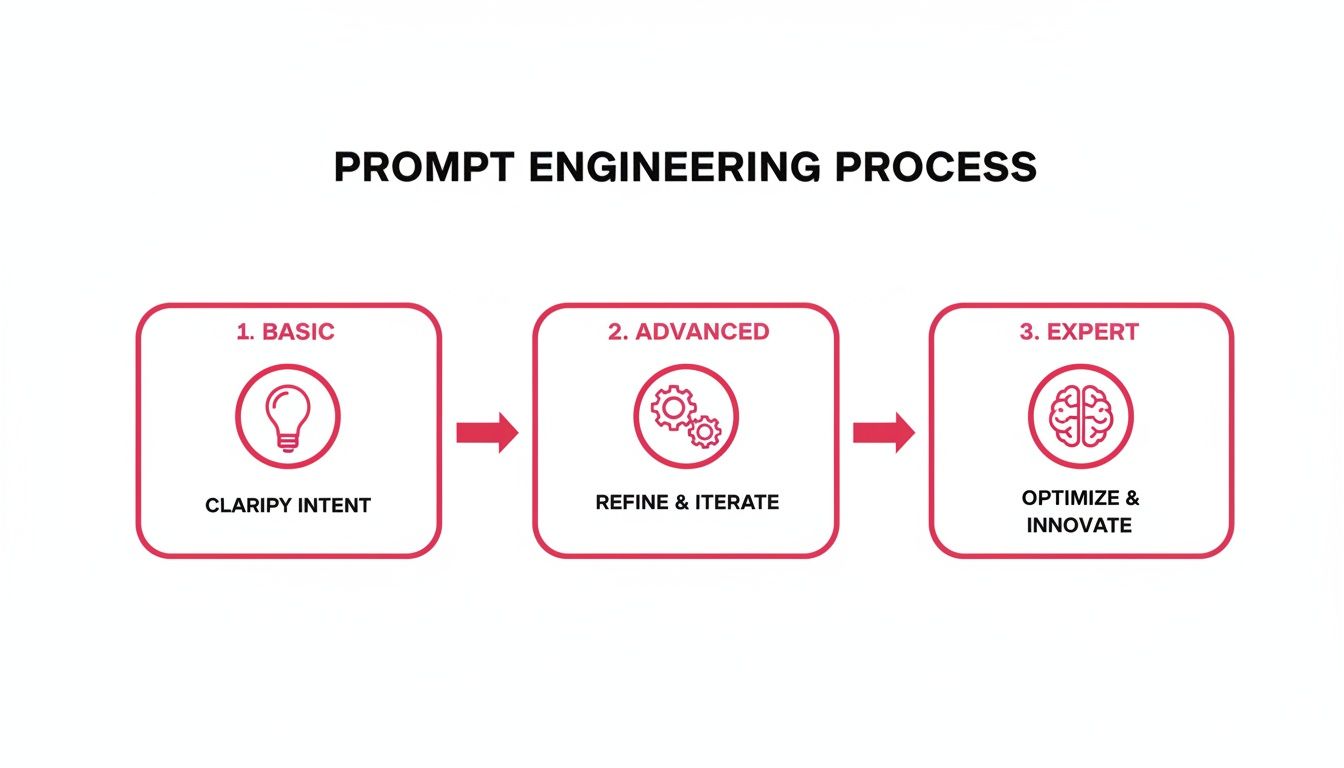
As this shows, building effective automated workflows begins with learning how to give the AI precise and context-rich instructions.
The Regional Push for AI Integration
This drive toward deep integration is happening everywhere, but it's especially pronounced in the UAE. Thanks to government initiatives, the region has become a world leader in AI adoption, with an incredible 59.4% of the working-age population actively using tools like ChatGPT. This enthusiasm is creating the perfect environment for businesses to build more advanced AI-powered systems.
Local business leaders are certainly paying attention. According to recent reports, 66% are already embedding these tools directly into their operations to supercharge tasks like content creation. For a closer look, you can explore detailed insights on the Middle East's AI strategy.
A successful integration strategy isn't just about adopting new software; it's a fundamental part of modern business agility. Creating these automated systems allows startups and established companies alike to operate with greater speed and precision, which is a significant competitive advantage.
Ultimately, integrating ChatGPT into your workflows is about building a smarter, more efficient business. It’s a strategic move that requires a thoughtful approach to both your technology and your processes. To see how this fits into a bigger picture, you might want to read about our approach to digital transformation consulting. Done right, it can fundamentally reshape how your company operates, delivering productivity gains that were once unimaginable.
Of course. Here is the rewritten section, designed to sound like an experienced human expert.
Using ChatGPT Responsibly: A Guide to the Guardrails
To get the most out of ChatGPT, you need to know its limits just as well as its strengths. It’s an incredible tool, but it's not a sentient expert. If you treat it like one, you’re setting yourself up for mistakes that can hurt your brand’s reputation and undo the trust you’ve worked so hard to build.
The smart way to use ChatGPT is with a healthy dose of human oversight. Think of it as a brilliant but sometimes unreliable intern—fast and versatile, but always in need of a final review. This means being crystal clear about its limitations and putting firm guidelines in place for your team.
The Problem with "AI Hallucinations"
One of the biggest pitfalls with ChatGPT is its tendency to make things up. These aren't malicious lies; they're what we call AI hallucinations. The model will state incorrect facts, cite non-existent studies, or invent statistics with absolute certainty. It doesn't know it's wrong—it's just generating what it predicts is the most likely next word, and sometimes that path leads away from reality.
Research has shown that even the most advanced models can get their facts wrong. This brings us to the golden rule for any business: never, ever publish AI-generated content without fact-checking it first. Let ChatGPT handle the first draft, but a human must be the one to verify every single claim, number, and important detail before it sees the light of day.
Keeping Your Data Private and Secure
When your team uses the free, public version of ChatGPT, anything they type in could be used by OpenAI to train its future models. This is a massive security risk if someone pastes sensitive company financials, customer lists, or your secret product roadmap into the chat window.
You absolutely need to set up some internal policies to prevent this.
- Create Clear Rules: Make it a non-negotiable rule that no one inputs personally identifiable information (PII), confidential client data, or any internal company secrets.
- Upgrade to a Business Plan: Look into ChatGPT’s Teams or Enterprise plans. They come with much stricter data privacy controls and a promise that your business data won’t be used for training.
- Train Your People: Don’t just send a memo. Hold a quick training session to explain the "why" behind the rules so everyone understands how to use the tool safely.
Dealing with Inherent Bias
ChatGPT learned from the internet—and the internet, unfortunately, is full of human biases. The model has absorbed stereotypes related to culture, gender, and more, which can sometimes creep into the content it generates. This output might clash with your brand values or, in a worst-case scenario, be genuinely offensive.
To get ahead of these issues, UAE businesses need a clear and practical framework for responsible AI use. This isn't about avoiding AI, but about building a system of checks and balances to catch potential problems before they escalate.
Here's a checklist to help you get started:
Responsible AI Usage Checklist for UAE Businesses
| Action Item | Why It Matters | Implementation Tip |
|---|---|---|
| Establish a "Human-in-the-Loop" Policy | Ensures every piece of AI-generated content is reviewed by a human for accuracy, tone, and brand alignment. | Assign a dedicated editor or team lead to approve all external-facing content, from ad copy to blog posts. |
| Conduct Regular Bias Audits | Proactively identifies and corrects any biased language or stereotypes that the AI might generate. | Periodically review a sample of AI-generated content. Ask a diverse group of employees to check for potentially insensitive material. |
| Mandate Data Privacy Training | Educates your team on what constitutes sensitive information and prevents accidental data leaks. | Run a mandatory 30-minute training session on AI usage policies for all new hires and hold an annual refresher for existing staff. |
| Verify All Factual Claims | Protects your brand's credibility by preventing the publication of "AI hallucinations" or incorrect data. | Create a simple fact-checking process. For statistics, require a link to the original source. For quotes, verify the speaker and context. |
| Maintain Brand Voice Consistency | AI can drift from your brand's unique personality. Human review keeps your messaging consistent and authentic. | Provide the AI with a detailed brand style guide in your prompts, and have a brand manager review the final output. |
| Stay Informed on Regulations | The UAE and global AI regulations are evolving. Staying current ensures your business remains compliant. | Designate someone to monitor updates from regulatory bodies like the UAE's Artificial Intelligence Office. |
The bottom line is that a proactive approach is the only way to manage these risks. The goal isn't to shy away from AI, but to implement a smart system that lets you benefit from its power safely. Every blog post, every social media graphic from a tool like Poster.ly, and every customer-facing email must pass through a human checkpoint.
This "human-in-the-loop" workflow is the key to protecting your brand. It ensures everything you publish is accurate, on-brand, and ethically sound, giving you the confidence to make ChatGPT a true asset for your business.
Picking the Right Plan and Looking at Other Options
Figuring out which AI tool is right for your company is a big decision. While ChatGPT's free version is a great way to dip your toes in the water, any business that's serious about using AI will pretty quickly see the value in a paid plan. Each one is built to tackle different problems and give you access to better features.
The free version is surprisingly capable and works just fine for personal use or quick, one-off tasks. The catch? It can get bogged down during peak hours, which means slower responses, and it lacks the advanced features businesses really need for security and getting real work done.
For most small businesses and startups, upgrading is a no-brainer. This gets you priority access (no more waiting in line!), much faster response times, and the ability to use more powerful models like GPT-4. The difference is noticeable—GPT-4 provides far more accurate and sophisticated answers.
What Do You Get with a Paid ChatGPT Plan?
Once you're ready to commit, ChatGPT has a few different options designed for professional use. The right choice really boils down to how big your team is, whether you need to work together on projects, and how important data privacy is to you.
Here’s a quick look at the main paid tiers:
- ChatGPT Plus: This one’s perfect for individual professionals, freelancers, or small business owners. It unlocks the latest models, gives you a speed boost, and adds powerful tools like data analysis and the ability to upload files, which is a must for any serious business task.
- ChatGPT Team: Built for small-to-medium teams, this plan has everything from Plus but adds a shared workspace, admin controls, and—this is a big one—a guarantee that your business data won't be used to train OpenAI's models.
- ChatGPT Enterprise: This is the top-tier plan for large organisations. It comes with the highest level of security, unlimited high-speed access, and advanced admin tools for managing AI use across the entire company.
A Quick Look at the Competition
While ChatGPT gets a lot of the spotlight, it's definitely not the only game in town. The AI field is packed with powerful tools, and some might be a better fit for your company’s specific needs or the software you already use.
The two biggest names you'll hear are Google’s Gemini and Anthropic’s Claude. Gemini, for example, is woven directly into the Google ecosystem—think Workspace, Google Cloud, and Search. That makes it an incredibly compelling choice if your business already runs on Google. We actually take a closer look at this in our in-depth comparison of ChatGPT and Google Gemini.
The key is to really think about what you need. Are you looking for raw creative power? Seamless integration with your existing tools? Or a model known for being extra cautious and ethical? Your answer will point you to the right tool.
With all these choices, it can be tough to know where to start. We've put together a simple table to help you compare some of the leading generative AI tools at a glance.
Comparing ChatGPT with Leading Alternatives
| Tool | Key Strength | Best For |
|---|---|---|
| ChatGPT | Versatility and a massive ecosystem of plugins and integrations. | General-purpose tasks, creative content generation, and custom workflow automation. |
| Google Gemini | Deep integration with Google Workspace and search capabilities. | Businesses that heavily rely on Google's suite of products for research and productivity. |
| Anthropic's Claude | Strong focus on safety, detailed reasoning, and handling long documents. | Companies in regulated industries or those needing to analyse complex legal or technical texts. |
Ultimately, there's no single "best" tool for everyone. The right choice depends entirely on your team's workflow, your industry, and your specific goals. It's always a good idea to experiment with a few different options before making a final decision.
Common Questions About Using ChatGPT in Business
Jumping into the world of AI can feel like a big step, and you probably have a lot of questions about how a tool like ChatGPT really fits into a business strategy. To clear things up and help you get started, here are some straight-shooting answers to the questions we hear most often from business owners and marketing leaders.
Is Content from ChatGPT Actually SEO-Friendly?
Yes, but there’s a catch. Google has been very direct about this: they reward high-quality content, no matter who—or what—wrote it. The goal is to create content that’s genuinely helpful and reliable for real people. Using AI to churn out spammy, low-value articles just won't cut it.
So, how do you make sure your AI-assisted content hits the mark? It needs to be:
- Valuable: It has to offer real insights and properly answer what the searcher was looking for.
- Accurate: A human needs to step in and fact-check every claim. Your credibility is on the line.
- Polished: The final output should be well-written, engaging, and edited to perfection.
Think of ChatGPT as a very capable research assistant or a first-draft machine. The real magic happens when you and your team add your human expertise on top. That’s what creates content that actually deserves to rank.
How Can I Keep My Brand’s Voice from Sounding Robotic?
This is a big one. Without the right direction, ChatGPT can easily default to generic, soulless text that sounds nothing like your brand. The secret to avoiding this is all in how you ask—what we call prompt engineering.
You need to give the AI a "brand persona" to work with. Get specific. In your prompts, describe your voice with clear adjectives. Are you "witty and informal"? Or "authoritative and professional"? Maybe "friendly and encouraging"? Better yet, paste in a few examples of your best copy and ask it to match that style. By giving it this context every time, you essentially teach ChatGPT to speak your language, keeping your communications consistent and true to you.
What About Data Privacy? Should I Be Worried?
You absolutely should be thinking about data privacy. It’s a huge deal. If you're using the free, public version of ChatGPT, anything you type in could be seen by OpenAI and potentially used to train their models. That’s a massive risk if your team starts plugging in sensitive company secrets, customer information, or details about an upcoming launch.
The best way to handle this is to set up firm ground rules internally: no proprietary or personal data goes into the public tool. Period. For any business that regularly handles sensitive information, upgrading to a plan like ChatGPT Team or Enterprise is the smartest move. These paid versions come with much tighter data controls and a promise that your conversations won't be used for training. It’s the only way to create a truly secure workspace for your team.
At Grassroots Creative Agency, we don't just talk about theory—we help businesses put powerful tools like ChatGPT to work in their marketing. We make sure every piece of content you create is effective, on-brand, and secure. We can even help you build a seamless workflow, from generating killer copy with AI to designing eye-catching visuals with platforms like Poster.ly.