
In a world buzzing with AI, you've probably heard of a few big names. But there's another major player you need to know about: Claude, an advanced AI assistant from Anthropic. Think of it less as a simple tool and more as a versatile digital partner, ready to tackle everything from creative writing and deep data analysis to genuinely complex problem-solving.
Your New Digital Partner for Business Growth
Imagine adding a new team member who can read and summarise a 100-page market research report in minutes. Or one who can draft a month's worth of social media posts in a single afternoon. What if they could brainstorm dozens of ad copy variations while you’re still finishing your morning coffee? That’s the kind of power Claude puts in your hands. It’s not just another app; it's a strategic asset designed to amplify what your team can do.
What really sets Claude apart is how it was built. It runs on a framework Anthropic calls 'constitutional AI.' It's a unique approach focused on safety and reliability, making sure the AI operates within a clear set of ethical principles. This means you get an assistant that’s not only incredibly smart and fast but also dependable and aligned with responsible business practices—a trustworthy partner for handling sensitive company data or customer communications.
Gaining a Competitive Edge in the UAE
The UAE has cemented its reputation as a global hub for technology and innovation. For any business operating in a fast-paced market like Dubai, staying competitive means adopting tools that provide a real, measurable advantage. AI isn't a futuristic talking point anymore; it's a daily reality for companies that are leading the pack.
In fact, the UAE is a global frontrunner in AI adoption. Tools like Claude are already part of the daily workflow for nearly 60% of the working-age population. That staggering 59.4% adoption rate, brought to light in Microsoft's latest AI Diffusion Report, puts the UAE ahead of even tech-forward nations like Singapore. It’s clear proof of how AI is fundamentally changing business strategy.

The platform itself is clean and conversational, empowering teams to jump right in, upload documents, and get intelligent help without a massive learning curve.
To quickly grasp how Claude can fit into your marketing efforts, this table breaks down its key features and their practical applications.
Claude AI at a Glance for Marketers
| Feature | Description | Marketing Application Example |
|---|---|---|
| Large Context Window | Can process and recall information from very large documents (up to 150,000 words). | Analyse an entire year's worth of customer feedback survey results in one go to identify top complaints and praise. |
| Constitutional AI | Built-in ethical principles ensure safer, more reliable, and less biased outputs. | Generate brand-safe ad copy for a sensitive campaign, knowing the AI will avoid harmful or off-brand suggestions. |
| Advanced Reasoning | Capable of understanding complex, multi-step instructions and solving nuanced problems. | Create a detailed, multi-channel marketing plan for a new product launch, including budget allocation and KPI suggestions. |
| Data Analysis | Can interpret charts, graphs, and unstructured data to pull out key insights. | Upload a sales performance spreadsheet and ask Claude to identify the top-performing regions and potential reasons for their success. |
| Creative Content Generation | Excels at writing human-like text, from emails and blogs to scripts and social media posts. | Brainstorm and write five distinct blog post drafts on "The Future of E-commerce in the UAE," each with a different angle. |
This summary highlights just how versatile Claude can be, moving far beyond simple text generation to become a genuine strategic partner for growth.
From Complex Data to Creative Solutions
For marketing managers and business owners, the possibilities are huge. Claude can sift through mountains of customer feedback to spot hidden trends, generate SEO-ready blog posts, or help you nail your brand’s tone of voice. But just having the tool isn't the whole story. The real magic happens when it's integrated strategically.
By partnering with a creative agency, you can move beyond simple prompts and integrate Claude into a cohesive strategy. This builds data-driven marketing solutions that turn AI-powered insights into measurable growth and tangible business outcomes.
For example, a creative brainstorming session with Claude can generate dozens of powerful campaign concepts. Then, a tool like Poster.ly—a direct product of Grassroots Creative Agency—can help visualise those ideas, turning abstract AI outputs into polished, ready-to-launch marketing assets. It's this fusion of AI strategy and hands-on creative execution that gives modern businesses their edge.
Getting to Know Claude’s Core Strengths
So, what actually makes Claude tick? To see why it’s more than just another chatbot, we need to get under the hood and look at the features that give it its power. These aren’t just bullet points on a spec sheet; they’re practical tools that can solve real problems and open up new ways to grow.
Three capabilities, in particular, stand out: its massive context window, its sharp reasoning skills, and its knack for creative writing. One minute, Claude can be a tireless research assistant, and the next, it’s your go-to copywriter. This flexibility is what makes it such a strong contender for businesses.
The Game-Changing Context Window
Imagine trying to follow a complex story by reading only one sentence at a time, forgetting the previous one as soon as you move on. That's a real limitation for many AI models. Claude is different. It has an exceptionally large context window, which is like giving it a fantastic short-term memory. It can process and recall information from huge documents—we're talking up to 150,000 words with some versions.
This is a massive deal for deep analysis. For instance, a Dubai-based e-commerce brand could feed Claude an entire year's worth of customer feedback transcripts. Claude can sift through all of it in one go to spot recurring themes, pinpoint specific complaints, and highlight positive trends to use in the next marketing campaign. It doesn't just read the words; it understands the entire conversation.
Think of the context window as Claude's working memory. A bigger window means it can hold more information in its head at once—entire reports, complex spreadsheets, long email chains—which leads to smarter, more context-aware insights.
This is also great for competitive analysis. You could give Claude the entire website of a key rival and ask for a complete content audit, pulling out their core messaging, SEO strategy, and tone of voice. The insights from that single task could shape your own strategy for months. While other models, like Google Gemini, have their own impressive features, Claude's ability to handle massive documents gives it a clear edge.
Sharp Reasoning and Creative Flair
Claude is more than just an information processor; it’s excellent at reasoning and synthesis. It can connect the dots between different ideas, follow complex, multi-step instructions, and write in a way that feels genuinely human. This isn't just about drafting an email—it’s about creating a strategic proposal or a creative brief that truly gets your brand.
For example, a marketing agency could ask Claude to map out a full-funnel content plan for a new property launch in Abu Dhabi. It could be tasked with creating high-level blog topics for brand awareness, persuasive social media copy for lead generation, and detailed email sequences to nurture potential buyers. Claude's reasoning helps it grasp the different goals at each stage of the journey and produce the right kind of content for each one.
Its creative writing is just as strong. The model can shift its tone from professional and authoritative to playful and casual, making it perfect for all sorts of marketing materials. Whether you need a formal press release or a witty Instagram caption, Claude can whip up quality drafts that need very little editing.
A Powerful Ally for Coding and Automation
One of Claude’s most practical skills for marketing teams is its coding ability. This is being snapped up by tech-savvy firms across the region. In fact, enterprise adoption of Claude in the Middle East, especially the UAE, shows a 4-5x per capita surge, pointing to a sophisticated user base.
Digital marketing agencies are reaping the rewards, with Claude dominating coding tasks at 36% of its uses. Think of it: automating Google Ads scripts or fine-tuning social media algorithms, which can slash campaign costs by 20-35%. You can get the full story in the Anthropic Economic Index report.
A marketing team could use Claude to write a Python script that automatically pulls weekly performance data from multiple ad platforms into one clean report. This doesn't just save dozens of hours a month; it also cuts down on human error, ensuring your big decisions are based on accurate, fresh data. It’s a perfect example of how Claude helps teams work smarter, not harder.
How Claude Compares to Other AI Models
Trying to pick the right AI assistant can feel a lot like being a sports scout. You have a few all-star players like ChatGPT and Gemini, but then you have Claude, an AI that has quietly built a reputation for excelling at specific, high-value tasks. It's not about which model is "smarter" across the board, but about matching the right player to the right position on your marketing team.
Here’s a good way to think about it: if you need a quick, clever caption for a social media post, ChatGPT is your sprinter—fast and agile. But if your goal is to have an AI digest a dense, 50-page market research report and pull out subtle consumer insights, Claude is your marathon runner. Its real power lies in its massive context window, which gives it the endurance to process and remember information from huge amounts of text.
Let's dig into how these models really perform when you put them to work on day-to-day marketing tasks.
A Head-to-Head for Marketers
When you’re on the hook for a campaign, you don’t care about abstract benchmarks. You care about results. Does the AI get your brand voice? Can it actually make sense of the data you feed it? Is the creative output something you can actually use? Those are the questions that keep marketers up at night.
For teams wanting a deeper dive into the nitty-gritty differences between these AI powerhouses, our in-depth guide is a great resource. You can learn more about the specifics in our article on how to use ChatGPT for your business. It really helps clarify where each model shines and where you might run into limitations.
To help you see this in action, here’s a look at how they stack up on common marketing jobs.
Claude vs ChatGPT vs Gemini for Key Marketing Tasks
This table breaks down how the three leading AI models perform on tasks that matter most to marketers. It’s designed to help you decide which tool is the best fit for your specific needs, whether that’s content creation, data analysis, or campaign strategy.
| Marketing Task | Claude | ChatGPT (GPT-4) | Gemini |
| :— | :— | :— |
| Creative Writing Style | excels at producing long-form, thoughtful, and nuanced content with a consistent, natural tone. | highly versatile and creative, especially for short-form content, brainstorming, and generating multiple creative options quickly. | strong at synthesising information from various sources into clear, structured, and fact-driven content. |
| Analytical Accuracy | superior for analysing long documents, reports, and code due to its large context window, providing deep and accurate summaries. | strong analytical skills but can sometimes struggle with recalling details from very long texts in a single session. | integrates well with Google's ecosystem, making it excellent for analysing data from Google Sheets or summarising search trends. |
| Ad Copy Creation | great for developing detailed, persona-driven ad copy that reflects a deep understanding of a target audience. | excellent for rapid A/B testing, generating dozens of creative hooks and calls-to-action in seconds. | effective at creating data-informed ad copy by pulling insights from current market trends and search data. |
| Social Media Calendars | builds comprehensive, strategic content calendars with detailed post descriptions and thematic consistency. | perfect for brainstorming viral-worthy ideas and generating a high volume of engaging, platform-specific post captions. | good for creating topical content calendars that align with current events and trending conversations. |
As you can see, there’s no single "best" AI. The smart move is to build a toolkit and use the right one for the job at hand.
Choosing the Right Tool for the Job
A modern marketing workflow might involve using Claude to draft a detailed white paper, then pivoting to ChatGPT to brainstorm a week's worth of punchy social media posts. The goal is to play to each model's strengths.
This flowchart maps out where Claude fits into different business goals, from heavy-duty document analysis to sophisticated content creation.
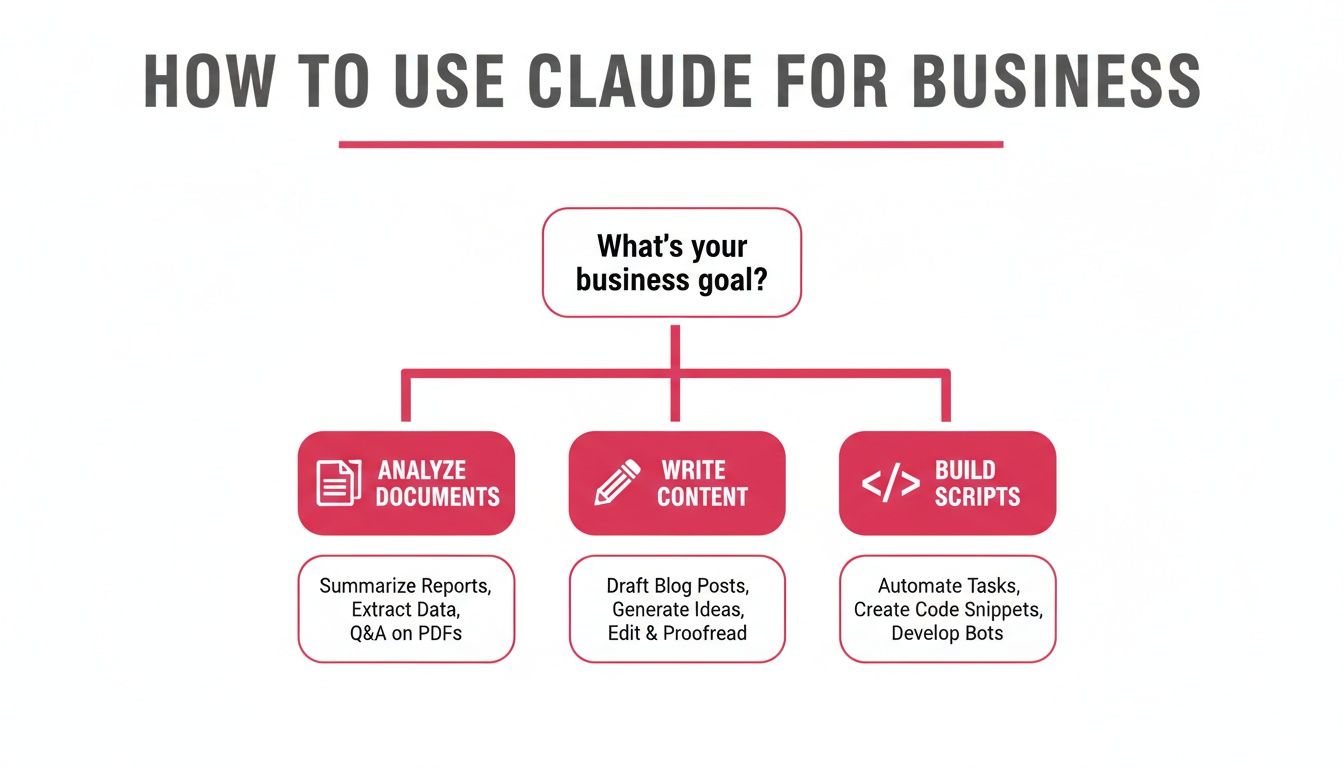
It really highlights Claude’s knack for deep analysis, thoughtful writing, and even technical scripting.
Ultimately, if your work requires depth, context, and a high degree of accuracy with long documents, Claude is a serious contender. Its "Constitutional AI" foundation also gives it a more measured and reliable voice, which is a huge plus when you need brand-safe, carefully considered content. For businesses that live and die by the quality of their detailed analysis and long-form writing, Claude often ends up being the most dependable tool in the box.
Putting Claude to Work in Your Marketing
It’s one thing to talk about what an AI can do, but it’s another thing entirely to see how it can actually make a real difference in your marketing campaigns. Claude isn't just a fancy writing tool; think of it as a versatile partner that can jump in and handle complex, multi-step marketing jobs. From building out SEO-rich content to pulling apart your competitor's strategy, its skills are a direct match for the daily hurdles that businesses in the UAE face.
This section is all about actionable workflows. We'll walk through some practical blueprints you can take, tweak, and put to work for your own brand and team goals.
Content Creation and SEO Strategy
Great content is the engine of modern marketing, but let's be honest—producing it consistently is a massive undertaking. This is where Claude really shines. It's fantastic at drafting long-form content that not only reads well but is also strategically tuned for search engines.
Here’s a simple workflow you could use for your next blog post:
- Topic Ideation: First, get the ideas flowing. Ask Claude to brainstorm topics that are a good fit for your industry and the local UAE market. For instance, a Dubai-based real estate firm could prompt: "Generate 10 blog post ideas about 'luxury property investment in Dubai for expatriates'."
- Outline Generation: Once you’ve picked a winner, ask for a detailed outline. "Create a comprehensive blog post outline for '5 Key Factors for Expats Buying Property in Dubai,' including an intro, key sections with sub-points, and a conclusion."
- Drafting the Content: With the skeleton in place, you can have Claude write the article piece by piece. This gives you more control over the tone and direction. A prompt could be: "Write the introduction for the blog post, using a professional but approachable tone for high-net-worth individuals."
- SEO Optimisation: Finally, get it ready for Google. Ask Claude to polish the draft: "Review this blog post and suggest relevant keywords for the UAE market. Weave them naturally into the headings and body text, and suggest a meta title and description."
This kind of structured approach turns a seriously time-consuming process into a quick and collaborative session between you and your AI assistant. To see how this fits into a bigger picture, you might want to explore our guide on effective AI content creation.
Social Media Management and Visual Brainstorming
A buzzing social media feed needs a constant stream of fresh ideas and eye-catching content. Claude can step in as your social media strategist, helping you plan, write, and even dream up the visuals for your campaigns.
Let's say you're managing the Instagram for a new café in Jumeirah. You could use Claude to:
- Develop a Content Calendar: "Create a one-week Instagram content calendar for a new artisanal café in Dubai. Include daily themes (like 'Meet the Barista Monday'), post ideas, engaging captions, and relevant hashtags."
- Brainstorm Visual Concepts: Claude can't create images itself, but it can give your designer a brilliant brief. "Provide three creative visual concepts for an Instagram Reel promoting our new saffron latte. Describe the shots, camera angles, and background music needed."
- Generate Engaging Copy: From witty captions to interactive polls, Claude can spit out all sorts of text. "Write five different Instagram story poll questions to engage our followers and learn about their coffee preferences."
This frees up your team to focus on bringing the ideas to life while Claude handles the grunt work of planning and copywriting. You can take these AI-generated concepts and easily turn them into finished assets with tools like Poster.ly.
Paid Advertising and Ad Copy Variation
Strong paid ad campaigns on platforms like Meta and Google Ads hinge on testing. You need to try out multiple ad variations to discover what truly connects with your audience. This is where Claude’s speed is a game-changer.
One of the biggest enemies of a paid ad campaign is 'ad fatigue'—when people have seen your ad so many times they just tune it out. Claude helps you fight this by generating dozens of unique ad copy variations in seconds, making continuous A/B testing simple.
Imagine you're running a Meta Ads campaign for a fashion brand's new Ramadan collection. You could ask Claude to:
- Generate Headline Variations: "Write 10 different headlines for a Facebook ad promoting our new Ramadan fashion collection. Target women aged 25-45 in the UAE and use a mix of aspirational and benefit-driven language."
- Draft Ad Body Copy: "Create three versions of ad body copy. One should focus on elegance and tradition, another on modern style, and a third on the limited-time offer."
- Suggest Calls-to-Action (CTAs): "Provide five compelling CTAs for this campaign, like 'Shop the Collection,' 'Discover Your Eid Look,' and 'Embrace Tradition.'"
This rapid-fire generation gives you a deep well of creative to pull from, letting you run more agile and effective ad campaigns that get better results.
Market Research and Competitor Analysis
You can't build a winning strategy in a vacuum; you have to know your market and your competition inside and out. Claude's large context window is perfect for this. It can digest huge amounts of text—like competitor websites or industry reports—and pull out the actionable insights for you.
For a tech startup in Abu Dhabi, this could look like feeding Claude a competitor's URL and asking: "Analyse this website's content to identify their core value proposition, target audience, and key marketing messages. Summarise their content strategy and tone of voice."
Or, you could upload a dense industry report and prompt: "Read this market research report on the UAE's fintech sector and summarise the top three emerging trends and strategic opportunities for a new payment gateway startup." A task that used to take hours of manual reading can now be done in minutes, giving you a huge strategic leg up.
Getting Claude to Work for Your Business
Alright, so you understand what Claude is. The next step—and where the magic really happens—is weaving it into your team's day-to-day work. Just buying a subscription isn't enough; you need a game plan to make sure it's actually helping you hit your goals and not just another shiny new toy. A little strategy here goes a long way in turning Claude’s potential into real, measurable results.
First things first, you need to pick the right plan. Anthropic has a few different options, and what you choose depends on what you need. A free or lower-tier plan is perfect for letting your team dip their toes in and see what Claude can do. But once you're ready to get serious with content creation, data analysis, or customer support, you'll likely need the Pro or Team plan to handle the workload.
With access sorted, the focus has to shift from the tech to the people. Getting the most out of Claude has less to do with the tool itself and more about teaching your team how to "talk" to it.
Teach Your Team How to Ask the Right Questions
Handing your team a login to Claude without any training is like giving someone a high-performance car without driving lessons. The quality of what you get out is entirely dependent on the quality of what you put in. This is where prompting becomes a mission-critical skill. It’s all about teaching the AI exactly what you need by giving it clear context, setting the right tone, and telling it how to format the answer.
You can start with some simple, hands-on training sessions. A great mental model is to treat Claude like a brilliant but very literal junior assistant who needs explicit instructions. For example, "Write a social media post" is way too vague.
A much better prompt is: "Write an upbeat Instagram caption for our new organic coffee blend launch. Make sure you mention its rich flavour and ethically sourced beans. Give me three relevant hashtags that would resonate with the Dubai foodie community." See the difference?
Think of a great prompt as a creative brief for your AI. The more detail, context, and specific constraints you provide, the closer the final output will be to your vision.
A Starter Kit of Prompt Templates
Here are a few templates to get your team started. Encourage them to tweak these to match your brand’s voice and the specific goals of each project.
- For Brainstorming Blog Posts: "Generate 10 blog post titles for a [Your Industry] company that sells to [Your Audience] in the UAE. The ideas should revolve around [Main Theme] and include keywords like [Keyword 1] and [Keyword 2]."
- For Writing Ad Copy: "Write 3 versions of a Facebook ad for our [Product/Service]. I need a headline that grabs attention, body copy that focuses on [Key Benefit 1] and [Key Benefit 2], and a call-to-action that feels urgent. Keep the tone [Adjective, e.g., professional, playful, luxurious]."
- For Handling Customer Service: "Draft a polite and empathetic email for a customer who's unhappy with their recent purchase. You need to acknowledge their frustration, apologise for the problem, and offer [Specific Solution, e.g., a full refund or a replacement item]."
When you bring a tool like Claude into your workflow thoughtfully, you’re building a marketing machine that’s both creative and backed by data. It's about working smarter, not just harder—automating tedious tasks and finding insights that actually push the business forward. For example, you could have Claude automate campaign reporting and then use a tool like Poster.ly to quickly whip up visual assets based on the insights it finds.
Understanding Claude's Limitations and Ethical Use
As impressive as Claude is, it's not magic. Like any powerful tool, you have to understand its limits to use it well. Treating any AI as a flawless oracle is a surefire way to run into problems, so knowing its boundaries from the start is key to using it responsibly and getting real value.
All large language models, Claude included, can sometimes get things wrong. This phenomenon is often called "hallucination," where the AI confidently states an incorrect fact or misremembers a detail from a document you just gave it. This is precisely why human oversight is non-negotiable.
Navigating Biases and Data Privacy
Bias is another reality we have to confront. These models are trained on immense amounts of text written by humans, and they inevitably absorb the biases contained in that data. You might see this pop up in subtle ways—maybe slightly skewed language or assumptions based on stereotypes. It's something to watch out for.
Data privacy is an even bigger deal, especially if you're working with sensitive customer data or your company's secret sauce. While Anthropic has strong privacy policies, your business needs its own clear rules about what kind of information is safe to upload to a third-party AI.
Anthropic’s "Constitutional AI" approach is a fascinating attempt to tackle these issues head-on. They've built a set of ethical principles right into the model to guide it toward being helpful, harmless, and honest. But it’s a risk-reduction framework, not a magic wand that eliminates all potential problems.
This all points to one core truth: Claude is a phenomenal assistant, but it's not a replacement for human judgment and experience. Its job is to enhance what your team can do, not to make their decisions for them.
Best Practices for Responsible AI Use
To bring Claude into your workflow safely, you need to set some ground rules for the team. This makes sure everyone is on the same page about how to get the most out of the tool while steering clear of the pitfalls.
Here are a few practical tips to get you started:
- Always Fact-Check: Think of everything Claude produces—especially stats and factual claims—as a first draft. Always double-check critical information with trusted sources before you publish it or make a decision based on it.
- Maintain Human Oversight: A human expert should review every piece of content, analysis, or code before it goes out the door. This final pass is crucial for catching errors, ensuring quality, and making sure it sounds like your brand.
- Develop Clear Internal Guidelines: Create a company policy that clearly states what data can and cannot be used with Claude. This should explicitly prohibit inputting personally identifiable customer information or confidential company strategies.
- Promote Creative Collaboration: Encourage your team to use Claude as a brainstorming partner and a drafting assistant. The final strategic direction and creative polish, however, should always come from a person. AI can generate the clay, but a human artist needs to shape it. For instance, you could use it to brainstorm campaign ideas and then use a tool like Poster.ly to bring those concepts to life with professional, on-brand designs.
Frequently Asked Questions About Using Claude
Jumping into any new AI tool always comes with a handful of questions. Let's tackle some of the most common ones that business owners and marketers have about getting the most out of Claude.
Is Claude Better Than ChatGPT for Business Use?
This is the big question, isn't it? The truth is, there's no single "better" option—it's more about picking the right tool for the right job. I like to think of them as two highly specialised employees.
ChatGPT is often your go-to for quick-fire creativity. It's fantastic for brainstorming a dozen blog post ideas in a minute, whipping up snappy social media captions, or just getting a wide range of creative thoughts on paper fast.
Claude, however, plays a different game. It truly excels when you need it to handle complexity and depth. Its massive context window is the star of the show, allowing it to digest and analyse huge documents—think annual reports, dense market research, or a giant file of customer feedback—with incredible accuracy. If your task requires nuanced analysis, maintaining a consistent brand voice across a long report, or just having a more cautious and reliable AI partner, Claude is almost always the stronger choice.
How Secure Is Our Business Data When Using Claude?
Data security is, and should be, top of mind for any business. Anthropic, the team behind Claude, has made safety and privacy a core part of their mission. They have clear data handling policies, and they state they don't train their commercial models on your inputs or outputs unless you give them explicit permission to do so.
But security is a two-way street. Your team also has a role to play. It's absolutely vital to create and enforce internal guidelines about what kind of information is appropriate to upload.
As a rule of thumb, never feed personally identifiable information (PII) or your most sensitive strategic documents into any third-party AI. Treat Claude like a brilliant but external consultant—powerful, but always engaged with a security-first mindset.
What Is the Best Way to Start Using Claude?
The key is to start small and solve a specific, high-value problem. Don't try to boil the ocean by using Claude for everything all at once. Instead, find one real bottleneck your team is struggling with. Maybe it's the constant grind of blog content creation, the time it takes to analyse competitor websites, or just drafting enough ad copy variations for a new campaign.
Here’s a simple way to get started:
- Find the Pain: Pinpoint one marketing task that's repetitive or just a major time-sink.
- Train on Prompting: A quick workshop can make all the difference. Teach your team the basics of writing clear, detailed prompts to get better results.
- Run a Small Pilot: Dedicate one week to using Claude for that single task. Afterwards, get together, review the output, and see what everyone thinks.
This focused approach helps your team build confidence with the tool and see real, tangible wins right away. It makes the whole process of bringing a new tool on board much smoother and far more likely to stick.
At Grassroots Creative Agency, we help businesses integrate powerful tools like Claude into a cohesive marketing strategy that drives real growth. To see how we can build a data-supported, content-driven plan for you, explore our services at https://poster.ly/.