Finding the right Dubai creative agency isn't just about hiring a supplier; it's about bringing on a partner who can turn your business ambitions into real, tangible results. This is especially true in a market as fast-paced as Dubai, where you need a team that gets your vision and has the creative muscle to bring it to life.
First Things First: Define Your Goals Before You Start Searching
Before you even open a browser tab to search for agencies, the most important work needs to happen within your own team. I can't stress this enough: a thorough internal audit is non-negotiable. It’s the single best way to avoid partnering with a mismatched agency, saving you a world of headaches, time, and money down the line.
Get started by putting together a detailed brief that spells out exactly what you want to achieve. Vague goals like "we want more brand awareness" won't cut it. You need to dig deeper and define specific, measurable outcomes that directly impact your bottom line.
Pinpoint Your Primary Objectives
What does success actually look like for your business over the next 6-12 months? The answer to that question will immediately narrow down the type of agency you should be looking for.
Think about which of these common goals is your top priority:
- Boosting E-commerce Sales: Is your main focus on driving direct revenue through your online shop? If so, you'll need an agency with proven expertise in conversion rate optimisation (CRO) and laser-targeted paid advertising.
- Generating B2B Leads: For businesses looking to fill their sales pipeline, the right partner will be a master of B2B content marketing, strategic LinkedIn campaigns, and effective lead nurturing funnels.
- Executing a Complete Brand Overhaul: This is a big one. It’s a major project that demands a full-service agency capable of handling brand strategy, visual identity, core messaging, and a new website launch from top to bottom.
- Improving Social Media Engagement: Maybe your goal is to build a vibrant community and create die-hard fans. This calls for a team that lives and breathes creative content and knows how to spark genuine conversations.
To get a clearer picture of what's possible, it’s worth exploring the various services in digital marketing to see how different tactics align with your specific aims.
Use this simple checklist to clarify what you need and what kind of results you expect.
Matching Your Business Goals to Agency Services
| Business Objective | Required Creative Services | Key Performance Indicator (KPI) |
|---|---|---|
| Increase Online Sales by 20% | Paid Ads (Google, Meta), Conversion Rate Optimisation, E-commerce SEO | Return on Ad Spend (ROAS), Conversion Rate, Average Order Value (AOV) |
| Generate 50 Qualified B2B Leads per Month | Content Marketing (Blogs, Whitepapers), LinkedIn Lead Generation, Email Marketing | Cost Per Lead (CPL), Marketing Qualified Leads (MQLs), Lead-to-Customer Rate |
| Relaunch Brand and Website in 6 Months | Brand Strategy & Identity, Web Design & Development, Go-to-Market Strategy | Website Traffic, Time on Page, Branded Search Volume |
| Double Social Media Engagement Rate | Social Media Strategy, Content Creation (Video, Graphics), Community Management | Engagement Rate (Likes, Comments, Shares), Follower Growth, Reach & Impressions |
Having this clarity from the outset makes your conversations with potential agencies far more productive.
Set a Realistic Budget
Figuring out your budget isn't just about numbers; it's about showing potential partners that you're serious. Here in the UAE, marketing budgets are getting smarter. Most companies allocate 8-12% of their total revenue to marketing, but you'll see high-growth businesses pushing that closer to 12-20%. It’s all about investing in channels that deliver a clear and measurable return.
A well-defined budget and a clear set of objectives are the two most powerful tools you have. They filter out unsuitable agencies from the start and attract partners who are confident they can deliver the results you need.
Once you’ve done this internal work, your search is no longer a random shot in the dark—it’s a strategic mission. You're not just looking for any Dubai creative agency; you're looking for your creative agency.
How to Look Past the Polish and Really Vet an Agency's Portfolio
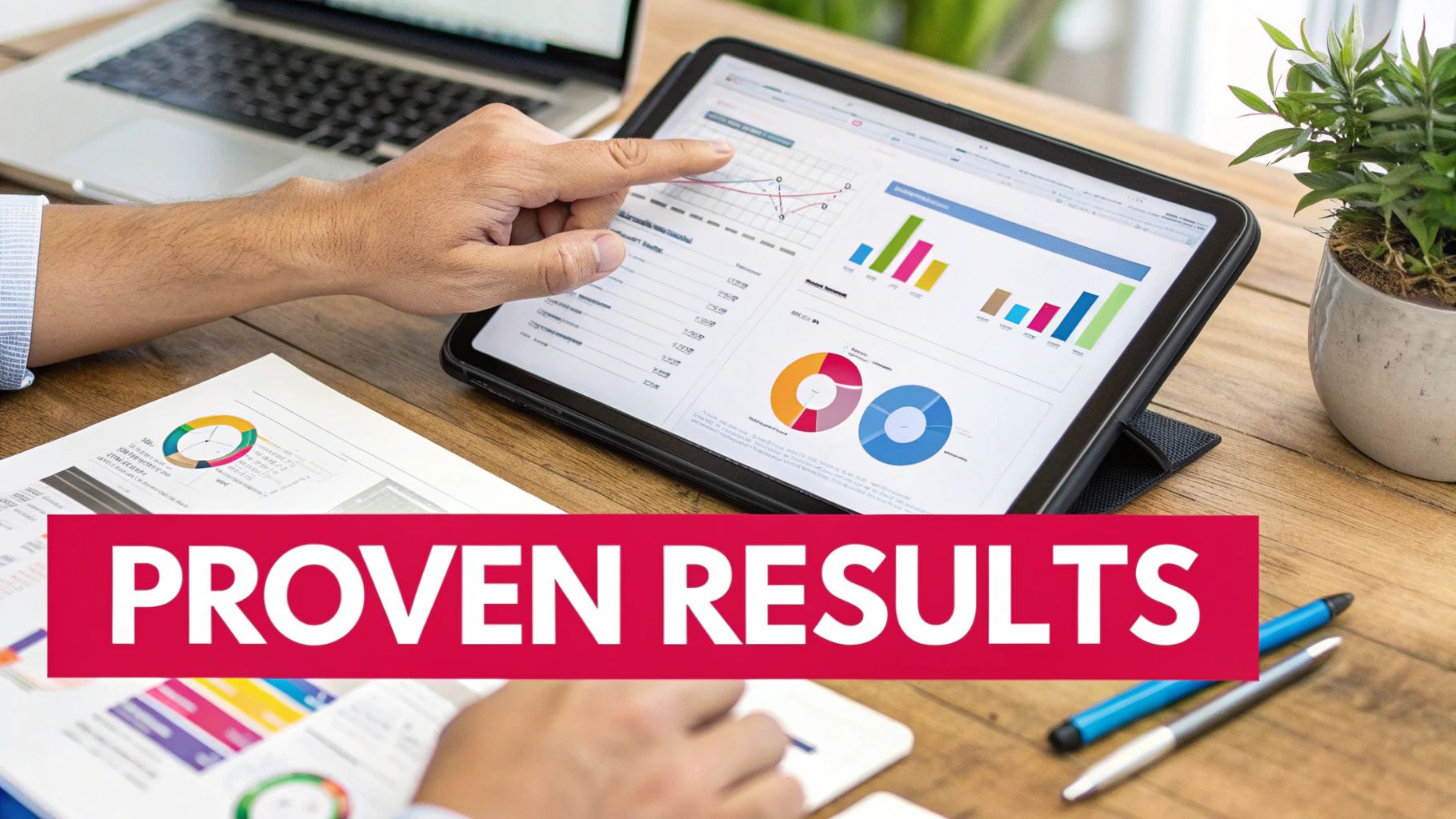
You've got your shortlist of potential partners. Now, it's time to dig deeper. Forget the polished homepages and the cool logos for a moment. Any half-decent agency can build a slick website; what you're looking for is a portfolio packed with genuine, measurable results. This is where the real contenders separate themselves from the pretenders.
The best portfolios don’t just show you what an agency made. They show you why they made it and—most importantly—what it actually achieved for the client. Your goal is to find detailed case studies that walk you through the entire project, because a truly capable Dubai creative agency will be eager to share the full story behind their wins.
Look for the Story Behind the Success
A great case study reads less like a gallery and more like a business report. It should lay out a clear narrative that showcases their problem-solving chops. As you go through their work, keep an eye out for this kind of structure:
- The Initial Challenge: What was the client's actual problem? Were they struggling with low lead generation, invisible brand recognition, or flatlining e-commerce sales?
- The Strategic Approach: How did the agency break down the problem? What was their game plan to fix it? This part reveals how they think.
- The Execution: A quick look at what they delivered – was it a full-scale ad campaign, a website overhaul, or a new content strategy?
- The Measurable Outcomes: This is the most critical piece of the puzzle. You need to see hard numbers, percentages, and real-world results that tie directly back to that initial challenge.
Watch out for vague claims like "increased engagement" or "boosted brand awareness." These are red flags. You should be demanding concrete proof, like "achieved a 45% increase in qualified leads" or "drove a 2.5x return on ad spend in the first quarter."
Check for Industry Relevance and Creative Fit
While a versatile agency has its merits, nothing beats proven experience in your specific sector. An agency that already gets the nuances of your industry—whether it's real estate, fintech, or hospitality—can hit the ground running and produce work that actually connects with your audience. Their portfolio should prove they can speak your customers' language.
Just as crucial is finding the right creative alignment. Does their overall aesthetic feel like a good match for your brand’s personality? If you're a luxury brand, you probably don't want an agency whose portfolio is full of bright, cartoonish graphics. You’re looking for a style that feels like a natural extension of your own. It's worth spending some time getting familiar with the different styles of various design agencies in Dubai to see what clicks.
The UAE's creative sector is absolutely booming, part of a wider regional push to become a global creative hub. The graphic design market alone is set to be worth AED 2.4 billion in 2025, growing at an impressive 9.3% CAGR since 2020. This explosive growth means there's an incredible amount of talent out there, but it also makes it essential to find an agency that genuinely gets you.
Finally, don't just gloss over the client testimonials. A few lines of authentic praise from a past client can tell you more about the working relationship than any polished case study ever could.
Understanding Agency Pricing and Contracts
Getting the money talk right is one of the most important parts of building a solid relationship with your new Dubai creative agency. When you nail this part from the get-go, you sidestep future headaches and make sure everyone feels like they're getting a fair deal. It all comes down to finding a financial arrangement that fits your budget, the scale of your project, and how you prefer to work.
Most agencies in Dubai will propose one of a few standard pricing structures. Each has its pros and cons, and knowing the difference will put you in a much stronger negotiating position.
Decoding Common Pricing Models
Let’s get into the nitty-gritty of how agencies typically charge.
-
Monthly Retainer: This is your classic setup for ongoing work. You pay a set fee every month for a pre-defined list of services, like managing your social media channels or handling your SEO. It's fantastic for predictable budgeting and really allows the agency to sink their teeth into your brand, becoming a genuine part of your team.
-
Project-Based Fee: Got a one-and-done job with a clear finish line? Think website redesign or a complete branding overhaul. A project-based fee is perfect here. You agree on a single, fixed price for the entire scope of work, so there are no surprises on the final invoice.
-
Performance-Based Model: This is where things get interesting. In this model, the agency's compensation is directly linked to the results they deliver. It could be a percentage of your ad spend or a flat fee for every qualified lead they generate. It’s a powerful way to make sure your agency’s goals are perfectly aligned with your own business objectives.
So, which one is right for you? If you need continuous marketing support, a retainer is almost always the answer. If you have a specific, contained project, the fixed fee is your best bet.
What to Look for in Your Contract
Don't just skim the contract – it’s the rulebook for your entire partnership. A solid agreement protects you and the agency, laying out expectations so clearly that there’s no room for misinterpretation.
Before you put pen to paper, double-check that the contract covers these points in detail:
- Clear Deliverables: What are you actually getting? The contract needs to be specific. Not just "social media management," but "12 static posts and 4 reels per month."
- Detailed Timelines: When will things get done? Look for key milestones, review periods, and a final delivery date. This keeps everyone accountable and the project moving forward.
- Payment Schedule: This should spell out exactly when and how you’ll be invoiced—whether it's a 50% deposit upfront, monthly payments, or upon hitting certain project milestones.
- Termination Clauses: Life happens. The contract should clearly state how either side can end the agreement and what the required notice period is.
- Scope of Work: This is the big one. It must detail every single task and service included in the price. This is your best defence against "scope creep," that sneaky process where a project keeps growing bigger and bigger without any adjustment to the budget.
A transparent, detailed contract is the hallmark of a professional agency. If a potential partner is cagey about putting things in writing or uses fuzzy, ambiguous language, that’s a major red flag.
By taking the time to scrutinise these details, you can kick off the partnership on the right foot, confident that you’ve laid the groundwork for a successful and stress-free collaboration.
Measuring What Matters: KPIs and Real Results
A partnership with a Dubai creative agency lives and dies by its results. Sure, you want brilliant creative work, but if it isn't moving the needle for your business, what's the point? This is where Key Performance Indicators (KPIs) come in. Setting them from the very beginning is how you build a relationship based on accountability, not just aesthetics.
It’s incredibly easy to get sidetracked by "vanity metrics." A spike in Instagram 'likes' or a growing follower count feels great, but these often don't translate into actual business growth. We need to look deeper. The metrics that truly define success are things like lead conversion rates, customer acquisition cost (CAC), and return on ad spend (ROAS). These are the numbers that tie directly back to your revenue.
Building a Reporting Framework Together
Don't just accept a standard, cookie-cutter report from your agency. The best partnerships involve co-creating a reporting framework that’s built around your specific business goals. A report shouldn't just be a data dump; it needs to tell a story with context, analysis, and a clear plan for what comes next.
So, what does a genuinely useful report look like? It should always cover:
- Performance Analysis: A straightforward summary showing how we’re tracking against the agreed-upon KPIs.
- Actionable Insights: This is the crucial "so what?" behind the numbers. Why did that campaign smash its targets? Why did another one fall flat?
- Next Steps: Clear, concrete recommendations for what we should do next based on what we’ve learnt.
A great agency partner doesn’t just report the numbers—they interpret them. They connect the dots between their work and your business growth, offering strategic advice to make the next month or quarter even better.
This collaborative approach makes sure everyone is on the same page and working towards the same definition of success. If you want to dive deeper into which metrics you should be tracking, getting familiar with the fundamentals of strong marketing performance indicators is a great starting point. It'll arm you with the knowledge to ask the right questions and ensure your agency is delivering what really counts.
Tools and Transparency: The Keys to a Smooth Partnership
The right tools can make a world of difference when it comes to transparency and smooth collaboration. For example, using a shared social media scheduler like Poster.ly can give you a real-time window into the entire content process—from drafting and approvals to publishing and performance tracking. This eliminates the back-and-forth and builds a much stronger, more trusting partnership.
Finally, regular review meetings are non-negotiable. These weekly or bi-weekly check-ins are your chance to discuss progress, troubleshoot any issues, and make quick adjustments to the strategy. This constant communication loop is what keeps both teams aligned and focused on one thing: achieving tangible, impressive results for your business.
Onboarding Your Agency and Spotting Red Flags
The first 90 days with your new Dubai creative agency are where the rubber meets the road. This period doesn't just kick things off; it sets the tone for your entire partnership. A structured, thoughtful onboarding is one of the clearest signs you've picked a winner.
Think of it this way: your job is to give them the keys to the car so they can start driving. The faster they have access to the right tools, assets, and people, the faster you'll start seeing results.
Laying the Groundwork for a Strong Start
A good agency will come prepared with an onboarding checklist, but don't wait for them to ask. Get ahead of the game by pulling together everything they’ll need.
- Your Brand's DNA: Gather your logo files, detailed brand guidelines, fonts, colour codes, and any marketing materials you already have.
- Access to Data: They'll need a look under the hood. Grant access to your Google Analytics, Meta Business Suite, and any other platforms you use to track performance.
- The Right People: Make the introductions. Connect the agency team with your key internal stakeholders to avoid bottlenecks in communication and approvals down the line.
When you're proactive like this, you dramatically cut down the 'getting to know you' phase and empower them to get to work.
Setting the Rules of Engagement
I’ve seen more agency partnerships fall apart due to poor communication than anything else. It’s a silent killer. Right from the start, you need to agree on how you'll talk to each other.
Decide on your main channel for daily chatter—whether that’s Slack, Microsoft Teams, or plain old email—and commit to it.
Then, talk about the details. What’s a reasonable response time? How often will you have check-in calls? A weekly cadence is usually a good starting point. What qualifies as a true emergency that needs an all-hands-on-deck response? Getting this sorted early builds trust and prevents a lot of future headaches.
A partnership thrives on clarity. A great agency will lead this conversation, but if they don't, take the initiative. Defining how you’ll work together is just as important as defining the work itself.
This little bit of housekeeping ensures your collaboration is built on a solid foundation, focused on shared goals instead of logistical friction.
The best relationships follow a simple, powerful cycle: set clear goals, report on what's happening, review the results together, and then refine your approach. It’s a constant loop of improvement.

As this shows, success isn't a one-time event. It’s an iterative process that relies on consistent communication and a willingness to adapt based on what the data tells you.
How to Spot Trouble Early On
Even with the best start, things can sometimes drift off course. The first few months are your best opportunity to spot red flags before they turn into full-blown crises.
Keep your eyes peeled for these warning signs:
- Radio Silence: If you’re consistently waiting on replies, seeing meetings get cancelled, or getting vague, non-committal updates, that’s a major problem.
- Deadlines Are Just Suggestions: A small delay here and there is understandable, but a pattern of missed deadlines without a heads-up points to poor project management.
- They're Just Order-Takers: Are they bringing fresh ideas to the table? Are they challenging your assumptions? If not, you've hired a pair of hands, not a strategic partner.
This is especially important in a market that’s growing as fast as ours. The wider Middle East marketing and advertising sector is set to expand from USD 7.79 billion in 2024 to USD 8.18 billion in 2025—a healthy jump of 4.7%. With that kind of growth, you need an agency that thinks strategically, not just one that executes a to-do list. You can dig deeper into MENA branding market and its trends to see just how competitive it's getting.
Catching these issues early gives you a chance to get the relationship back on track. And if you can't, it allows you to make a clean break and find a better fit, saving you time, money, and frustration.
Common Questions About Hiring a Dubai Creative Agency
Entering into a partnership with a creative agency in Dubai is a significant step, so it's only natural to have a few questions swirling around. Getting straight answers is the only way to feel confident you're making the right call. Here are some of the most common things we get asked, with some real-world advice to help you out.
How Much Will a Dubai Creative Agency Cost?
This is usually the million-dollar question, and the honest-to-goodness answer is: it really depends. The price tag is tied directly to the agency's size and reputation, but most importantly, to the exact scope of work you need them to do.
For instance, a simple monthly retainer for social media management might start at a few thousand dirhams. On the other end of the spectrum, a massive project like a full rebrand coupled with a new website build could easily climb into the tens, or even hundreds, of thousands.
Most agencies you meet will work on one of three payment structures:
- Monthly Retainer: Best for ongoing services where you need consistent support.
- Fixed Project Fee: Ideal for one-off jobs with a clear beginning and end.
- Hourly Rate: Usually reserved for smaller, ad-hoc tasks or consultations.
The most important thing? Insist on a proposal that breaks down every single cost. Full transparency is non-negotiable and the only way to make sure you don’t get hit with nasty financial surprises down the line.
Should I Go Niche or Full-Service?
This really boils down to what you’re trying to achieve right now.
If you have a very specific, laser-focused goal—say, running high-performance marketing campaigns for your e-commerce store—a niche agency could be perfect. They live and breathe that one specialism, offering an incredible depth of expertise that a generalist might lack.
However, if your vision is bigger and needs multiple threads woven together—branding, web design, content, and paid ads—a full-service agency is almost always the smarter bet. They provide a cohesive, unified strategy, ensuring every piece of your marketing puzzle fits together perfectly. It also saves you the immense headache of trying to manage and coordinate several different specialist agencies yourself.
Think of a full-service partner as the central hub for your entire marketing machine. They ensure your message stays consistent and your strategy is unified across every single channel.
What Does a Good Onboarding Process Look Like?
Any agency worth its salt will have a proper, structured onboarding process. This isn't just about paperwork; it's the bedrock of your entire working relationship.
It should always kick off with a detailed meeting to get everyone on the same page about goals, KPIs, and what success actually looks like.
After that, they'll need you to hand over the keys to the kingdom: access to brand assets, analytics accounts like Google Analytics, and introductions to the key people on your team. The agency will then do its own deep dive, getting under the skin of your brand, your competitors, and your audience.
Be prepared for the first 30-60 days to be heavily focused on strategy and planning before the real campaign execution gets underway. How an agency communicates during this critical early phase is a massive tell. Clear, proactive updates are the hallmark of a healthy partnership, and a great Dubai creative agency will make this whole process feel effortless.
At Grassroots Creative Agency, we’re all about building partnerships based on transparency and results you can actually see. Our team blends bold, creative storytelling with sharp data insights to connect your brand with the right audience and drive genuine growth. And for businesses looking to get a better handle on their social media, our team built Poster.ly, a tool designed to make content planning and approvals a whole lot simpler.