So, what does a PPC advertising agency actually do? In short, they manage your paid ad campaigns on platforms like Google Ads and Meta Ads, taking care of everything from keyword research and budget management to writing ad copy and analysing performance. The goal is to maximise your return on investment by applying expert strategies you might not have the time or specialised knowledge to build on your own.
When Is It Time to Partner With A PPC Agency?
Knowing when to hire a pay-per-click advertising agency is a huge decision for any growing business. It’s usually the moment when managing campaigns in-house goes from being a productive task to a real roadblock to growth.
Many businesses hit a wall. Their initial ad success starts to flatline, and they simply don't have the deep, nuanced expertise to figure out why or how to break through that plateau. This is where an agency's strategic value really shines. It’s not just about setting up a few ads; it's about untangling complex platform algorithms, running deep-dive competitor analysis, and making every pound of your ad spend work harder.

Signs Your Business Needs an Agency
Recognising the right time to call in the experts can save you a ton of time and wasted money. If any of the following scenarios sound a little too familiar, it's a good sign that an agency partnership should be on your radar.
- You're Out of Time and Resources: Your team is already wearing too many hats. Effective PPC management is a full-time commitment that demands constant monitoring and tweaking—something most business owners or small marketing teams just can't sustain.
- Your Results Have Stalled: Those early wins that felt so great have fizzled out. The strategies that used to work aren't delivering anymore, and you're not sure which levers to pull to get things moving again.
- You're Burning Through Your Budget: You see the money going out, but you can't confidently connect that spend to real business results like qualified leads or actual sales. An agency can quickly spot wasted spend and redirect your budget toward what's actually working.
- You Need More Advanced Skills: You're ready to try more sophisticated tactics like remarketing, Google Shopping campaigns, or multi-channel advertising, but you don't have the technical skills in-house to execute them properly.
A big "aha!" moment for many businesses is realising they're amateurs competing against professionals. Your top competitors are almost certainly using a specialist agency, which gives them a serious edge in both strategy and day-to-day execution.
The Strategic Shift from DIY to Professional Management
Bringing on a pay-per-click advertising agency isn’t just about offloading a task; it's a strategic upgrade for your entire marketing function. An agency brings a dedicated team of specialists—strategists, copywriters, data analysts, and designers—who are completely immersed in the world of paid advertising. This depth of experience, gathered from working across countless industries and accounts, is something an in-house person can rarely match.
Here's a look at how that strategic approach differs from a typical in-house effort.
| Area of Focus | Typical In-House Approach | Specialist Agency Strategy |
|---|---|---|
| Keyword Strategy | Focuses on broad, high-volume keywords. | Targets a mix of high-intent long-tail keywords and broader terms, using sophisticated negative keyword lists to eliminate waste. |
| Budget Allocation | Spreads budget evenly or based on guesswork. | Uses data-driven models to allocate budget to the highest-performing campaigns, platforms, and even specific times of day. |
| Ad Creative | Uses a few ad variations and refreshes them infrequently. | Continuously A/B tests dozens of ad copy, headline, and image variations to find the optimal combination for conversions. |
| Performance Analysis | Tracks basic metrics like clicks and CTR. | Focuses on bottom-line metrics like Cost Per Acquisition (CPA) and Return on Ad Spend (ROAS), connecting ad performance directly to revenue. |
| Technology & Tools | Relies on the default platform tools. | Leverages a suite of advanced third-party tools for competitive analysis, bid management, and reporting automation. |
This table shows it's not just about doing the same tasks better; it's about a fundamental change in approach, moving from reactive management to proactive, data-informed strategy.
For example, an experienced agency understands the unique dynamics of competitive markets and can tailor campaigns to stand out. If your business is struggling to generate high-quality leads, an agency can overhaul your audience targeting and messaging to attract the right people. For an e-commerce brand, they can optimise product feeds and bidding strategies to drive sales directly.
This focused expertise is often the missing piece needed to turn stagnant campaigns into reliable revenue generators. It’s also where having a steady stream of high-quality creative assets becomes essential. Access to design platforms like Poster.ly can be a game-changer, helping an agency quickly produce the polished visuals needed to grab attention in a crowded ad space.
What a High-Performing PPC Agency Actually Does
When you hire a top-notch PPC agency, you’re not just paying someone to “run your ads.” You’re bringing a strategic partner into the fold, a team that’s obsessed with a constant cycle of research, execution, and optimisation. Let’s pull back the curtain on what really goes into turning your ad spend into actual business growth.
This isn't a "set it and forget it" game. Far from it. It’s a hands-on discipline that demands constant attention and a real-world understanding of market shifts, platform algorithms, and what makes your customers tick.
They Live and Breathe Keyword Strategy
Everything good in PPC starts with understanding intent. A skilled agency digs deep into keyword research to figure out not just what people are searching for, but why they’re searching for it in the first place. They’ll go way beyond the obvious, high-traffic terms to find those long-tail keywords that signal someone is ready to pull out their wallet.
This process involves a few key things:
- Spying on the Competition: They’ll figure out which keywords your competitors are winning with and, more importantly, find the gaps in their strategy that you can exploit.
- Mapping the Buyer's Journey: The keywords someone uses when they’re just starting to look are very different from the ones they use when they’re ready to buy. Your agency aligns keywords to each specific stage.
- Building a 'Don't-Go-There' List: They proactively build out lists of negative keywords to stop your ads from showing up for irrelevant searches. Think of a luxury furniture brand adding terms like “free” or “cheap” to their negative list to avoid wasting money on bargain hunters.
This foundational work is what separates a targeted campaign from just throwing money at a wall and hoping something sticks.
They Craft Ads People Actually Want to Click
Once the keyword strategy is solid, the game shifts to grabbing attention. In a sea of digital noise, generic, boring ads are completely invisible. A great agency blends persuasive writing with a bit of psychology to create ads that connect with your audience and make them want to click.
The goal isn’t just to get a click; it’s to get the right click. The ad needs to set the right expectation for what’s on the other side, creating a smooth path from ad to landing page that gets the visitor ready to convert.
This is also where visuals become make-or-break, especially on platforms like Meta. High-quality images and videos aren't just a nice-to-have anymore; they're essential. An agency that can produce and test engaging creative quickly has a huge advantage. Using streamlined tools is key here. For instance, creating polished visuals with a platform like Poster.ly lets them rapidly test different ad designs to find the winning combination much faster.
They Manage Your Budget Like It's Their Own
Managing a PPC budget effectively is part science, part art. A good agency doesn’t just set a daily spend and walk away. They use sophisticated bidding strategies to squeeze the most value out of every single pound you give them. This means they are constantly tweaking bids based on a ton of different factors.
This includes things like:
- Performance Data: Funnelling more budget into the campaigns, ad groups, and keywords that are already driving the best results.
- Time of Day/Week: Bidding more aggressively during the hours your customers are most likely to buy.
- Device Type: Adjusting bids based on whether someone is searching from their phone, desktop, or tablet.
- Geographic Location: Focusing your spend on the specific cities or regions that bring in the most valuable customers.
For example, imagine a Dubai-based e-commerce brand selling premium coffee. The agency might notice that most sales happen on weekday mornings from people on their phones in Downtown Dubai and the Dubai Marina. They’d immediately adjust bids to be more competitive at those times and in those locations, making sure every dirham is spent with laser precision.
They Obsess Over Your Landing Pages
Finally, any agency worth its salt knows the job isn’t done when someone clicks the ad. The landing page is where the magic (the conversion) actually happens. They will constantly analyse how people are behaving on your site and come back to you with data-backed ideas to improve it.
This could mean A/B testing different headlines, calls-to-action, page layouts, or even the number of fields in a form—all to find the combination that turns more visitors into leads or sales. By constantly refining that post-click experience, they make sure the valuable traffic they’re sending you has the best possible chance of becoming a customer.
How to Actually Vet a PPC Agency (And Not Get Burned)
Choosing the right pay-per-click advertising agency is one of the biggest marketing decisions you’ll make. Get it right, and you've got a partner who can seriously accelerate your growth. Get it wrong, and you can burn through your budget in a flash with almost nothing to show for it.
So, how do you avoid that nightmare scenario? You need a solid, practical way to evaluate potential agencies.
This isn't about falling for a slick sales pitch. It’s about digging deeper to find a true strategic partner—one that understands your business and is committed to getting real results. You're looking for substance, process, and people.
A high-performing agency runs on a continuous cycle of improvement. It’s never "set it and forget it."
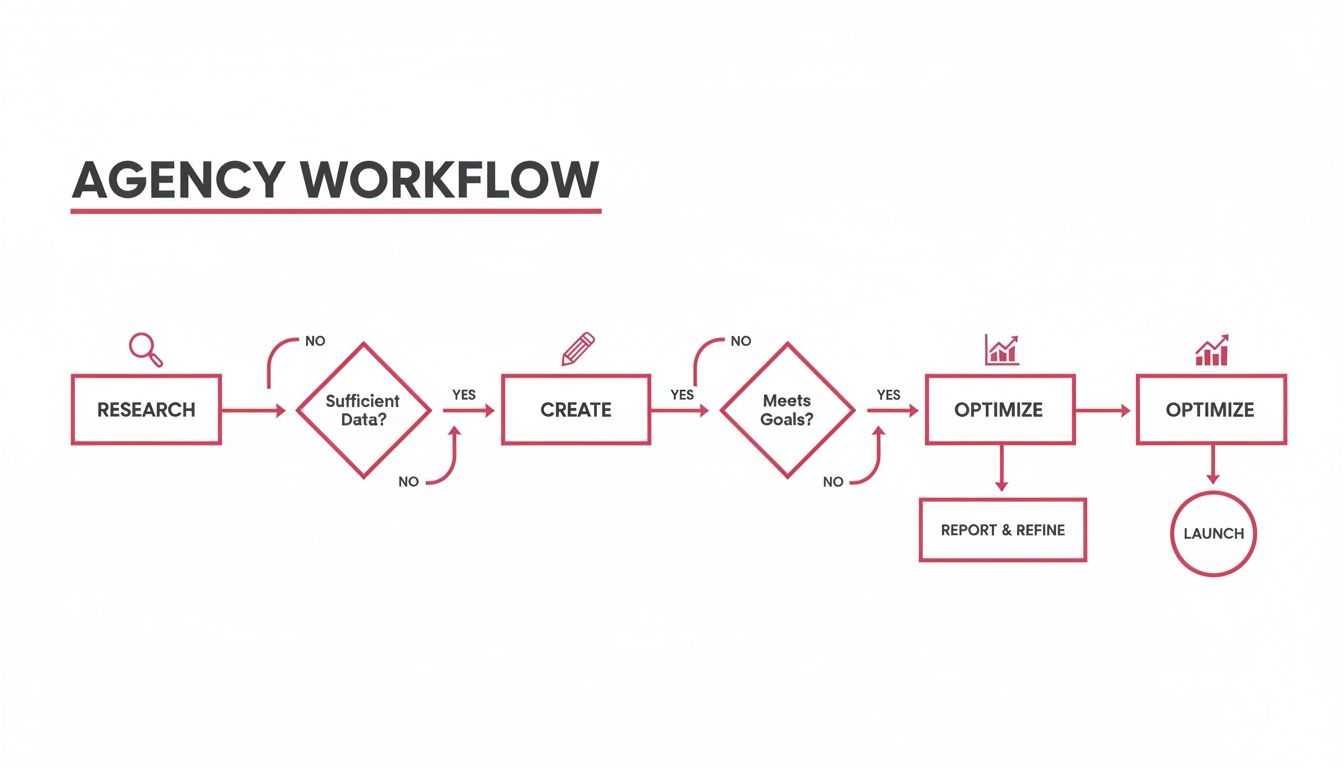
This constant loop—researching, creating, and optimising—is what separates successful campaigns from the ones that fizzle out. Every decision is informed by performance data, ensuring the strategy evolves and improves over time.
Look for Substance, Not Just a Sales Pitch
A great agency’s real value shines through in its past work and client relationships. Start your vetting process by getting critical about their track record. Don’t just glance at the company logos on their website; ask for detailed case studies that are actually relevant to your industry or your specific business goals.
A truly compelling case study should lay it all out:
- The Problem: What specific challenge was the client up against?
- The Strategy: What, exactly, did the agency do to tackle that problem?
- The Results: What were the measurable outcomes? Look for hard numbers like ROAS, cost per acquisition (CPA), or lead volume.
Genuine client testimonials are just as important. Look for reviews that talk about the agency's communication, proactivity, and strategic thinking—not just empty metrics. Any agency that’s truly confident in its work will be more than happy to connect you with a current or past client for a reference call. Don't be afraid to ask for one.
The Right Questions to Ask in Your First Meeting
That initial consultation is your best shot at getting a feel for an agency’s strategic mindset. Go beyond the basic "what do you do" questions and really dig into their process and philosophy. The quality of their answers will tell you everything you need to know.
Here are five essential questions to have in your back pocket:
- "For a business like mine, how would you define and measure success?" A good answer will focus on bottom-line business metrics (leads, sales, return on ad spend) instead of vanity metrics (clicks, impressions).
- "Can you walk me through your reporting and communication process?" You're listening for a clear commitment to regular, transparent reporting and a dedicated point of contact. How often will you meet? What do the reports actually cover?
- "What's your approach to building a custom campaign strategy?" A top-tier agency will immediately reject any one-size-fits-all packages. They should be the ones asking you in-depth questions about your business, your customers, and your goals.
- "Tell me about the team's certifications and experience." Make sure the people who will actually have their hands on your account have relevant qualifications, like Google Ads or Meta Business Partner certifications.
- "How do you all stay on top of platform changes and new industry trends?" The world of PPC is always changing. A great agency is obsessed with continuous learning to keep its clients ahead of the curve.
Green Flags: The Hallmarks of a Great Partner
As you talk to different agencies, you'll start to notice certain characteristics—let's call them 'green flags'—that signal you're talking to a high-quality partner. These are the signs that an agency is genuinely focused on building a long-term, results-driven relationship.
A key differentiator of an elite pay per click advertising agency is a data-first approach. Every decision, from budget allocation to ad copy, should be justified by performance data, not just gut feelings or industry conventions.
Keep an eye out for these positive signs:
- They Insist on a Bespoke Strategy: They won’t even talk about solutions until they deeply understand your business. They refuse to push a generic package.
- Transparency is a Given: They are completely open about their fee structure, their processes, and what you can realistically expect. Crucially, you should always retain ownership of your ad accounts.
- They Care About Creative: They know that powerful ad copy and eye-catching visuals are what make campaigns work. An agency that streamlines its creative production, perhaps using tools like Poster.ly, shows they value both efficiency and quality.
- The Vibe is Right: They feel like an extension of your team. Good communication and a shared understanding of your company's values are absolutely essential for a successful partnership.
Ultimately, choosing the right PPC advertising firm is about finding a team that blends deep technical expertise with a genuine investment in your success. This framework will help you cut through the noise and find a partner who will be a true asset to your business's growth.
Understanding PPC Agency Pricing and Contracts
Let’s talk about the money side of things. For many business owners, figuring out the costs and contract terms for a PPC agency can feel like the most daunting part of the entire process. How much should you set aside? What are the standard contract terms?
It’s actually more straightforward than you might think. A transparent agency will always be clear about their fees and what you get for your investment, so there are no nasty surprises down the road. Getting a handle on these details is key to finding a partner that truly fits your budget and your business goals.
Common Pricing Models Explained
Most PPC agencies you’ll encounter use one of three main pricing structures. Each has its pros and cons, and the best fit for your business really depends on your ad spend, how complex your campaigns are, and how you prefer to manage your budget.
-
Percentage of Ad Spend: This is probably the most common model out there. The agency’s fee is a set percentage of what you spend on ads each month, usually somewhere between 10% and 20%. It’s simple and scales with your investment—as you spend more, their fee increases. This model gives the agency a reason to help you grow your ad budget, but you need to make sure their focus stays on your profitability (ROAS), not just on spending more for the sake of it.
-
Flat-Rate Retainer: With a flat-rate model, you pay the same fixed fee every month, no matter how much you spend on ads. This gives you predictable costs, which is a huge plus for businesses with a steady budget. It's perfect when you have a clear scope of work, like managing a specific set of campaigns. We often see this as a great starting point for smaller businesses. If you're wondering how this fits into your bigger picture, our guide on creating a marketing budget for a small business can help.
-
Performance-Based Fees: This model is all about results. The agency's pay is directly tied to specific outcomes, like the number of leads you get or the sales revenue they generate. It’s a powerful motivator for the agency and feels lower-risk for you, but it’s not as common. These agreements require super-clear definitions of what counts as a "win" (like a qualified lead) and can mean a higher payout for the agency when they knock it out of the park.
Budget Expectations in the Dubai Market
In a fast-paced market like Dubai, setting a realistic budget is everything. The competition for eyeballs online is fierce.
Typically, small to mid-sized businesses here allocate around AED 3,000 to 10,000 per month just for the ad spend itself. On top of that, you can expect management fees to range from AED 2,000 to 8,000. Why the high investment? You’re competing in a dynamic landscape where affluent consumers and major players in real estate and tourism are all bidding for the same top ad spots. Depending on your industry, a single click can cost anywhere from AED 3–12.
Reading the Fine Print on Contracts
Okay, beyond the pricing model, the contract itself is where the critical details live. This document protects both you and the agency, so paying close attention before you sign is an absolute must. A solid contract sets clear expectations and prevents headaches later.
Your ad accounts and all associated data belong to you, period. An agency should only ever have manager-level access. Any agency that insists on creating accounts under their own name is a massive red flag and should be avoided at all costs.
Make sure you’re clear on these key points:
-
Contract Length: Most agencies will start with an initial contract of 3-6 months. This gives them enough time to dig into the data, run tests, and actually start delivering real results. After that initial period, it's common for the agreement to roll over to a more flexible month-to-month basis.
-
Termination Clause: Always know how to end the contract if you need to. A standard notice period is usually 30 days. This gives everyone enough time to wrap things up and ensure a smooth handover if you decide to go in a different direction.
-
Ownership of Accounts and Data: I can't stress this enough. The contract must state, in no uncertain terms, that you own your ad accounts (Google Ads, Meta Ads, etc.) and all of your campaign history. This data is your intellectual property, and you should never give up control of it.
By getting comfortable with these pricing and contract basics, you can walk into negotiations with confidence and find a PPC agency that offers a fair, transparent, and genuinely effective partnership.
How to Know if Your PPC Campaigns Are Really Working
So, you've hired a PPC agency. The reports are coming in, and they're full of numbers—clicks, impressions, click-through rates. But how do you know if any of it is actually making a difference to your business? It’s easy to get caught up in metrics that look good on paper but don't translate to real growth.
The truth is, true success isn't measured in clicks. It's measured in the Key Performance Indicators (KPIs) that directly impact your bottom line. Shifting your focus to these metrics is what separates the campaigns that just coast along from the ones that become genuine profit centres for your business. It changes the conversation with your agency from "How many people saw our ad?" to "How much money did we make from our ad spend?"

Ditch the Vanity Metrics
Let's be blunt: clicks and impressions feel good, but they don't pay the bills. A truly proactive agency will guide you away from these "vanity metrics" and zero in on the numbers that actually matter.
Here are the core KPIs you should be obsessing over:
- Return on Ad Spend (ROAS): This is the big one—the ultimate measure of profitability. It answers the simple question: for every pound I spend on ads, how many pounds do I get back? A ROAS of 4:1 means you’re generating £4 in revenue for every £1 invested.
- Cost Per Acquisition (CPA): This tells you exactly how much it costs, on average, to gain one new customer or qualified lead. Understanding your CPA is critical for knowing whether your customer acquisition efforts are actually profitable and sustainable.
- Conversion Rate: This is the percentage of people who take the action you want them to (like buying a product or filling out a form) after clicking your ad. A strong conversion rate is a sign that your ads and landing pages are hitting the mark and effectively persuading visitors.
A great agency doesn't just report these numbers; they live and breathe them. They use this data to constantly refine your campaigns, analysing which keywords, ads, and audiences are delivering the best ROAS and lowest CPA, and then they reallocate your budget to double down on what’s working.
Your Goals Dictate Your KPIs
Not all KPIs are created equal for every business. The metrics you prioritise should flow directly from your specific business objectives. An agency's first task should always be to get crystal clear on your goals and then build a measurement strategy to match.
Think about it this way: a B2B company trying to generate leads has a completely different definition of success than an e-commerce store.
For a B2B firm, the immediate goal isn't a sale; it's getting a qualified lead into the hands of the sales team. Here, the agency should be laser-focused on a low Cost Per Lead (CPL) and a high Lead-to-Customer Rate, not just the initial ROAS.
In that scenario, the campaigns would be built to attract industry decision-makers, send them to a compelling landing page, and get them to fill out a contact form. Success is all about the quality and quantity of leads generated within a target CPL.
On the other hand, for an e-commerce brand, it’s all about immediate sales. ROAS is king. A good agency gets these nuances and builds a tailored strategy. For instance, e-commerce sellers in the UAE and KSA can often hit an impressive ACoS of 15-20% and a 5x ROAS because of lower competition and eager buyers. As that market gets more crowded, keeping ACoS under 20% becomes crucial for survival, and a transparent agency will help you pivot quickly when costs rise. You can find more on regional PPC benchmarks in this video analysis.
Using Data to Make Smart Moves
The real magic of working with a PPC agency isn't just in the reporting—it's in how they use that performance data to make strategic adjustments. A report should be a springboard for action, not a history lesson.
If a campaign's CPA starts creeping up, your agency should already be in motion—testing new ad copy, tweaking audience targeting, or recommending improvements for your landing page.
This constant cycle of analysis, testing, and optimisation is what fuels long-term growth. Solid marketing campaign tracking ensures every decision is backed by hard data, transforming your PPC investment into a predictable and scalable growth engine. When you understand these core metrics, you can have far more productive, data-driven conversations with your agency about what's working, what isn't, and what's next.
Common Questions About PPC Agencies Answered
Thinking about bringing on a pay-per-click agency is a big step. It’s a serious investment, and you’re right to have a few questions before you commit. Let's walk through some of the most common things business owners ask, so you can move forward with confidence.
How Long Does It Take to See Results?
This is the big one, isn't it? While you'll see traffic and clicks almost as soon as a campaign goes live, real business results—the leads and sales you're after—take a little more patience.
Think of the first 30 days as the discovery phase. This is when your agency is gathering crucial data, testing different ads, and figuring out what makes your audience tick. It's all about building a solid foundation.
By the 90-day mark, things should really start to click. A good agency will have enough performance data to fine-tune your campaigns, and you should be seeing a consistent, positive return on your investment. Of course, things like how competitive your industry is, your budget, and the quality of your landing pages can shift this timeline. Any agency worth its salt will give you a realistic roadmap from day one.
Will I Own My Ad Accounts?
Yes. Full stop. This is a non-negotiable.
You, the client, must always have full ownership and admin access to your Google Ads, Meta Ads, or any other platform you're using. The agency should only ever have manager-level access, allowing them to work their magic on your behalf without actually owning the account.
This setup ensures all your historical data, campaign structures, and performance insights belong to you. If you ever decide to part ways or take things in-house, you take it all with you. Any agency that tries to create accounts under its own name is waving a massive red flag.
Make sure your contract explicitly states that you are the sole owner of all ad accounts and the data inside them. These are your assets, and you need to protect them.
This principle extends to creative assets, too. If an agency uses a tool like Poster.ly to build eye-catching ad visuals, you need to be clear on who owns those designs and how you can access them.
What Is the Difference Between PPC and SEO?
PPC (Pay-Per-Click) and SEO (Search Engine Optimisation) are two sides of the same search marketing coin, but they operate very differently.
With PPC, you’re paying for immediate visibility. Your ads show up at the top of Google or in social media feeds, and you pay when someone clicks. Essentially, you're buying traffic.
SEO, on the other hand, is the long game. It’s the process of optimising your website to rank higher in the unpaid search results. It's all about earning traffic by building authority and relevance over time.
A truly effective digital strategy uses both. PPC gets you quick wins and valuable data right away, while SEO builds a sustainable, long-term asset that keeps generating traffic without a constant ad spend.
What Results Can I Expect in the Middle East?
The Middle East, especially the UAE and the wider GCC region, is a fascinating and rewarding market for PPC. It’s a dynamic digital space full of opportunity, largely because you're dealing with a highly connected, mobile-first audience that spends a ton of time on social media.
Programmatic advertising here is huge, on track to hit USD 30.10 billion by 2030. This isn't surprising when you see stats showing TikTok drives a 67% in-app purchase motivation among users in the region.
A skilled pay per click advertising agency that understands the local nuances can leverage these trends for incredible results, often at a lower cost-per-click than in more saturated Western markets. But don't get complacent—competition is heating up, which makes having a smart, data-driven strategy more important than ever to secure a strong return.
At Grassroots Creative Agency, we turn these questions into clear, actionable strategies. Our data-supported approach ensures your PPC campaigns are built for real, measurable business growth—not just clicks. To see how our paid advertising services can make a difference for you, explore our work.