A good search engine optimisation company does a lot more than just send a few more visitors to your website. They should be a true strategic partner, someone in the trenches with you, fighting to capture market share and deliver real, measurable business growth. Especially in a competitive space like Dubai, just having a website up and running is nowhere near enough to get noticed.
Why A Specialist SEO Company Is a Non-Negotiable Investment

It’s easy to see SEO as just another line item on the marketing budget, something you can cut when things get tight. But that's missing the point entirely. Professional SEO is a direct investment in a sustainable, long-term asset for your business. It’s about building a lead generation engine that runs 24/7, freeing you from the endless, and often expensive, cycle of paid advertising.
I like to think of it this way: paid ads are like renting your audience. The second you turn off the tap, the traffic vanishes. SEO, on the other hand, is like owning digital real estate. Every well-optimised page and every hard-earned backlink adds to your site's authority, creating a snowball effect that pays dividends for years.
Moving Beyond Vanity Metrics
One of the biggest mistakes I see businesses make is getting hung up on raw traffic numbers or keyword rankings. Don't get me wrong, those are useful indicators, but they aren't the end goal. A top-tier search engine optimisation company is laser-focused on what actually matters: business outcomes.
The real magic happens when you attract the right kind of traffic—people who are actively looking for the exact solutions you offer. A strategic approach like this delivers tangible results:
- Greater Market Share: When you consistently outrank your rivals for high-intent keywords, you’re not just getting clicks; you’re capturing a bigger piece of the pie.
- Enhanced Brand Authority: Showing up at the top of Google again and again does wonders for your reputation. It positions you as the go-to expert in your field.
- Sustainable Lead Generation: A solid SEO strategy builds a predictable pipeline of quality leads, which is the fuel for consistent, long-term growth.
This relentless focus on results is what truly separates a specialist firm from a run-of-the-mill provider.
The Economic Case for SEO in the UAE
As digital marketing investment has exploded across the United Arab Emirates, so has the demand for professional SEO. The digital marketing software market in the Middle East is projected to nearly triple, reaching USD 13,346.8 million by 2034.
Within that massive market, the Middle East now commands about 5.34% of global SEO revenue—a share that jumped by over 62% in just four years. You can dig into the full SEO market analysis to see how these trends are playing out. Given this economic reality, bringing in a specialist search engine optimisation company isn't just a smart move; it's an essential part of any serious growth plan.
What Does an SEO Company Actually Do?
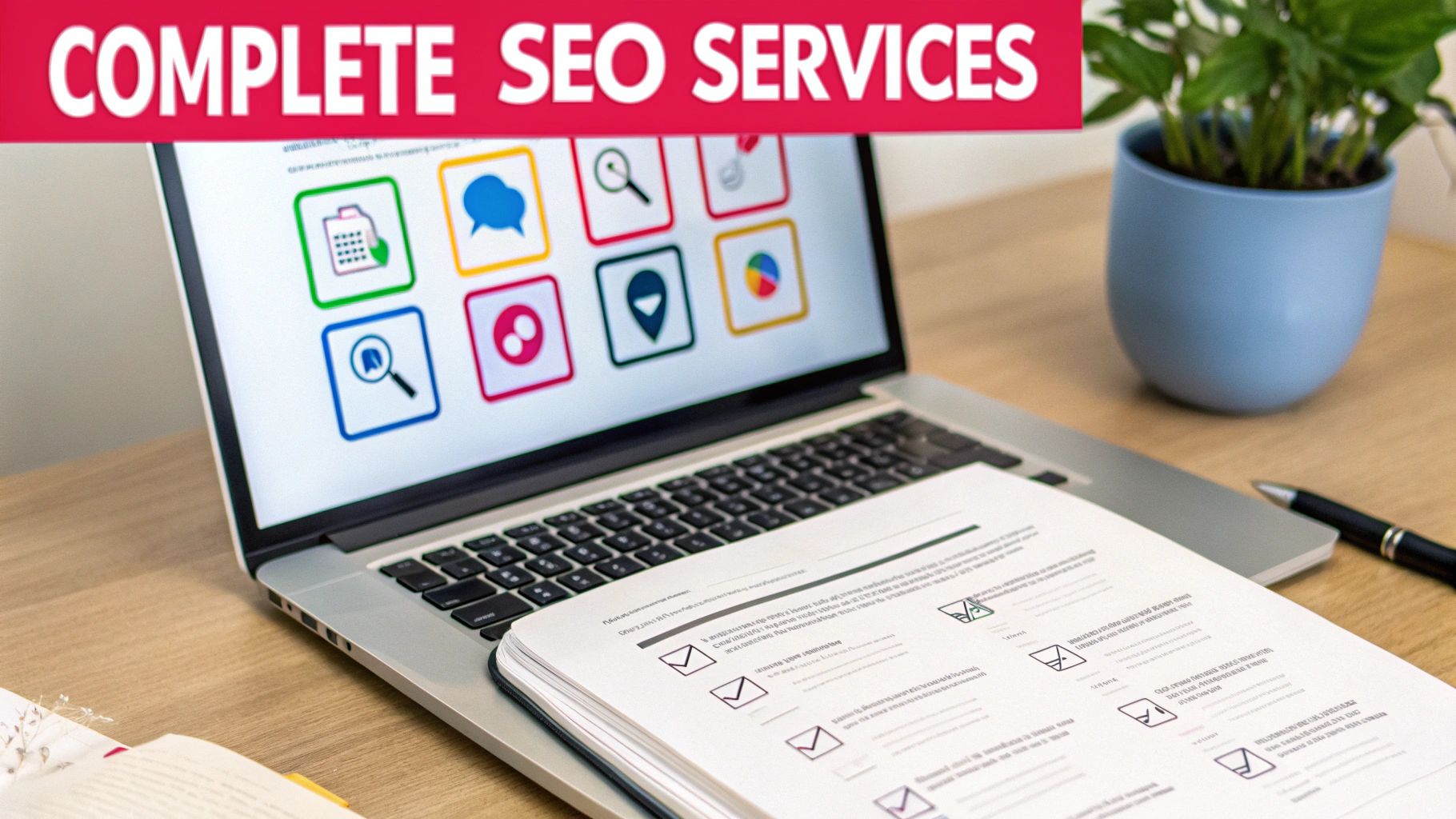
When you hire a search engine optimisation company, you’re not just buying a single service. You're bringing in a team to build a comprehensive, multi-layered strategy. A good, modern agency does so much more than just sprinkle a few keywords onto your website. They orchestrate a whole range of activities designed to build your digital presence from the ground up.
I like to think of it as building a house. You need a solid foundation, sturdy walls, a good roof, and a clear address. Miss one of these, and the whole structure is compromised. It’s the same with SEO.
The Four Core Pillars of SEO
Any competent agency will build your strategy around these four essential service areas. Understanding what each one involves is crucial, so you know exactly what your money is paying for.
- Technical SEO: This is the foundation of your website. It’s all the behind-the-scenes work that helps search engines like Google find, crawl, and understand your site. This includes things like improving site speed, making sure it works perfectly on mobile devices, and fixing any broken links or crawl errors. If Google can't read your site, nothing else matters.
- On-Page SEO: Think of this as the quality of the rooms inside your house. It focuses on your actual content and page structure. This involves deep keyword research, mapping those keywords to specific pages, writing genuinely helpful content that people want to read, and optimising the small-but-mighty details like title tags and meta descriptions.
- Off-Page SEO: This is your home's reputation in the neighbourhood. It's all about building authority and trust across the internet. The main activity here is earning high-quality backlinks from other reputable websites, which act as "votes of confidence." But it also includes things like digital PR, managing your brand's mentions, and building a presence on relevant platforms.
- Local SEO: If you have a physical storefront or serve a specific geographic area, this is your street address and sign out front. It’s absolutely critical. This pillar focuses on optimising your Google Business Profile, actively managing customer reviews, and ensuring your business name, address, and phone number (NAP) are consistent everywhere online.
The digital marketing landscape in the UAE is advancing at an incredible pace, making specialised expertise more important than ever. In fact, the United Arab Emirates SEO advertising software market is projected to grow from USD 3,074.5 billion in 2024 to an astounding USD 6,434.91 billion by 2033. The biggest chunk of that is on-page optimisation, which tells you just how much brands are focusing on quality content and user experience. You can dig into the numbers in the full research on the UAE's SEO advertising software market.
Bringing It All Together
The best SEO partners don't treat these four pillars as separate checklists. They weave them into a single, unified strategy that often pulls in content marketing and even social media. This cohesive approach creates a much more powerful and consistent brand message across all your channels.
A truly effective SEO strategy doesn’t just chase rankings. It creates a seamless user journey that converts visitors into customers, leveraging every digital touchpoint to build trust and authority.
For example, a great blog post (on-page SEO) can be shared on social media to earn backlinks and drive traffic (off-page SEO). That same content demonstrates your expertise, which builds authority. You can see how we put these ideas into practice in our guide to search engine optimisation in UAE.
One smart tactic we've seen work well is embedding social proof directly on key pages. Using a tool like Posterly, a direct product of Grassroots Creative Agency, you can display a live feed of social media testimonials on your service pages. This not only boosts visitor trust but also sends positive engagement signals to search engines, showing them your site is a credible and valuable resource.
How to Properly Vet a Potential SEO Company
So, you've got a shortlist of potential SEO agencies. Now the real work begins. Getting past a slick sales pitch requires a bit of detective work. Remember, a great partnership isn't just about a promise of top rankings; it’s built on transparency, shared goals, and a genuine fit with your team's culture.
That first call or meeting is your chance to dig in. Don't hold back—ask the tough questions. Any confident and capable search engine optimisation company will welcome the scrutiny and give you clear, straight answers.
Look Beyond Vanity Metrics in Case Studies
Every single agency will flash impressive case studies in front of you. Your job is to look right through them. A graph showing a massive spike in traffic looks fantastic, but traffic alone doesn't pay the bills. The only question that truly matters is this: did that traffic actually turn into real business results?
You need to hunt for proof of genuine growth. Here’s what to look for:
- Lead Generation: Can they show you a clear increase in qualified leads that came from organic search? Ask to see the conversion data.
- Sales and Revenue: If you're an e-commerce business, can they directly tie their SEO work to a bump in online sales?
- Business Impact: Do their reports talk about how SEO helped achieve the client's core business goals, or are they just focused on search rankings?
If a case study is all about vanity metrics, that's a warning sign. The best agencies I've worked with connect every single action back to a business outcome. This is especially true in the competitive Middle Eastern market, where results are everything.
Assess Communication and Transparency
Think about it: would you want to work with a partner who disappears for weeks, only to pop back up with a report you can't even understand? A solid partnership needs clear, consistent communication. As you talk to them, pay close attention to their style. Are they breaking down complex ideas into plain English?
A trustworthy agency acts as an extension of your team. They should be proactive, educational, and completely transparent about their processes—the good, the bad, and the ugly.
Be direct and ask them about their reporting. How often will you hear from them? What metrics are they tracking? A top-tier firm will offer custom dashboards that link their activities straight to your KPIs, making it incredibly easy to see the return on your investment.
Spotting Red Flags and Green Lights
When you're vetting a potential search engine optimisation company, you have to know what the warning signs look like. Anyone promising "guaranteed number one rankings" is a huge red flag—nobody can control Google's algorithm. Be just as cautious with agencies that are cagey or secretive about their methods.
On the flip side, a big green light is an agency that’s obsessed with building a custom strategy just for you. They should be asking you as many questions as you're asking them, trying to get to the heart of your business, your audience, and your goals. For more on this crucial step, you can see our detailed approach to search engine optimisation consulting.
The money involved here is no small matter. Globally, the revenue for SEO services is expected to climb as high as USD 127.3 billion by 2025. The Middle East's share of that is projected to reach USD 10.137 billion by 2033, a boom driven by agencies that can prove they move the needle on revenue. You can dig into the full projections for the SEO industry to see just how massive this market is.
Making Sense of SEO Pricing and Budgets

Talking about money can be tricky, but getting a firm grip on how a search engine optimisation company prices its services is a must. These numbers aren't just pulled out of a hat; they're a reflection of the strategy, man-hours, and expertise required to deliver real, measurable growth. Nailing this conversation early on is the key to a healthy partnership.
In my experience, you'll run into three common pricing models. Each serves a different purpose, and the right one for you really boils down to your goals, your budget, and how established your online presence already is.
Common SEO Pricing Structures
Most agencies lead with a monthly retainer. This is the standard for anyone serious about long-term, consistent growth. A retainer transforms the agency from a simple vendor into a strategic partner who is constantly fine-tuning your campaign, creating content, and building on last month’s wins. It’s predictable and perfect for an always-on strategy.
Then you have project-based fees. Think of this as the "à la carte" option. It's ideal for a one-off job with a clear beginning and end, like a deep-dive technical audit, setting up a new business for local SEO success, or running a focused link-building sprint. You get cost certainty for a specific, tangible outcome.
Finally, there’s hourly consulting. This is a great fit if you have an in-house team but need an expert to parachute in and help solve a specific problem. You might hire a consultant to train your team on the latest algorithm changes, untangle a complex site migration issue, or help map out a high-level strategy for your team to implement.
Evaluating Value Over Cost
It's so easy to get fixated on the price tag and just pick the cheapest quote. But trust me, that's almost always a mistake in the long run. A low-cost SEO service that delivers nothing is far more expensive than a higher-priced retainer that floods your inbox with qualified leads. The conversation should always be about value.
The right question isn’t "How much does SEO cost?" but rather "What business growth can my investment generate?" A great SEO partner frames their pricing around the value they deliver to your bottom line.
Try to frame it in terms of potential return. If a £5,000 per month retainer brings in £25,000 per month in new business, that's not an expense—it’s a profit engine. A solid search engine optimisation company will be able to help you build a realistic forecast and tie their work directly to business KPIs.
This is also where clever tactics can make a huge difference. For example, using a tool like Posterly to add social proof and testimonials to your key landing pages can boost conversions from the organic traffic you’re already getting. It's a simple move that directly increases the ROI of your entire SEO spend, making every pound work harder.
Kicking Off Your SEO Partnership: The First 90 Days
You’ve signed on the dotted line and officially brought an SEO company on board. Fantastic. Now, the real work begins. This initial three-month window is absolutely critical—it’s where the foundation for the entire partnership is laid. A smooth, transparent onboarding process during these first 90 days sets the tone for everything that follows, making sure your team and their team are moving in lockstep.
The first month is all about getting under the bonnet. Your new agency partners will immediately launch a deep-dive technical audit of your website. Think of it like a full diagnostic check-up. They’ll crawl your site the same way Google does, hunting for anything that could be holding you back—slow-loading pages, broken links, or gnarly indexing issues that are making you invisible to search engines. To do this, they’ll need access to a few key platforms to see the full picture.
What to Expect in the First Month
Your involvement here is crucial. This isn't a "set it and forget it" service. The agency will need access to your analytics to see what's happening with your traffic and how users are behaving on your site. Get ready to open up about your business, your customers, and your past marketing efforts.
- Sharing the Keys: Granting access to your Google Analytics and Google Search Console is the first order of business. This isn't optional; it's the raw data they need to establish a baseline. Our guide on how to use Google Search Console is a great primer if you want to understand what they're looking for.
- The Brain Dump: The more context you can provide, the better. Tell them about your ideal customer avatar, your most profitable products or services, and who you're constantly battling for market share. This inside information is gold.
- The First Readout: A good agency will schedule a meeting to walk you through their initial audit findings. They should be able to explain complex technical concepts in plain English and clearly outline what needs to be fixed first.
Month Two: Moving from Audit to Action Plan
Once the technical baseline is established, the second month is all about strategy. This is where your SEO partner pivots to deep keyword research and a thorough competitive analysis. They’ll dig in to find the valuable keywords your audience is actually typing into Google and see what your top competitors are doing to own those search results. It’s not just about chasing high-volume terms; it’s about finding the strategic gaps where you can realistically make an impact.
A truly great agency doesn't just hand you a spreadsheet of keywords. They'll build a content strategy that maps those keywords to the real-world questions and problems your customers have at every single stage of their journey.
All this research comes together in a customised SEO strategy. Your agency should present you with a clear roadmap detailing the on-page, off-page, and technical SEO tasks they plan to execute in the months ahead.
Month Three: Defining What Success Looks Like
The final piece of the onboarding puzzle is agreeing on the metrics that matter. This is where you work together to set the Key Performance Indicators (KPIs) that will be used to track progress. It's time to move past fuzzy "vanity metrics" like total website traffic. The focus needs to be on KPIs that tie directly to business goals.
Here are a few meaningful KPIs you should be talking about:
- Organic Lead Conversion Rate: What percentage of visitors coming from search engines actually turn into a lead or a sale?
- Non-Branded Traffic Growth: Are you getting more traffic from people who don't know your brand name yet? This shows you're expanding your reach.
- Keyword Rankings for High-Intent Terms: How visible are you for the phrases people search for when they're ready to make a purchase?
By the time you hit the 90-day mark, you should have a clear strategy in hand, a mutual understanding of your goals, and a transparent reporting system in place. This solid start paves the way for a partnership that actually drives results.
A Few Common Questions About Hiring an SEO Agency
Even after all the research and vetting, it’s completely normal to have a few final questions rattling around. Choosing the right search engine optimisation company is a big commitment, and you deserve clear, straight-up answers before you sign on the dotted line.
How Long Does It Take to Actually See SEO Results?
This is usually the first thing everyone wants to know, and it's a fair question. SEO is a long game, not an overnight fix. While you might see some quick wins from technical cleanups in the first few weeks, you should realistically plan for four to six months before you see significant, lasting growth in your rankings and organic traffic.
If you’re in a really competitive industry, that timeline could stretch out even further. The magic is in the consistent, strategic work. Any agency worth its salt will be upfront about this from the start, laying out a roadmap with clear short-term wins and long-term goals to keep expectations grounded in reality.
What’s the Real Difference Between SEO and Google Ads?
It's easy to get these two confused, but they play fundamentally different roles. Think of SEO as earning your spot at the top through organic (unpaid) visibility. It’s all about creating fantastic content, making sure your site is technically sound, and building its authority over time. You're building a valuable digital asset that pays dividends for years.
Google Ads, on the other hand, is pure paid advertising. You bid on keywords to have your ads show up at the top, which can drive traffic to your site almost instantly. But here's the catch: the moment you stop paying, that traffic vanishes. A smart marketing plan often uses both—Ads for immediate results and SEO for sustainable, long-term growth that you truly own.
This is what the first 90 days with a new SEO partner typically look like, moving from discovery and research to a fully-fledged strategy.
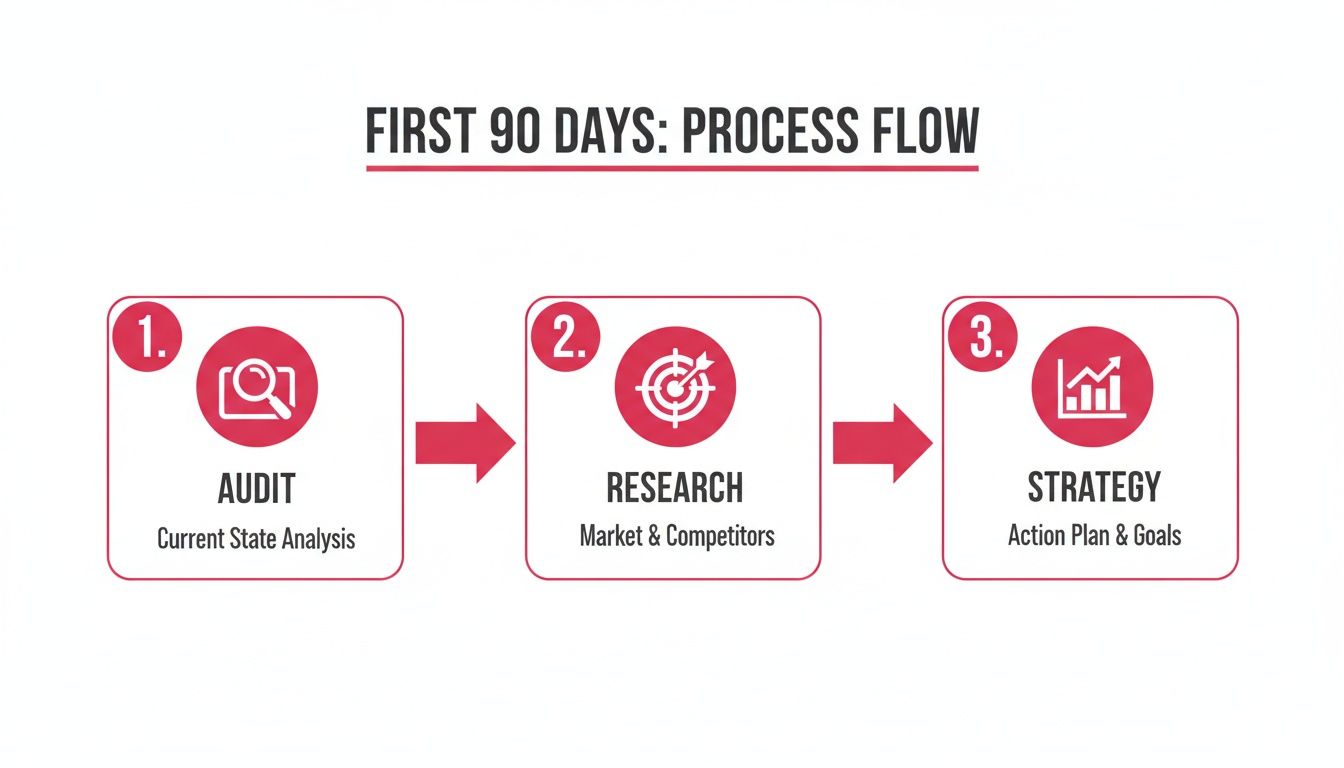
As you can see, a successful campaign always starts with deep analysis and careful planning, not just jumping into tactics.
What Are Some Red Flags I Should Watch Out For?
Run—don't walk—from any agency that makes guarantees, especially for "guaranteed number one rankings." No one can promise that, because Google's algorithm is a constantly shifting, complex beast.
You should also be wary of any search engine optimisation company that’s cagey about their methods. If they won't tell you what they're doing, they might be using 'black-hat' tactics that can get your site penalised or even de-indexed by Google. That's a mess you don't want to clean up.
A great partner is an open book. They educate you, they're transparent about their process, and they focus on metrics that actually matter to your bottom line—like qualified leads and revenue, not just vanity metrics like traffic.
Can't I Just Do My Own SEO?
You absolutely can learn the basics, but SEO is a seriously deep and time-intensive field that never stops changing. A professional agency isn't just buying a few tools; they bring years of specialised expertise, access to enterprise-level software, and the hard-won experience of navigating countless algorithm updates.
For most business owners, the time it would take to get truly good at SEO is much better spent on running their company. An agency can deploy a comprehensive strategy much faster and more effectively, ultimately delivering a far greater return on your investment than most DIY efforts can achieve.
Ready to stop guessing and start growing? At Grassroots Creative Agency, we build data-driven SEO strategies that deliver real business results. To enhance your strategy, consider a tool like Poster.ly to showcase social proof and boost conversions on your most important pages.