Forget what you think you know about PPC agencies. The game has changed. A modern PPC advertising firm isn't just a group of people buying clicks on Google Ads. They're strategic growth partners, obsessed with turning your ad spend into real, measurable business results.
They look past simple bid management and focus on outcomes. This means crafting campaigns that slot perfectly into your broader marketing efforts to squeeze every last drop of value from your investment.
What a Modern PPC Advertising Firm Actually Does
Before you even think about creating a shortlist, you need to grasp what separates a top-tier partner from a basic "ad manager". The best firms don't just live inside the ad platform; they dig deep into your entire sales funnel.
Think about it. They're just as concerned with your landing page conversion rates as they are with your ad copy. Why? Because they know that even the most brilliant ad is useless if the user lands on a page that doesn’t convince them to act. A true PPC advertising firm understands that the click is just the beginning of the journey.
Beyond Bids and Clicks
A truly modern firm's work extends far beyond the ad auction. They operate as strategic thinkers, making sure your paid search campaigns amplify what you're doing with SEO, content, and social media. When everything works together, the impact is so much greater.
Here’s what that looks like in practice:
- Strategic Planning: They start by understanding your core business goals. Are you a B2B company hunting for qualified leads, or an e-commerce brand driving direct sales? The strategy must align with your definition of success.
- Creative Execution: This is where strategy meets action. It involves producing compelling ad creatives—from text to visuals—that grab attention and earn the click. Many forward-thinking firms use specialised tools like Poster.ly to quickly build and test dozens of ad variations, finding the winners faster.
- Data Analysis & Reporting: They skip the vanity metrics. Impressions are nice, but profit is better. The focus is on what truly matters: your Cost Per Acquisition (CPA) and Return On Ad Spend (ROAS). Their reports should clearly show how their work is impacting your bottom line.
- Continuous Optimisation: Campaigns are never "set and forget". The best firms are constantly testing—new ad copy, refined audience targeting, A/B tested landing pages—to steadily improve performance month after month.
This strategic approach is critical, especially in fast-growing digital markets. Take the MENA region, where digital advertising is projected to capture a massive 65.9% of all ad revenue by 2025. According to a recent WPP media forecast, firms are heavily leaning on AI-driven bidding to achieve incredible ROIs, with some e-commerce campaigns seeing returns as high as 200%.
When you understand this bigger picture, you can evaluate potential agencies on their strategic value, not just their technical promises. You're looking for a partner who is genuinely invested in your long-term growth.
Defining Your Goals and Budget for PPC Success
Before you even think about shortlisting PPC agencies, you need to get crystal clear on two things: what you want to achieve and what you're willing to spend to get there. Walking into a conversation with a potential partner armed only with a vague desire for "more traffic" is a surefire way to burn through your cash with little to show for it.
Clarity is your best friend in this process. It's the difference between hiring just any agency and finding the right strategic partner who understands your business.
Your goals shape everything that comes next. An e-commerce store chasing sales has a completely different definition of success than a B2B SaaS company hunting for demo requests. The former will live and die by their Return On Ad Spend (ROAS), while the latter is laser-focused on the Cost Per Acquisition (CPA) of a genuinely qualified lead.
Setting Clear and Measurable Objectives
Vague goals breed vague results. It’s that simple. Let's move beyond fuzzy aspirations and get specific.
- Instead of "increase sales," a better goal is: "Achieve a 4:1 ROAS within six months."
- Instead of "get more leads," aim for: "Generate 50 marketing-qualified leads per month at a CPA below £100."
Think about what success looks like for your specific business model.
-
For E-commerce: Your world revolves around direct sales. Key performance indicators (KPIs) like ROAS, average order value (AOV), and customer lifetime value (LTV) are your north stars. Maybe a secondary goal is building your email list for future sales pushes.
-
For B2B/Lead Generation: Here, it’s all about the quality of the lead, not the quantity. Success is measured by your CPA, lead-to-close rate, and the ultimate cost to acquire a new customer. A cheap lead that never converts is worthless.
-
For Brand Awareness: If you're launching a new product or breaking into a new market, your first priority might just be getting your name out there. In this case, you’ll track metrics like impressions, click-through rates (CTR), and reach within your target audience.
A well-defined objective is the compass for your entire PPC strategy. It ensures you and your future agency are rowing in the same direction and makes it incredibly easy to judge performance and hold them accountable.
Establishing a Realistic PPC Budget
Your budget is one of the first things any serious PPC firm will ask about, so have a realistic number ready. Think of it as an investment, not an expense.
One of the most common pitfalls I see is businesses starting with a budget that’s just too small. This starves the agency of the data they desperately need to learn, test, and optimise your campaigns. It’s like trying to power a V8 engine with a thimbleful of petrol—you’ll never get up to speed.
Remember, your total budget needs to cover two distinct parts:
- Ad Spend: The actual money that goes directly to platforms like Google or Meta every time someone clicks your ad.
- Management Fee: This is what you pay the agency for their strategy, expertise, and day-to-day work managing the campaigns.
Agency pricing models can vary quite a bit. You'll typically encounter a flat monthly retainer, a percentage of your ad spend, or sometimes a hybrid model tied to performance. Getting familiar with these will make it much easier to compare proposals down the line.
When you can state your budget clearly from the outset, a good agency can immediately tell you what’s possible. It grounds the entire conversation in reality and makes sure your financial expectations are perfectly aligned with your growth ambitions.
How to Vet and Shortlist Potential PPC Firms

Alright, you’ve got your goals mapped out and a budget in mind. Now for the real work: finding the right people to make it happen. This is where you put on your detective hat and start building a shortlist of agencies that look like a genuine fit. It’s about digging past the slick sales pages to find true expertise.
A great place to start is with trusted industry platforms. Directories and review sites like Clutch or GoodFirms are invaluable because they offer unfiltered client feedback. Another smart filter is to look for official Google Partners. This instantly tells you an agency has met Google’s own standards for performance and skill. You can find more Google Partner information to understand exactly what that badge means for your campaigns.
As you click through agency websites, train your eye to look for substance. Are their case studies specific? Do they feature businesses like yours? Vague claims of "amazing results" are a red flag. You want hard numbers—give me the percentage increase in ROAS or the exact reduction in CPA.
Scrutinising Their Digital Footprint
Think about it: if a PPC advertising firm can't market itself well, how can you trust them with your money? Their own online presence is their CV. Dive into their blog, check out their social media, and see what they're putting out into the world.
A few things to look for:
- Real Client Testimonials: Are the testimonials from actual people at companies you can look up? Video testimonials are a huge plus—they’re much harder to fake and show a genuinely happy client.
- Team Certifications: Beyond the company-level Google Partner badge, are the individual team members certified? Look for qualifications in Google Ads, Meta Blueprint, or other platforms relevant to your strategy.
- Culture and Transparency: Do they hide their team behind a generic "contact us" form? An agency that proudly features its people often has more confidence in their talent.
This initial deep dive should help you narrow the field to a solid list of three to five agencies. Now, you’re ready to actually talk to them.
Key Questions for Your Initial Calls
Your first call with a potential agency isn't just for them to pitch you; it’s for you to interview them. You're in the driver's seat. The goal is to get past the canned presentation and understand how they actually think and operate.
Your questions should be designed to uncover their strategic thinking, communication style, and actual experience, not just their ability to manage bids. A great firm will welcome detailed questions and provide thoughtful, transparent answers.
To keep things fair, ask every agency on your shortlist the same core questions. This makes comparing them apples-to-apples much easier later on.
Essential Vetting Questions:
- Relevant Experience: "Can you walk me through a campaign you ran for a client in the [your industry] space with a budget similar to ours? What were the biggest hurdles, and how did you get past them?"
- Strategic Approach: "Based on our goal of [state your primary goal], what’s your initial gut reaction on strategy? How do you typically handle keyword research and audience targeting for a new client?"
- Team Structure: "If we move forward, who would be our day-to-day contact? What’s their background, and who else on the team would be supporting our account?"
- Reporting and Communication: "What can we expect for reporting? How often will we connect, and what are the handful of metrics you’ll focus on to show us we’re winning?"
This structured vetting process helps ensure you find a PPC advertising firm that’s focused on growth, not just clicks. And the opportunity is massive. The MEA digital advertising market is expected to grow at a 16.7% CAGR between 2025 and 2030, with e-commerce in the UAE, in particular, pushing PPC budgets higher. Learn more about the MEA digital advertising outlook on Grand View Research.
Cracking the Code on Proposals and Pricing
When the proposals start rolling in, it's easy to get overwhelmed. They'll all look a little different, but the great ones have a few things in common. They don't just list services; they show you they've actually listened and understand your business.
A top-notch proposal won't just give you a price tag. It should kick off with some form of initial audit or analysis of where you are right now—proof that they’ve done their homework. You want to see a crystal-clear scope of work that details what you can expect every single month, covering everything from keyword research and ad creation to landing page advice and reporting.
Most importantly, the proposal has to connect the dots between their activities and your business objectives. If they’re suggesting a slate of KPIs, make sure those are the metrics that actually matter to you. It's always a good idea to brush up on choosing the right marketing performance indicators to ensure everyone is aligned. Also, look closely at their process for ad creative. A solid agency will have a plan for developing and testing visuals and copy—this is where efficiency tools like Poster.ly can be a game-changer for producing creatives at scale.
Comparing PPC Agency Pricing Models
Getting your head around how an agency charges is fundamental to building a healthy partnership. Most firms use one of a few common structures, so let's break down what they mean for your budget and campaign goals.
Each model has its place, and the right one for you depends entirely on your budget, goals, and how you prefer to work with a partner.
| Pricing Model | How It Works | Best For | Potential Drawback |
|---|---|---|---|
| Percentage of Ad Spend | The firm charges a percentage, usually 10-20%, of your monthly ad spend. | Businesses with larger, scaling budgets where the management workload naturally increases with spend. | The agency makes more when you spend more, which could create a conflict of interest if not managed well. |
| Flat Monthly Retainer | You pay a consistent, fixed fee each month for an agreed-upon scope of work. | Businesses that need predictable costs and have a steady budget and workload month-to-month. | The scope can feel too rigid if your needs suddenly pivot or you need to scale up or down quickly. |
| Performance-Based | Fees are tied directly to results, like a fixed cost per lead or a slice of the revenue generated. | Businesses with rock-solid conversion tracking and very specific, measurable goals (e.g., e-commerce sales). | It can be tricky to set up and may inadvertently incentivise the agency to chase lead volume over lead quality. |
| Hybrid Model | This blends a base retainer with a performance bonus for hitting pre-defined targets. | Businesses wanting the stability of a retainer but also want to incentivise top-tier performance from their agency. | Requires incredibly clear, agreed-upon goals from the start to avoid any confusion or disputes down the line. |
The key is to find a model that aligns the agency’s success with your own.
Red Flags to Watch for in a Proposal
A proposal can tell you a lot by what it doesn't say. Be wary of any PPC advertising firm that promises the moon without showing you the rocket ship they plan to use.
The biggest red flag in this industry? Guaranteed results. No credible agency can promise a #1 ranking or a specific ROI. The ad auction is a live, dynamic marketplace that shifts with competitor moves, platform updates, and customer behaviour.
Here are a few other warning signs to keep an eye out for:
- Fluffy Deliverables: If the scope of work just says "campaign optimisation," push back. What does that actually mean? Ask them to define the specific actions they'll take.
- A "One-Size-Fits-All" Vibe: A generic, copy-pasted proposal that barely mentions your company by name or references your goals is a sign of laziness.
- Murky Reporting: The proposal should spell out exactly what metrics will be reported on, how often you'll receive reports, and what kind of analysis will be included.
At the end of the day, the right proposal feels less like a sales pitch and more like the first draft of a strategic partnership. It should leave you feeling confident that the agency not only has the technical chops but has also invested the time to understand what success truly looks like for your business.
Onboarding Your New Partner for a Strong Start
You've signed on the dotted line and picked your PPC partner. Fantastic. But the work doesn’t stop there—in fact, this is where it really begins. The first month with your new agency can make or break the entire relationship. A messy start creates a foundation of missed expectations and wasted ad spend, while a well-orchestrated kickoff paves the way for a smooth, profitable partnership.
The first thing on the agenda should be a deep-dive kickoff meeting. This isn't just a formality. It's your chance to get both teams in a room (virtual or otherwise) to align on everything: your big-picture business goals, the nitty-gritty of your target audience, and who you’re up against in the market.
This is also when you hand over the keys. Your new team will need access to your Google Ads account, Meta Business Suite, and any analytics platforms you're using. Getting this done quickly and securely means they can get straight to work on audits and initial campaign builds without hitting any roadblocks.
Establishing Communication and Reporting Rhythms
Nothing sinks an agency partnership faster than poor communication. You need to decide on a communication cadence right away. Are you a fan of weekly check-in calls? Do you prefer a monthly report delivered as a live dashboard, or would a detailed PDF work better?
There's no wrong answer, but setting these expectations upfront saves a ton of headaches later. We often recommend a dedicated Slack channel or a shared project board. It keeps quick questions and updates out of the black hole of email and makes collaboration feel much more fluid.
A great PPC advertising firm doesn't just send you data; they provide insights. The reporting process should be a collaborative conversation about what the numbers mean for your business and what strategic adjustments will be made as a result.
The journey to this onboarding stage really begins much earlier, with the agency's initial evaluation of your accounts.
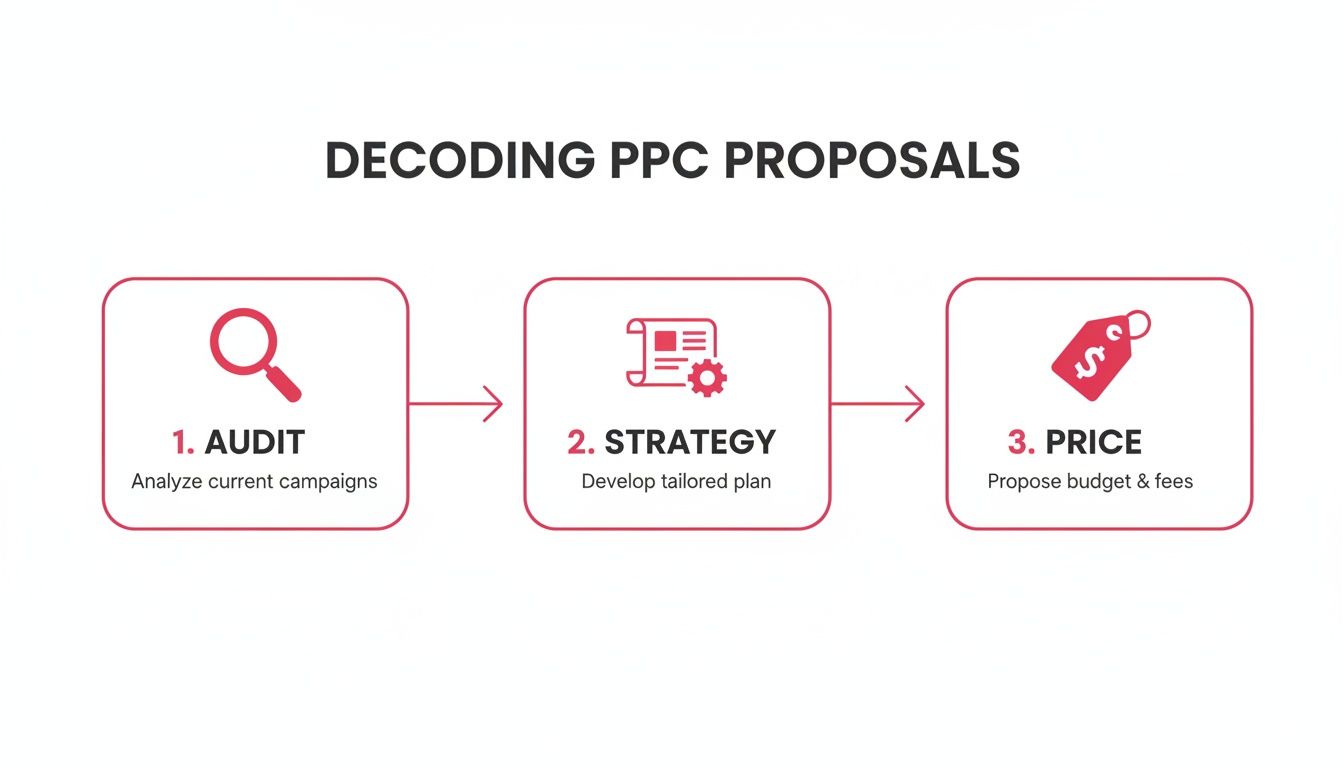
As you can see, a solid proposal is built on a thorough audit and a clear strategy. This data-first approach is what ensures you're starting the partnership on the right foot.
Defining Your Key Performance Indicators
Now it's time to make your strategy measurable. A crucial part of onboarding is finalising the Key Performance Indicators (KPIs) that actually move the needle for your business. These aren't just vanity metrics; they're the benchmarks you'll use to judge success, and they need to tie directly back to your revenue goals.
- For E-commerce: The undisputed king of KPIs is Return On Ad Spend (ROAS). You’ll also want to keep a close eye on metrics like Average Order Value (AOV) and Customer Lifetime Value (LTV) to understand the bigger picture.
- For B2B Lead Generation: Here, the focus shifts to Cost Per Acquisition (CPA). How much are you paying for a qualified lead? Just as important is tracking the lead-to-close rate—it’s the only way to know if your ad spend is generating real sales opportunities.
- For Brand Awareness: Success looks different here. You'll be tracking metrics like impression share, click-through rate (CTR), and overall reach within your target demographics.
Getting these KPIs locked in means everyone is pulling in the same direction. It's also why robust conversion tracking is non-negotiable from day one. If your data isn't clean, your KPIs are meaningless. You can learn more about setting up proper analytics to make sure every pound is accounted for.
This alignment is especially critical in fast-growing markets. For instance, the programmatic ad market in the Middle East and Africa is projected to hit an incredible USD 30.10 billion by 2030. In Saudi Arabia, fuelled by Vision 2030, key sectors like retail and tourism are now dedicating 30-40% of their marketing budgets to PPC. With that kind of investment on the line, having razor-sharp KPI tracking isn't just good practice—it's essential for survival.
Still Have a Few Questions?
Even with the best plan in place, it's natural to have some lingering questions before you sign on the dotted line with a PPC firm. Getting these sorted out upfront is the key to building a partnership that works and making sure everyone is on the same page from the get-go.
Let's walk through some of the most common things businesses ask us right before they make a decision.
How Long Until We See Real Results?
This is the big one, and the honest answer is: it's a process. You'll see data like clicks and impressions almost right away, but real, meaningful business results typically take three to six months to show up.
Think of the first month as the "learning phase". This is all about setup, running initial tests, and gathering baseline performance data. In months two and three, the agency will start using what they've learned to optimise campaigns, sharpen targeting, and improve ad performance. By that three-month mark, you should see a clear, positive trend in lead quality or sales, which tells the firm it's time to start scaling up the winners. PPC isn't a light switch; it's a marathon.
Can't I Just Run Google Ads Myself?
Sure, platforms like Google Ads are designed to be user-friendly, but the difference between running ads and running them profitably is huge. That's where a professional PPC advertising firm comes in.
An experienced firm brings a deep understanding of complex bidding strategies, advanced audience segmentation, and the kind of competitive analysis that's nearly impossible to do without a dedicated team. They also have access to expensive, powerful tools that simply don't make sense for a single business to invest in.
At its core, a good firm saves you two things you can't get back: time and money. They help you sidestep the costly rookie mistakes and apply years of experience from countless other campaigns to your business, getting you a better return, faster.
What’s the Difference Between a PPC Agency and a Creative Agency?
Excellent question. A traditional PPC agency is all about the mechanics—the bidding, the keywords, the analytics. They're the engineers of the campaign. A modern, creative-driven agency, on the other hand, knows that the ad creative itself is one of the biggest factors in whether a campaign flies or flops. They don't just manage the campaign; they also create the compelling ad copy and visuals that grab attention.
For example, a creative-focused firm might use tools like Poster.ly to quickly design and test dozens of ad variations to find the one that truly connects with your audience. This integrated approach—blending technical know-how with killer creative—almost always drives better results because it considers the entire journey, from the first impression of the ad to the final click on the landing page.
What Level of Involvement Is Expected from Me?
The best agency relationships are true collaborations. The firm will be in the driver's seat for the day-to-day campaign management, but your strategic input is absolutely essential.
At the beginning, you’ll be deeply involved, sharing everything you know about your business, your customers, and your goals. As things get rolling, you should plan for weekly or monthly check-in calls to go over performance and plan next steps. Your job is to give feedback on lead quality, sign off on new creative ideas, and keep your agency in the loop on business changes like a new sale or product launch.
At Grassroots Creative Agency, we build partnerships that fuel real growth. We blend data-smart PPC management with bold creative to deliver results you can actually measure. See how our approach can work for your business at https://grassrootscreativeagency.com.