

Picture this: a creative partner that never sleeps, one that’s always ready to jump in and help you brainstorm ideas, draft copy, or even mock up visuals at a moment's notice. This isn't some far-off fantasy; it's the reality of AI content creation today. Artificial intelligence has grown from a simple automation tool into a genuine collaborator for marketers, writers, and business owners everywhere.
Welcome to the New Era of Content

In this guide, we'll pull back the curtain on how AI is fundamentally changing the content game. Think of it as a practical tour through the tech, the workflows, and the very real advantages it brings to the table. This is no longer science fiction—it's a tool that’s here to amplify our own creativity.
At its core, AI content creation is about spotting patterns. These systems sift through enormous amounts of data to learn what works and then generate something entirely new. This isn't just about speeding up routine tasks; it's about opening up more room for us to think strategically. Keeping up with the latest trends in AI content generation is the best way to stay ahead of the curve.
What AI Content Creation Means for Your Strategy
Let's get one thing straight: bringing AI into your workflow is about empowering your team, not replacing it. The whole point is to hand off the repetitive, time-consuming tasks so your creative experts can do what they do best—focus on high-level strategy, originality, and building a real connection with your audience.
Just think about how AI can pitch in across your content plan:
- Brainstorming and Ideation: Instead of staring at a blank page, you can have an AI analyse competitor content and market trends to spit out a list of blog topics, social media hooks, or video ideas your audience will actually care about.
- Drafting and Writing: It can whip up a first draft of an article, email, or ad in minutes. This gives your writers a solid starting point to then polish, refine, and inject with human personality.
- Visual Design: Need a unique image or a social media graphic? AI tools can generate them from a simple text prompt, dramatically cutting down the time it takes to go from concept to finished design.
AI essentially acts as a powerful assistant at every step, from the first spark of an idea to hitting "publish." It brings the speed and scale you need to keep up, while human oversight ensures everything stays on-brand and meets your quality standards.
To see this in action, look at platforms like Poster.ly, a tool born directly out of our work at Grassroots Creative Agency. It was designed to make sophisticated AI easy to use, helping businesses automate social media content creation and scheduling for more consistent and effective communication.
How Does an AI Actually Learn to Create?
Ever wondered how a machine can write a compelling blog post or design a stunning graphic? It’s not magic. It’s a process of recognising patterns and making predictions on an absolutely massive scale.
Think of a large language model (LLM), like the tech behind ChatGPT, as a student who has consumed nearly the entire internet. It hasn't memorised everything word-for-word. Instead, it’s learned the intricate patterns, styles, and relationships within language. This lets it generate completely new sentences that sound natural because they follow the countless rules it has absorbed from its training data.
The breakthrough technology that makes this possible is called transformer architecture. This model is incredibly good at understanding context. For example, it gets that the word "bank" means something different in "river bank" versus "savings bank" by analysing how all the words in a sentence relate to one another.
The Engines of AI Creativity
At the core of AI content tools are a few key technologies. Each one is a specialist, excelling at a different kind of creative task, from writing articles to generating photorealistic images.
Here are the main players:
- Natural Language Processing (NLP): This is the bedrock for any AI that deals with text. NLP is what gives computers the ability to understand, interpret, and generate human language, making everything from chatbots to AI writers tick.
- Generative Adversarial Networks (GANs): Picture two AIs in a creative contest. One, the "generator," creates an image. The other, the "discriminator," judges whether it looks real. This constant back-and-forth forces the generator to get better and better, producing incredibly realistic and high-quality visuals.
- Diffusion Models: A newer and hugely popular technique for image generation. It starts with a canvas of random noise and slowly refines it, step-by-step, into a clear image based on your text prompt. It's a lot like a sculptor chipping away at a block of marble to reveal the statue hidden inside.
At its heart, AI learns by finding patterns in enormous datasets. Whether it's the rhythm of a sonnet or the composition of a photograph, the AI internalises these rules to produce something entirely new.
From Words to Images and Beyond
These same principles of pattern recognition apply across all kinds of content. An AI trained on millions of lines of code learns to write software. One fed a library of musical scores learns to compose original melodies. The creative potential of these models is growing every day.
This rapid progress is being fuelled by huge investments in raw computing power. Across the Middle East—especially in the UAE and Saudi Arabia—major investments in AI infrastructure are boosting the capacity for this kind of work. The Middle East & Africa AI data-centre market is expected to hit USD 6.60 billion by 2030, with Saudi Arabia leading the spending in 2024. You can dig into more stats about this growing market on Mordor Intelligence.
All this growth enables more powerful models that can process different types of information at once, like Google's latest systems. To see how these next-gen AIs work, check out our guide on what Google Gemini means for marketers. Getting a handle on these basics is the first step to confidently using AI content creation tools and getting real results from them.
Building an End-to-End AI Content Workflow
Let's be clear: creating great content with AI isn't about typing a lazy prompt and hitting "generate." That’s a recipe for generic, soul-less copy. The real magic happens when you build a strategic process that weaves together machine efficiency with irreplaceable human expertise.
A truly effective AI content creation process is a structured workflow. It turns AI from a simple gadget into a genuine creative partner, helping you build a repeatable system that saves time while consistently producing high-quality, on-brand work that actually moves the needle.
At its core, AI learns by taking in data, training on it, and then generating something new. This simple flow is key to understanding everything that follows.
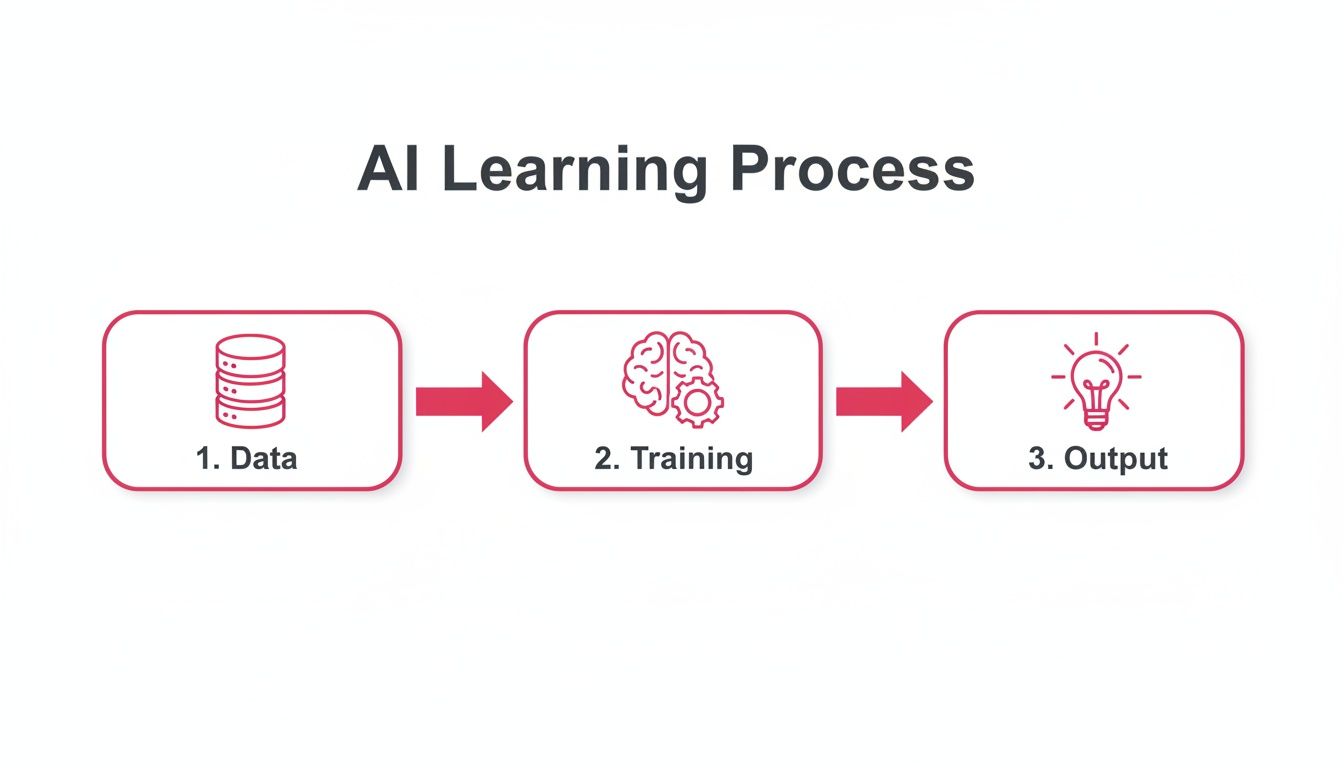
This process makes one thing obvious: the quality of what comes out is entirely dependent on the quality of what goes in. Rubbish in, rubbish out.
To avoid the rubbish, marketers need a well-defined workflow that puts the human expert in the driver's seat at every critical step. It’s less about automation and more about smart augmentation.
Here’s a look at what that process actually looks like, broken down stage by stage.
The Modern AI Content Creation Workflow
| Workflow Stage | AI's Role | Human's Role (Crucial Input) | Example Tools/Techniques |
|---|---|---|---|
| 1. Ideation & Research | Acts as a research assistant, generating topic clusters, keyword ideas, competitor angles, and audience questions at scale. | Provides the strategic direction, defines the target audience and business goals, and validates the AI's suggestions. | ChatGPT, Jasper (Brainstorm Mode), Copy.ai |
| 2. Prompt Engineering | Follows instructions to generate a draft based on the prompt's parameters. | Crafts detailed, context-rich prompts specifying the tone, style, audience, format, and key messaging. This is the most critical human skill. | Role-playing prompts, chain-of-thought prompting, providing brand voice examples. |
| 3. Generation & Editing | Produces the first draft quickly, handling the heavy lifting of initial writing and structuring. | Edits for accuracy, injects brand voice, adds personal stories or unique insights, and ensures the content feels authentic and human. | Grammarly, Hemingway Editor, human proofreaders. |
| 4. Publishing & Repurposing | Can help draft social media posts, email snippets, or ad copy from the core content. | Approves the final piece, schedules it, and strategically plans how to repurpose it across different channels for maximum impact. | Poster.ly, Buffer, Hootsuite |
| 5. Measurement & Iteration | Can analyse performance data to identify trends, top-performing topics, and engagement patterns. | Interprets the data, draws strategic conclusions, and uses those insights to refine prompts and ideas for the next content cycle. | Google Analytics, native social media analytics. |
This table shows that at every stage, the AI handles the grunt work, but the human provides the strategy, nuance, and final judgment.
Let's dig a little deeper into each of these stages.
Stage 1: Ideation and Brainstorming
Every piece of content starts with an idea. But instead of staring at a blank page, you can use AI to get the ball rolling. Feed it details about your audience, your industry, and what your competitors are talking about, then ask it to spit out a list of blog topics, social media angles, or ad hooks.
This isn’t about letting a robot decide your marketing strategy. It's about using its processing power to quickly surface relevant themes and ideas that you can then filter through your own expertise. The AI provides the raw clay; you decide what to sculpt.
Stage 2: Prompt Engineering
The quality of your AI-generated content hinges almost entirely on the quality of your prompts. This is the art and science of prompt engineering—learning to write detailed, context-rich instructions that guide the AI toward the exact output you need.
A good prompt is so much more than a simple command. It should include:
- Role and Goal: Tell the AI who it should be ("You are an expert B2B SaaS copywriter") and what you need ("Write a 500-word blog post that explains…").
- Target Audience: Describe your reader. What are their pain points? How much do they already know about the topic?
- Tone of Voice: Be specific. Instead of "friendly," try "witty, professional, but approachable."
- Format and Structure: Ask for what you want, whether it's a listicle, a step-by-step guide, or a case study. Specify headings and bullet points.
- Constraints: Tell it what not to do. "Do not use clichés," or "Avoid industry jargon."
A well-crafted prompt is the difference between a generic, unusable draft and a piece of content that's 80% of the way home. It's the single most important human touchpoint in the entire process.
Stage 3: Generation and Human Editing
With a solid prompt in hand, the AI can generate a first draft in minutes. Think of this draft as a really strong starting point, not the finished product. Now comes the crucial "human-in-the-loop" editing phase where your team’s expertise shines.
Here, editors and writers step in to refine the text. They'll fact-check every claim, inject brand-specific stories and nuance, and make sure the writing has a genuine human rhythm. This back-and-forth ensures the final piece is not only accurate but also perfectly aligned with your brand voice.
Stage 4: Publishing and Measurement
Once your content is polished and approved, it’s time to get it out there. This is where you can lean on tools built for efficiency. A platform like Poster.ly, for example, fits perfectly here, helping you schedule and publish your AI-assisted social media content across all your channels without missing a beat.
But the work isn’t done when you hit "publish." The final step is measuring performance. You need to track key metrics—engagement, click-through rates, conversions—to see what’s actually connecting with your audience. Those insights become fuel for the next round of ideation, creating a powerful feedback loop that makes your AI content creation smarter over time. This data-driven system is a core principle of many successful marketing automation workflow examples, where performance data directly informs future strategy.
Putting AI Content Creation into Practice
It's one thing to talk about AI in theory, but seeing it drive real business results is where things get interesting. Across the board, companies are now using these tools for more than just saving time; they're hitting specific marketing goals that used to be a massive headache to scale. Whether it's on social media or an e-commerce site, AI is starting to solve some very old problems.
And the growth is undeniable. In the GCC alone, the AI content creation market is already pegged at around USD 12.5 billion for 2024–2025, with the UAE and Saudi Arabia leading the charge. This is just one piece of a much larger picture: the total GCC AI market is expected to jump from QAR 12.4 billion in 2024 to a staggering QAR 56.3 billion by 2030. Most of that growth is coming from applications in social media, advertising, and e-commerce. You can dig into more of this data on the GCC's AI content market over at KenResearch.com.
This flood of investment shows just how essential these tools have become. Let's break down what this looks like on the ground for different marketing channels.
Scaling Social Media Management
For most businesses, keeping social media feeds fresh and engaging feels like a never-ending chore. It’s not just about posting something—it's about creating a steady stream of high-quality, relevant content that actually connects with different groups of followers.
This is a perfect job for AI. Instead of a social media manager agonising over every single post, they can feed one core idea into a tool and get dozens of variations back. This makes it incredibly easy to A/B test different hooks, calls-to-action, or even brand tones without a ton of extra work.
A great example is using a platform like Poster.ly, a tool from Grassroots Creative Agency designed to streamline this whole process. It can write post copy, pull in relevant hashtags, and even create visuals to go along with them. Suddenly, a small team can run a content calendar that looks like it belongs to a much bigger operation, all while making smarter, data-driven decisions.
Generating High-Performing Ad Copy
The world of paid ads moves at lightning speed. Ad fatigue sets in fast, meaning marketers are in a constant race to refresh their creative and copy just to keep performance from dropping off a cliff. Writing endless versions of headlines for Google Ads or Meta Ads by hand is not just tedious—it's a slow way to lose money.
AI content tools can scan top-performing ads in your industry and spit out hundreds of copy variations in a matter of minutes. This takes the guesswork out of the equation and lets you quickly test different angles to see what your audience actually clicks on.
Imagine an e-commerce brand. It can give an AI its product specs and target customer profile, and in return, get ad copy that hits on different selling points. One set might focus on affordability, another on a feeling of luxury, and a third on durability. This process supercharges the testing cycle, leading directly to higher click-through rates and a better return on ad spend.
Personalising Email and E-commerce Content
Generic, one-size-fits-all content just doesn't work anymore. Customers expect a personal touch, whether it's an email that lands in their inbox or a product they're viewing on your site. AI finally makes it possible to deliver that kind of personalisation without needing a massive team.
For email marketing, AI can draft different campaign messages for specific customer segments, all based on their past purchases or what they've clicked on. An online clothing store, for example, could generate unique launch emails for a new collection—one for loyal VIPs that references their favourite styles and another for new subscribers that tells the brand's story.
The same goes for e-commerce. AI can churn out engaging, SEO-friendly product descriptions. A business with thousands of products can automate the creation of unique descriptions for every single item. This saves an incredible amount of time and helps ensure every product page is set up to pull in organic search traffic. To get the most out of this, understanding answer engine optimisation is key. It helps ensure your detailed, AI-generated descriptions are found and favoured by search algorithms, bringing more qualified buyers right to your doorstep.
Ensuring Quality and Ethical AI Use

As exciting as AI is, at the end of the day, it's just a tool. Its real magic comes from how we use it—responsibly, thoughtfully, and with a clear purpose. You can't just hit "generate" and publish if you want to build trust with your audience. To make AI content creation a real asset, you need to set up some ground rules to ensure every piece of work is high-quality, on-brand, and ethically sound.
This isn’t about slowing things down; it’s about building a sustainable content engine your audience actually respects. It means putting smart guardrails in place that let your team get creative without putting your brand’s reputation on the line. Without a solid framework, you risk churning out generic, inaccurate, or even problematic content that could set you back.
Maintaining Your Unique Brand Voice
One of the biggest pitfalls of relying on AI is the risk of sounding like everyone else. AI models learn from the entire internet, so their default tone is often generic and completely forgettable. It’s up to you to inject the personality and human touch that makes your brand your brand.
To do that, you'll need to create detailed brand voice guidelines specifically for AI. Go deeper than just "friendly" or "professional." Give it concrete examples of your brand’s tone, specific words you love, and phrases you would never use. This document becomes the instruction manual you feed into your prompts, guiding the AI to generate content that genuinely sounds like you.
The goal isn’t for AI to perfectly mimic your voice right out of the gate. It's about giving it a solid starting point. The final, crucial polish—the unique stories, the sharp industry insights, the genuine personality—has to come from a human expert.
Think of it this way: your team members are the master craftspeople, and the AI is their new apprentice. The apprentice can handle the heavy lifting, but the final, artful touches that signal true quality and character can only come from human experience and judgment.
Upholding Accuracy with Human Oversight
AI models have a tendency to "hallucinate." That’s a gentle way of saying they sometimes invent facts, stats, or sources with unshakable confidence. This makes rigorous human oversight an absolute must, especially when you’re dealing with data or factual claims. A single mistake can shatter the trust you’ve worked so hard to build.
A strict human-in-the-loop system is your best defence. It simply means that every single piece of AI-generated content is reviewed by a human editor for fact-checking and verification before it goes live. This person’s job is to confirm every data point, check the sources, and make sure the information is both accurate and up-to-date.
This step is essential for building credibility. It lets you take advantage of AI’s efficiency without ever sacrificing the accuracy and authority your audience relies on. It's a non-negotiable quality control step that protects your reputation and your readers.
Navigating Ethical and Copyright Complexities
The rules of the road for AI content creation are still being written, which means we’re all navigating tricky questions around transparency, bias, and intellectual property. Businesses have to be proactive here to operate responsibly. This is especially true in the Middle East, where a lack of high-quality Arabic training data and lingering copyright questions can slow things down. While some analyses suggest AI could boost the region's GDP by up to 7% by 2030, earning public trust will require clear, transparent safeguards. You can find more regional AI technology trends from PwC here.
To get ahead of these issues, establish a few clear internal policies:
- Transparency: Be upfront about where you're using AI. For example, letting users know they're talking to an AI chatbot manages expectations and builds trust from the start.
- Copyright Awareness: Realise that AI can sometimes pull heavily from existing copyrighted work. Always run plagiarism checks and make sure your final output is original and adds new value.
- Bias Mitigation: AI models can inherit the biases found in their training data. Train your team to critically review content for stereotypes or unfair language, ensuring everything you publish reflects your company’s values.
Choosing Your AI Toolkit and Measuring ROI
With a seemingly endless stream of new AI tools hitting the market every week, it’s easy to feel overwhelmed. The goal isn’t to grab every new, shiny tool that comes along. Instead, it’s about carefully building a toolkit that actually helps you hit your business goals.
The first step is simply figuring out what you really need. Are you looking for a tool to help you brainstorm and write first drafts of blog posts? Maybe you need something to generate eye-catching images for social media. Or perhaps you’re after a tool that can handle the heavy lifting of SEO research and content outlining. Different tools are built for different jobs.
Once you know what you’re trying to solve, you can start looking at your options with a clear head. Don't let the marketing hype distract you; focus on how a tool will genuinely fit into your team’s daily workflow.
How to Evaluate AI Content Creation Tools
When you're trying out a new AI tool, it's crucial to look past the flashy demos and focus on what truly matters for your business. The right tool should feel like a natural extension of your team, not another complicated piece of software to learn.
To help you cut through the noise, we've put together a simple table outlining what to look for when evaluating potential AI partners.
| Evaluating AI Content Creation Tools | ||
|---|---|---|
| Evaluation Criterion | What to Look For | Why It Matters |
| Functionality & Features | Does it actually do what you need? Dig into the specifics—supported formats, style controls, and output quality. | A powerful image generator is useless if your main focus is writing long-form articles. You need a tool that solves your specific problem. |
| Ease of Use | How quickly can your team get up and running? Look for a clean, intuitive interface and minimal training requirements. | A tool is only valuable if people use it. A steep learning curve can kill adoption and negate any potential efficiency gains. |
| Integration Capabilities | Does it connect with your current tech stack (CMS, social scheduler, analytics)? Check for native integrations or Zapier support. | Seamless integration prevents frustrating data silos and keeps your workflow running smoothly without manual copy-pasting. |
| Cost-Effectiveness | Understand the pricing model (per user, per word, flat fee) and weigh it against the expected value. | The best tool provides a clear return on investment. Look for a plan that scales with your needs without breaking the budget. |
Thinking through these points ensures you choose a tool that empowers your team rather than just adding another subscription to the monthly bill.
Take Poster.ly, for example. It was born right here at Grassroots Creative Agency because we saw a specific need: a straightforward way to create and schedule social media content. It was designed from the ground up to make sophisticated AI practical for everyday marketing, a perfect illustration of a tool built to solve a real-world problem.
Measuring the Return on Your Investment
Bringing AI tools into your workflow is an investment of both time and money. And like any investment, you need to be able to measure its return. Simply "feeling" more efficient isn't enough; you need to track concrete Key Performance Indicators (KPIs) that show real business value.
Proving the value of AI in content creation isn't about counting how many articles you generate. It's about measuring the impact of that content on your bottom line—faster production, lower costs, and better engagement.
To make a solid case for using AI, you have to connect the dots between using the tool and seeing better results. These metrics show exactly how AI content creation is moving the needle. If you need help setting up a good tracking framework, our guide to selecting the right marketing performance indicators is a great place to start.
Here are a few essential KPIs to keep an eye on:
-
Content Production Speed: How long does it take to get a piece of content from an idea to a published post? Track this "time-to-market" before and after you bring in an AI tool to see a clear boost in efficiency.
-
Cost Per Asset: Add up the costs (tool subscription + team time) to produce one content asset, like a blog post or a social media graphic. With AI, this number should start to drop noticeably over time.
-
Engagement Rates: Look at the real-world performance of your AI-assisted content. Are you seeing more likes, shares, comments, or higher click-through rates? Better engagement is a strong sign that you're creating more relevant content, more often.
-
Conversion Lift: At the end of the day, your content needs to drive action. The ultimate proof of ROI is tracking whether content created with AI leads to more leads, sign-ups, or sales.
Common Questions About AI Content Creation
Dipping your toes into AI content creation always brings up a few questions. The technology is moving fast, and it's smart to wonder how it all works. To give you some clarity, we've pulled together the questions we hear most often from marketers and business owners.
The idea here is to clear up the confusion so you can feel confident using these tools in your marketing, whether that's for banging out blog posts or scheduling social media with a platform like Poster.ly. Let's tackle the big ones.
Can AI Completely Replace Human Content Creators?
This is the number one question on everyone's mind, and the short answer is no. Think of AI as an incredibly fast and capable assistant. It's fantastic for churning out a first draft, pulling together research, or handling the more repetitive parts of content creation. But it just can't replicate what makes content truly connect with people.
Where's the empathy? The personal stories? The strategic gut feeling that comes from years of experience? AI doesn't have that. The real magic happens when you let AI handle the grunt work, freeing up your team to focus on big-picture strategy, creative thinking, and actually building a relationship with your audience.
Is Content Created with AI Considered Plagiarism?
It’s a fair question. The best AI models are trained to create original text by understanding patterns, not by cutting and pasting from their training data. That said, there's always a slim chance it might generate something that sounds a little too close to an existing source.
The solution is simple: never just copy and paste. Treat the AI output as a starting block, not the finished product. A human editor absolutely must review, rewrite, and inject your brand’s unique perspective into the piece. As a final, non-negotiable step, run it through a good plagiarism checker before you hit publish. It’s a simple check that protects your brand’s reputation.
How Does AI Affect SEO Rankings?
Google and other search engines care about one thing above all else: high-quality, helpful content. They don't really care if a human or an AI helped write it. So long as your content is accurate, original, and genuinely helps the reader, it has every chance to rank well. In many cases, AI can even give your SEO a boost by helping you find relevant keywords and structure your articles properly from the get-go.
The pitfall to avoid is using AI to churn out mountains of low-effort, spammy articles. If you focus on creating valuable, people-first content with AI as your co-pilot, you're on the right track for great SEO results.
Ready to see how a strategic, data-driven approach can elevate your brand? At Grassroots Creative Agency, we combine bold creative ideas with precise analytics to deliver measurable results. Explore our services and learn how we can help you grow.