So, what exactly is AI content creation?
At its core, it’s about using smart technologies—think machine learning and natural language processing—to help with the heavy lifting of creating content. This could be anything from researching and planning to generating the first draft of an article, a social media post, or even a video script. Think of it less as a robot taking over and more as a powerful collaborator for your marketing team. It’s a way to dramatically speed up production, freeing up your people to focus on what they do best: strategy and creative thinking.
How AI Content Creation Actually Helps a Business Grow
Let's get one thing straight: this isn't about having a machine churn out soulless, generic text. The real magic of AI in content creation is the partnership it creates. It acts as a strategic assistant, amplifying your team's natural talents by handling the grunt work—like sifting through data or structuring a first draft—so your experts can pour their energy into high-value tasks. That sweet spot where human ingenuity meets machine efficiency is where real, tangible growth begins.
When you automate the repetitive stuff, you give your team back its most precious resource: time. Imagine your team no longer bogged down for hours with keyword research or writing simple social media updates. Instead, they’re refining your brand's voice, brainstorming innovative campaigns, and building genuine connections with customers. This move from manual labour to strategic direction is the key to scaling your content efforts without burning out your team.
Supercharge Your Efficiency and Scale Your Output
One of the first things you'll notice when you bring AI into your workflow is the incredible boost in speed and volume. A team that might have struggled to publish a couple of well-researched blog posts a month can suddenly have initial drafts for dozens of articles, along with countless social media variations and email newsletters, all in the same timeframe.
Being able to scale like this directly fuels your visibility and engagement. More quality content means more chances to rank on search engines, more material to share across your social channels, and simply more touchpoints to connect with your audience. For instance, a tool like Poster.ly—a direct product of our team here at Grassroots Creative Agency—is built to help businesses streamline their social media content, ensuring they maintain a consistent and powerful presence.
"AI isn't replacing my thinking. I bring the insights, the strategy, the real life examples. Then, AI handles the research, writing mechanics, and formatting."
This kind of collaboration means even a small start-up can go toe-to-toe with a much larger company by keeping up a steady, active content schedule without needing a massive team.
Create Genuinely Personalised Customer Experiences
Today’s customers don’t just want content; they expect content that feels like it was made just for them. AI is brilliant at digging through huge sets of customer data to spot patterns, preferences, and pain points. This insight allows you to craft highly personalised experiences for your audience, and do it at scale.
What does that look like in practice?
- Tailored email campaigns: Imagine sending messages that truly connect with different customer groups based on what they've done or shown interest in before.
- Dynamic website content: You could show different headlines or product suggestions to visitors depending on who they are or where they came from.
- Relevant blog topics: The AI can help pinpoint the exact questions your target audience is typing into Google, so you can answer them directly.
This intense focus on personalisation forges stronger customer relationships and, naturally, leads to better conversion rates. And this isn't just a local trend; it's a global movement. Here in the Middle East and Africa (MEA) region, the market for AI-powered content creation hit USD 93.6 million in 2024. It’s expected to explode to USD 420.7 million by 2033, which just goes to show how quickly businesses are adopting these tools. You can explore more data on this market expansion to get a clearer picture of its incredible trajectory.
Building a Smarter AI Content Workflow
Let's get one thing straight: an effective AI strategy is much more than just hitting 'generate' and hoping for the best. To get consistent, high-quality results, you need a structured workflow—a repeatable process that blends the incredible speed of AI with the non-negotiable oversight of human expertise.
Think of it as building a partnership. The technology handles the heavy lifting, freeing up your team to focus on what they do best: strategy, creativity, and ensuring every word is accurate. A well-organised workflow turns AI from a neat party trick into the core of your content engine. It ensures every blog post, social media update, or email aligns perfectly with your brand's voice and business goals.
We can break this entire process down into four manageable stages, giving you a clear blueprint for success.
Stage 1: Strategic Planning and Prompting
This first stage is all about preparation. Before you even think about opening an AI tool, you have to define your objectives. What’s the goal here? Who are we trying to reach? What's the one key message they need to walk away with? Answering these questions first gives you a clear direction and saves you from churning out generic, aimless content.
Once your goals are crystal clear, it’s time to craft a detailed prompt. Honestly, this is probably the most crucial part of the entire process. A weak, vague prompt will give you weak, vague results. A strong prompt, on the other hand, acts like a detailed creative brief for your AI assistant.
Make sure it includes:
- Target Audience: Be specific. Instead of "business owners," try "start-up founders in Dubai" or "marketing managers in the UAE's tech sector."
- Tone of Voice: Define the feeling you're after. Is it "professional yet approachable" or "energetic and witty"?
- Key Keywords: List the primary and secondary SEO keywords you need the AI to weave in naturally.
- Structure: Give it an outline. Tell it exactly how you want the content formatted, like "include a numbered list of five points and a concluding summary."
Stage 2: AI-Assisted Drafting
With a solid prompt in hand, you can now unleash the AI to generate the initial draft. This is where the magic happens. AI can research, outline, and write that first version in a fraction of the time it would take a human. It's a massive time-saver.
This completely bypasses the dreaded 'blank page' problem. Your team can jump straight into refinement, using the AI-generated draft as a robust starting point—a scaffold upon which they can build something truly great.
Stage 3: Human-Led Refinement and Quality Control
I cannot stress this enough: no AI-generated content should ever be published without a thorough human review. This stage is where your team’s expertise provides the most value. It’s the essential 'human-in-the-loop' system that acts as your final quality control checkpoint.
This refinement process involves several key actions:
- Fact-Checking: AI can sometimes invent things that sound plausible but are completely wrong. Verify all stats, facts, and claims for accuracy.
- Brand Voice Alignment: Edit the text to make sure it sounds like you. This is about injecting your brand’s unique personality and tone.
- Adding Human Insight: Weave in original stories, expert opinions, and unique perspectives that an AI simply cannot replicate. This is what sets your content apart.
- SEO Polish: Go back and optimise headings, meta descriptions, and internal links to give your content the best possible chance to rank.
This workflow visualises how AI can amplify your message and personalise its delivery, helping you build a stronger connection with your audience.
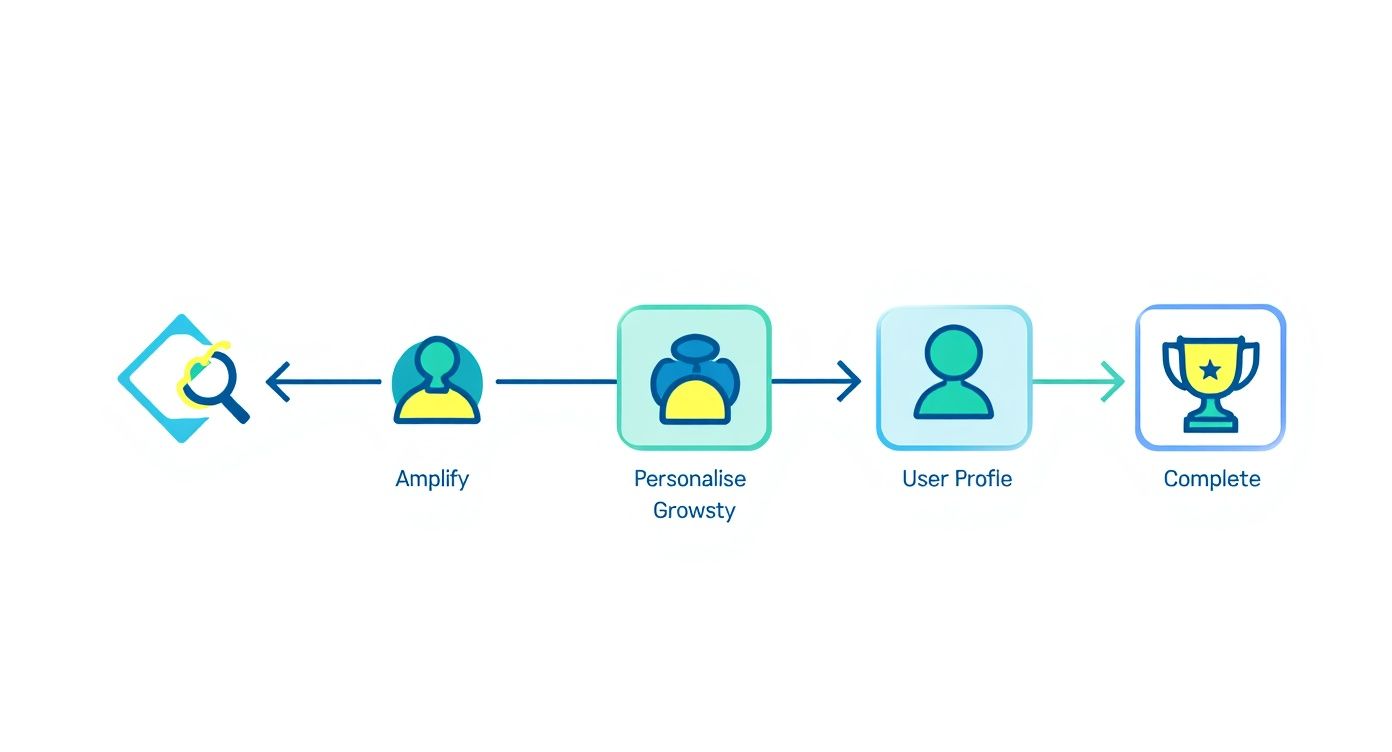
Ultimately, AI's role is to enhance a strategic business process, not just to pump out words.
Stage 4: Performance Analysis and Iteration
The final stage is all about closing the loop. You need to measure the content's performance and use those insights to get better next time. Track the metrics that matter to you—page views, engagement rates, time on page, and of course, conversions. How did the AI-assisted content stack up against your purely human-created pieces?
Use this data to fine-tune your prompts and refine your process. For example, platforms like Poster.ly, from our team at Grassroots Creative Agency, give you the tools to manage and analyse social content performance, helping you double down on what truly resonates with your audience.
By continuously analysing your results and iterating on your workflow, you create a powerful feedback loop. This is how your AI content creation efforts get smarter and more effective over time.
To pull it all together, here’s a simple breakdown of the four stages and how AI and human expertise fit into each one.
The Four Stages of an Effective AI Content Workflow
| Stage | Key Tasks | AI's Role | Human's Role |
|---|---|---|---|
| 1. Strategy & Prompting | Define goals, audience, and tone. Research keywords. Craft a detailed prompt. | Tool for keyword research and competitive analysis. | Setting strategic direction, defining brand voice, and creating a precise creative brief (prompt). |
| 2. AI-Assisted Drafting | Generate the first draft based on the prompt. Create outlines and initial content structure. | Rapidly produce a complete draft, handling the bulk of the initial writing. | Guiding the AI with a well-structured prompt and setting clear instructions. |
| 3. Human-Led Refinement | Fact-check all claims. Edit for brand voice. Add unique insights and stories. Optimise for SEO. | N/A (This stage is human-centric). | Applying critical thinking, creativity, fact-checking, and brand expertise to elevate the content. |
| 4. Analysis & Iteration | Track performance metrics. Analyse what worked and what didn't. Update prompts and workflows. | Can help analyse data patterns from analytics tools. | Interpreting performance data, making strategic decisions, and refining the overall process for future content. |
This table shows a clear partnership. Success isn't about replacing people with machines; it's about giving your brilliant team a powerful tool to help them create better content, faster.
Choosing the Right AI Tools for Your Marketing
Stepping into the world of AI content creation can feel like walking into a massive, bustling marketplace. With new tools popping up almost daily, it’s easy to feel overwhelmed. The key isn't to grab the first shiny object you see, but to carefully assemble a toolkit that actually fits your marketing goals and business needs.

The market for these tools is growing at a staggering pace, especially here in our region. The generative AI market in the Middle East and Africa (MEA) is projected to hit USD 1.5 billion in 2025 and is expected to rocket to USD 12.9 billion by 2032. This explosive growth shows just how vital it is for businesses to make smart choices right now. For a closer look at this expansion, you can discover detailed insights on the MEA generative AI market.
Categorising Your AI Toolkit
To cut through the noise, it helps to group AI tools by what they do best. Think of it like building a specialist team where every member has a distinct role. This approach ensures you cover all your bases without paying for features you don't need.
Here are the main categories to think about:
-
Text and Copy Generators: These are the workhorses for most marketers. They’re brilliant for drafting blog posts, whipping up email campaigns, and generating website text. Giants like GPT-4 and Google Gemini lead the pack, offering incredible flexibility for creating human-like text from simple prompts. For a deep dive, check out our guide on how Google Gemini is shaping content creation.
-
Image and Video Creators: In a world driven by visuals, AI has made creating high-impact content easier than ever. Tools like Midjourney and DALL-E 3 can produce stunning, high-quality images from just a text description. For video, new platforms are emerging that can create short clips, animations, and even edit your existing footage, saving you countless hours in production.
-
Integrated Content Platforms: These all-in-one solutions combine multiple functions into a single, smooth workflow. They often bundle text generation, social media scheduling, and performance analytics. They’re designed to let you manage entire campaigns from one spot, making them a perfect fit for busy marketing teams.
A great example is Poster.ly, a platform we developed right here at Grassroots Creative Agency. It simplifies the whole social media content process, using AI to help you plan, create, and schedule posts efficiently so your brand maintains a powerful and consistent online presence.
Matching Tools to Your Business Size
Let's be clear: the "best" AI tool is relative. What works for a massive corporation might be total overkill for a sole trader. Your business size and specific needs should be your guide.
For Start-ups and Sole Traders:
Your focus should be on affordability and versatility. Look for tools with generous free plans or low-cost monthly subscriptions. An all-in-one platform can be a lifesaver, giving you text generation, basic image creation, and scheduling without juggling multiple bills. The name of the game is efficiency and squeezing the most value from a lean budget.
For Small to Medium-Sized Enterprises (SMEs):
At this stage, you can start investing in more specialised tools. You might pair a powerful text generator for your blog and website with a dedicated AI image creator for social media. Look for tools that offer team collaboration features and can plug into your existing marketing software, like your CRM or email platform.
"Good AI content starts with YOU having something interesting to say. Your specific challenges, contrarian takes, real examples. Then AI becomes a force multiplier—helping you research, organise, and communicate your ideas better."
In other words, the tool should amplify your team’s expertise, not try to replace it.
For Large Corporations:
Here, enterprise-level solutions are the main event. These platforms offer advanced features like custom brand voice controls, robust security, and deep analytics. Scalability is everything, as is the ability to manage multiple teams and brands from a single account. You'll want tools that provide dedicated support and can handle a massive volume of content without breaking a sweat.
Ultimately, the goal is to build a smart, cohesive AI toolkit that empowers your team, simplifies your workflow, and delivers a clear return on your investment. Start by pinpointing your biggest content headaches and find the tools that solve those specific problems first.
Putting AI Content Creation into Practice
It's one thing to talk about the theory, but seeing the tangible results is where the real value of AI content creation clicks into place. Understanding the workflow is great, but the magic happens when you see how these tools are actively saving businesses hundreds of hours while actually boosting performance. Let's dig into some practical, real-world use cases you can start adapting for your own brand today.

Think of these examples as a starting point. They're meant to spark your own creativity and show just how versatile this technology is, whether you're tackling SEO-optimised blog posts, whipping up social media campaigns, or building out personalised email sequences that genuinely convert.
Generating SEO-Optimised Blog Posts
One of the quickest and most immediate wins for any business is using AI to get the ball rolling on blog production. Instead of staring at a blank page, you can get a solid, well-structured first draft in minutes, complete with headings and initial keyword placement. This frees up your team to focus their energy where it matters most: refining the content with unique insights, brand-specific examples, and your authentic voice.
Let’s say a UAE-based e-commerce brand selling sustainable homeware wants to create a new post. They could use a prompt like this:
Prompt Example:
"Act as an expert content writer for an eco-friendly brand in Dubai. Write a 1,000-word blog post titled '5 Simple Swaps for a More Sustainable Kitchen in the UAE'. The tone should be informative and inspiring. Target keywords are 'sustainable kitchen UAE', 'eco-friendly products Dubai', and 'zero-waste living'. Structure the post with an introduction, five numbered sections each detailing a product swap (e.g., beeswax wraps for cling film), and a concluding call-to-action to browse our products."
This prompt gives the AI a clear role, audience, tone, structure, and keywords, which means the output will be a strong, relevant starting point. Of course, to truly stand out, it's also crucial to master AI search optimisation; this ensures your brilliant content actually gets discovered in the new AI-driven search landscape.
Crafting Scalable Social Media Campaigns
Keeping a consistent social media presence can feel like a full-time job. AI tools can completely change the game here, generating dozens of post variations for different platforms from a single core idea. This way, your messaging stays cohesive across channels but is still tailored to each audience.
Platforms like Poster.ly, developed by our own team at Grassroots Creative Agency, are built specifically for this. They take the headache out of creating and scheduling high-quality social content at scale.
Here’s a simple way a local café might use this approach:
- Core Idea: Launching a new seasonal pistachio latte.
- AI Task: Generate five Instagram captions, three engaging Facebook posts with questions, and ten short, punchy tweets announcing the new drink.
- Human Refinement: The marketing manager then cherry-picks the best options, pairs them with high-quality photos, and slots them into the content calendar.
What used to be a multi-hour task becomes a quick, focused activity. You maintain your brand's presence without the manual grind.
Developing Personalised Email Sequences
Email marketing runs on personalisation, but crafting unique messages for every audience segment can be a massive drain on resources. This is where AI really shines. It can help you write tailored email sequences that speak directly to a subscriber's interests or recent behaviour—a powerful way to nurture leads and drive conversions on autopilot.
Imagine a software company trying to convert trial users into paying customers. They could use AI to create an entire drip campaign:
- Welcome Email: A warm, personalised greeting to start things off right.
- Feature Highlight Email: A message showcasing a specific feature based on what the user has been doing in the app.
- Case Study Email: An email sharing a success story that's directly relevant to the user's industry.
- Final Offer Email: A gentle nudge with a limited-time discount to encourage them to make the leap.
The AI can draft the initial copy for all of these emails. A human editor then swoops in to polish the text and make sure the tone is spot-on. This kind of personalised communication, scaled across thousands of users, is a game-changer for customer engagement and a core strength of many top-tier content marketing agencies. By putting these practices into play, businesses can turn AI from an abstract concept into a practical engine for growth.
Navigating the Ethics of AI-Generated Content
Using AI well means using it responsibly. As you start weaving AI content creation into your day-to-day work, you'll inevitably bump into some tricky ethical and legal questions. Thinking about these issues now isn't just about ticking compliance boxes; it's about building lasting trust with your audience and protecting your brand's good name.
Sorting this out early on saves a world of headaches later. It means you can use these incredible tools with confidence, knowing you're innovating the right way and holding up the standards your customers have come to expect. Let's walk through the big-ticket items you need to have on your radar.
Who Owns AI-Generated Work? A Look at Copyright
One of the biggest questions swirling around AI right now is about copyright. If an AI helps write something, who actually owns it? The legal world is still catching up, but the general feeling is that content spat out by a machine with no real human touch can't be copyrighted.
This is exactly why that 'human-in-the-loop' process is so critical—it’s not just a smart workflow, it's a legal safeguard. Your team's effort in tweaking, rewriting, and injecting original thought into an AI draft is what makes the work yours.
- Your Input is Everything: The more you edit and shape the AI's output with your brand's unique voice and perspective, the stronger your claim of ownership becomes.
- Check the Fine Print: Always read the terms of service for your AI tools. Most will grant you full ownership of what you create, but some might have different rules.
It helps to think of the AI as a high-tech paintbrush. The brush doesn't own the painting; the artist who guides it does. Your creative vision is what truly matters.
Transparency and When to Disclose AI Use
So, should you tell your audience you're using AI? The simple answer is, "it depends," but being transparent is almost always the best policy. Misleading your audience is a fast track to eroding trust, and in some jurisdictions, it could even land you in hot water.
A good first step is to create a clear internal policy on when and how you'll mention AI. For a quick social media post or a bit of marketing copy you've generated with a tool like Poster.ly, a disclosure probably isn't necessary. But for bigger pieces, like an article with an author's name on it or a detailed report, a small disclaimer can actually boost your credibility.
"Good AI content starts with YOU having something interesting to say. Your specific challenges, contrarian takes, real examples. Then AI becomes a force multiplier—helping you research, organise, and communicate your ideas better."
This really gets to the heart of it. AI should be a tool that amplifies your genuine message, not a machine that invents it. Being open about your process shows you're confident in the quality of your ideas, no matter how they were put to paper.
Dodging Plagiarism and Rooting Out Bias
AI models learn from a massive chunk of the internet, which means there's a small but non-zero chance they might accidentally spit out text that already exists somewhere else. Ultimately, it’s your responsibility to make sure everything you publish is original.
Before anything goes live, run it through a good plagiarism checker. It’s a simple step that protects you from being accused of stealing content and can save you from potential SEO penalties.
On top of that, remember that AIs learn from us—and that includes our biases. They can unintentionally echo societal stereotypes found in their training data. You need to be the final filter, actively reviewing content for any biased language or problematic assumptions. A sharp human eye is the best defence against publishing something that could alienate or offend your audience. By setting clear ethical guardrails, you can make sure AI content creation builds your brand up, responsibly.
Measuring the ROI of Your AI Content Strategy
Bringing any new technology into the fold, especially something like AI content creation, really only makes sense if you can see a real return. You need a solid way to measure success, proving that your investment is actually paying off. This means looking past simple vanity metrics, like how many articles you’ve churned out, and digging into the key performance indicators (KPIs) that actually mean something to the business.
This isn’t just about ticking a box to justify the cost. It's about building a rock-solid business case that shows stakeholders exactly how AI is fuelling growth, from saving money to making money.
Focusing on Efficiency and Cost Savings
The first place you'll see a return is almost always in efficiency. It's the low-hanging fruit. Time is money, after all, and AI hands a significant chunk of it back to your team. When you automate the grunt work of first drafts and initial research, your skilled content creators are freed up to do what they do best: focus on strategy, polish the final product, and come up with brilliant new ideas.
To put a number on it, start tracking these metrics:
- Time to First Draft: How many hours are you saving by letting AI handle the initial draft compared to the old way of starting from a blank page?
- Content Output Volume: Look at the sheer increase in articles, social posts, or emails your team can produce each month without needing to hire more people.
- Reduced Freelancer Costs: If you used to rely on a stable of external writers for overflow, AI can bring a lot of that work back in-house, which is a direct and immediate cost saving.
These efficiency gains are the foundation of your ROI calculation. They paint a clear picture of needing fewer resources to create great content.
Tracking Content Performance and Engagement
But let's be honest, efficiency is only half the story. The real win is when the content itself actually performs better. So, is your AI-assisted content hitting the mark? This is where you connect the dots between your AI efforts and your core marketing goals. You absolutely have to monitor the right performance indicators, and you can learn more about choosing the right marketing performance indicators to make sure you're tracking what matters.
Keep a close eye on these key performance metrics:
- SEO Rankings: Are the blog posts you've optimised with AI climbing the search rankings for your target keywords?
- Website Traffic: Are you seeing a noticeable lift in organic traffic to the pages where you’ve published AI-assisted content?
- Engagement Rates: Dive into metrics like time on page, bounce rate, and social media shares. Is the content actually holding people's attention?
- Lead Conversion: This is the big one. Is this content actually making people act? Track how many leads, sign-ups, or sales come directly from your AI-powered articles and pages.
Proving Value with A/B Testing
If you want undeniable proof, there's nothing better than a straight-up A/B test. It’s simple: create two pieces of content on the same topic. One is AI-assisted, the other is 100% human-written. Keep everything else the same—how you promote it, when you post it, the format—and just let the data decide which one gets better engagement and conversions.
This kind of direct comparison gives you the hard evidence you need to show stakeholders the real-world impact of your AI content efforts.
Taking this data-driven approach is more important than ever, especially as AI's role in the economy grows. Projections show that by 2030, AI could contribute an estimated 7% to the GCC region’s combined GDP, a boom driven by a thriving innovation ecosystem. You can discover more insights about the state of AI in the Middle East to get a better sense of how this trend is reshaping the entire business world.
Frequently Asked Questions About AI Content Creation
Diving into AI content creation for the first time? You're not alone. As businesses across the UAE start to explore these tools, plenty of questions pop up. It's smart to want clarity before you jump in.
We've gathered some of the most common questions we hear from clients and colleagues. Think of this as your quick-start guide to clear up any confusion and get you going with confidence.
Will AI Replace Human Content Creators?
The short answer is no. Think of AI as an incredibly capable creative partner, not a replacement for your team. The real magic happens when you pair AI's speed with a human's strategic mind and creative spark. To get a better handle on this, it's useful to understand what AI-generated content is and where it fits.
AI is brilliant at the heavy lifting—like knocking out a first draft or pulling together research. This frees up your human writers and strategists to do what they do best: refine the message, inject brand personality, fact-check, and think about the big picture. It’s a collaboration, with a human always in the driver’s seat.
How Can I Make Sure My AI Content Is Unique and Ranks on Google?
Treat everything an AI gives you as a starting point, never the finished product. The key to uniqueness is a heavy human touch. You need to edit, rewrite, and infuse the draft with your own perspective, specific examples, and brand voice. A final run through a plagiarism checker is always a good idea before hitting publish.
For SEO, you need to be the strategist. Feed the AI your specific keywords, tell it who you're writing for, and outline the structure you want. Once you have the draft, use your go-to SEO tools to fine-tune everything—headings, meta descriptions, and keyword placement. Most importantly, read it as a human and ask: does this actually answer the searcher's question?
What's the Best Way to Start Using AI in My Content Workflow?
Don't try to boil the ocean. Start small with a low-stakes pilot project. Pick a single, time-consuming task and see how AI can help.
Here are a few ideas to get you started:
- Brainstorming a month's worth of social media post ideas.
- Generating rough outlines for upcoming blog posts.
- Drafting different subject lines for an email campaign.
For example, you could use a tool like Poster.ly to create a week’s worth of social media captions. Track how long it took versus doing it manually and compare the quality. This gives you a tangible proof-of-concept to show your team before you go all-in.
At Grassroots Creative Agency, we build smart content strategies that blend human expertise with the best of AI to deliver real results. If you’re ready to see what that mix can do for your brand, we should talk.